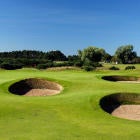
British Open 2018: Nine things to know about Carnoustie and the course's history
The Open Championship heads back to Carnoustie for an eighth Open

By
Kyle Porter
•
8 min read
The 147th Open Championship returns to the site of some classics over the years -- Carnoustie in Angus, Scotland, just across the North Sea from its more famous brethren, St. Andrews. Some of the most rough and tumble Opens ever played have come on these links (more on that in a minute), but boy has it produces some wondrous champions over the last century.
Here are nine things to know about this nasty course, the Opens it has hosted and what it all means for this 2018 Open Championship.
1. Toughest by numbers and anecdotes: Two of the four highest-scoring Opens since World War II have been played at Carnoustie. Gary Player won the 1968 Open on this course with a score of 289. Paul Lawrie won in 1999 with a score of 290. It's not just a numbers thing, either. The consensus among pros is that of the courses in the Open rota, this one is the hardest.
"It's just a bloody difficult golf course, especially if there's any rough," David Howell told Golfweek. "It got the term 'Car-nasty' for a reason. My first one was when Lawrie won. I remember seeing Sergio crying, that's how hard it was. That finish is the toughest in the world. If 15, 16 and 18 are into the wind, then it's brutal, and by the time you get to that last four holes you're already drained."
Three-time Open champ Tiger Woods agrees. "I think I made one birdie on the weekend and I finished three or four back of the playoff," Woods told the AP. "That was ridiculous how hard it was."
That 1999 Open resulted in an aggregate of 2,660 over par for the field. A bloodbath if there's every been one at a major. The same is not expected this year with the rough down and the fairway speeds up. But beware if the weather rolls in, it could get crazy.
Here are the winning scores by year at the seven Carnoustie Opens.
- 1931: 296 (Tommy Armour)
- 1937: 290 (Henry Cotton)
- 1953: 282 (Ben Hogan)
- 1968: 289 (Gary Player)
- 1975: 279 (Tom Watson)
- 1999: 290 (Paul Lawrie)
- 2007: 277 (Padraig Harrington)
2. That famous burn: You know the one, the Barry Burn which snakes its way through the final few holes and touches the 18th hole multiple times. Here's a look at it from overhead near the 18th tee box.
It has famously (or maybe infamously) shaped the last two Opens as Jean Van de Velde took triple-bogey seven after hitting it wayward and finding himself literally up to his ankles in the stuff (much more on that here). Padraig Harrington hit it into the same burn twice (off the tee and near the green) but gamely made six and beat Sergio Garcia in a playoff.
Speaking of the burn, I thought this was a quite beautiful (and apt description) of the burn and the course from a 1968 Sports Illustrated piece on Player's victory.
There are a number of reasons why Carnoustie is so difficult, the primary one being there is no safe place to hit a golf ball. The course is located on a flat plain of sandy soil between the settlement of small, square, stucco cottages that is the town of Carnoustie and the wide North Sea beaches. But flat plains do not smooth fairways make, at least not here. The fairways at Carnoustie are contoured like rolling waves of green surf and are as hard and dry as marble.
The rough is deep, the bunkers profuse and the greens almost as firm as the fairways. Knotting up this whole hazardous package is a serpentine ribbon, a twisting, water-filled ditch known as the Barry Burn, which wanders across the 17th fairway three times and crosses the 18th three times, too. When the wind blows at Carnoustie, which it usually does, the only safe place to be is in the clubhouse.
3. How the course began: There are rumors that golf at Carnoustie was played as early as the 1500s. That's fairly difficult to believe (although I enjoyed imagining dropping a box of ProV1s on those lads), but we know for sure that the club started in the mid-1800s and had 18 holes by 1867.
It was designed by Old Tom Morris and Allan Robertson but later reformed by James Braid in the early 1900s ahead of the first Open there in 1931. Finally, James Wright touched off some alterations between the 1931 Opena and 1937 Open that formed one of the hardest three-hole finishes in the game. Here's Golf Monthly.
In time for the 1937 Open, local man James Wright completed a redesign of the final three holes. James Braid had reworked the course in 1926 but it was thought by many his finish wasn't stern enough and Wright's alterations have remained largely unchanged to this day.
4. Hogan's heroics: One of my favorite stats in golf is that Ben Hogan won the only Open he ever played in 1953. One and done for the career slam is the stuff of legend, and it apparently almost never came to fruition. Hogan won that Open by four strokes, and he didn't even want to play. Here's Golf Monthly again.
But Hogan almost went home when he found his room at the Bruce Hotel did not have a private bathroom - after the crash he needed to soak his legs every night. He and Valerie, his wife, moved to the Tay Park guest house in Dundee, but his first sight of Carnoustie, the burned-out fairways, the unkempt nature of the layout and the slow greens, was not to his liking. He offered to buy the greenkeeper a lawnmower.
"When I saw the conditions and the transition I had to make to play any kind of decent golf, I said to myself: `I've made a mistake by coming'," he said.
Even crazier is the fact that The Open apparently made you play with a different ball in those days!
He arrived in Scotland two weeks before the event to acclimatise, to practise on the links and get used to playing with the smaller British ball.
5. More Classics: Gary Player and Jack Nickalus squared off in 1968, right before Nicklaus went on his preposterous run of events in the 1970s. Player clipped him by two on the back of an eagle at the par-5 14th hole.
"In the last round," Player told the New York Times, "I hit a 3‐wood on 14 to within 2 feet for an eagle. If there is such a thing as a career shot, this one qualifies. It gave me a two‐stroke lead over jack Nicklaus, and that was my margin of victory."
Player also recently lamented the sad state of the modern game in which players are not ok with scores under 300, which is hilarious and amazing.
"If you have a wind of note here, 300 could win the golf tournament," Player said. "And I wish that would happen because it would teach guys around the world a lesson they're not aware of. That a golf tournament can be won with 300.
6. Carnoustie proselytizers: St. Andrews is the home of golf, of course, but Carnoustie might be the home base for the greatest movement of taking this sport to the masses throughout the world. Here's the Times.
But the charm of Carnoustie also includes its history. In golf's formative years, more than 100 lads emigrated to the United States as instant pros from the tiny bleak Scottish town near the North Sea with its one small street of small stone houses, its railroad tracks and the flat, barren public links where the British Open is being conducted. Gary Player describes it as "a good swamp, spoiled." But in a real sense, the development of Jack Nicklaus is rooted there. One of the Carnoustie missionaries was Stewart Maiden, who inspired Bobby Jones, who inspired Jack Nicklaus, who now is inspiring his successor somewhere.
7. Thinking man's course? The case has been made that this is a thinking man's course. Certainly its list of champions -- Tommy Armour, Tom Watson, Hogan, Player and Padraig Harrington among them -- were terrific managers of their own games. I think all Open courses are thinking man's tracks to some extent, but when a course changes as much as this one has (see below) and more (not fewer) options are presented, I can see the evidence.
8. Scottish Drought: You've all seen the photos and videos by now. Carnoustie has baked because of some unseasonably warm and dry weather, and the result is a firm and fast experience that looks more like golf in a parking lot than near a sea. How that's going to affect the event, nobody knows.
It could take driver out of players' hands and mean, like I noted above, that thinking your way around the course becomes paramount. But I still haven't figured out if it makes the event tougher (because you can't stop the ball anywhere) or easier (because it rolls out forever).
"Links experience is exceptionally important, you'd have to go back to Hoylake in 2006 to see something as fiery," Padraig Harrington said recently. "It does play into the hands of guys who can thread the ball around.
Whatever the case, it's going to be different than what you normally see on this track -- either in 1999 when 6 over won the event or 2007 when 7 under won it.
"But I think with this year's setup -- the lack of rain, the fairways being firm, the fescue not being thick at all -- it almost seems like a completely different golf course from what I'm used to hearing," Jon Rahm told the AP.
You’ve heard Carnoustie is baked out, eh? Here’s the 1st fairway. #BrownIsGood pic.twitter.com/iXaHVE6lJp
— Sean Zak (@Sean_Zak) July 16, 2018
9. Home: The final hole at Carnoustie is called "home." That's fitting, and it's a place everyone will be shuffling to get to come Sunday evening.