Ryder Cup 2016: How it works, rules, format, scoring, explaining four-ball, foursomes
A look at the 2016 Ryder Cup and what some of the terms you'll hear this week actually mean

The Ryder Cup is here, and it is going to be spectacular. This we know. But what some of you might not know is how the event is actually played. That's understandable because the format is unique and not often used.
The myriad ways golf can be played is sometimes difficult to comprehend. Heck, we're also coming off a FedEx Cup Playoffs that I'm still not sure I totally understand, and I do this for a living. Throw in the team aspect, and it muddies the waters even more. So let's break down how this is going to work.
1. Rosters: There are 12 participants for each team, and they all will play.
2. Schedule: The United States and Europe will both have 12 golfers who compete in two days of team competition and one day of singles matches for the Ryder Cup trophy. Some golfers will play a max of five matches (two team events on each of the first two days and a singles match on Sunday), but most will play a lot fewer than that.
3. Scoring -- match play: You earn one point for your match per winning hole, no matter your score on that hole.
For example, if you make a quadruple bogey on No. 7, it will not affect your aggregate score other than losing the point for that one hole. So let's say you hit a ball into the water on a par 3 and end up making a six, while the golfer you are facing makes a hole in one. The golfer who made the hole in one still just gets a single point for winning the hole even though he beat you by five strokes. And you don't lose any points, you simply don't add one.
In this scenario, if Henrick Stenson made the ace and Patrick Reed the triple bogey, Europe would be "1 up" through one hole.
4. Scoring -- team points: Once you leads a match (four-ball, foursome or single) by more holes than you have left to play (i.e. 4 up with three holes left), you win the match and your team gets a full point. If the match finishes tied, each team gets a half point. The most points at the end of the three days wins.
There are 28 points to be won at Hazeltine. Technically, the first one to 14.5 points wins. However, a tie at 14 is possible and would result in the trophy staying in Europe as they are the reigning champions.
5. Types of matches: The first two days (Friday and Saturday) consist of 16 team matches divided over two sessions each day. That's eight four-ball and eight foursomes (more on those in a second) over four sessions on Friday morning, Friday afternoon, Saturday morning and Saturday afternoon. How do four-ball and foursomes work? I'm glad you asked.
Four-ball: Two-golfer teams representing each country square off. Each golfer plays his own ball all the way through to the end of the hole.
So let's say Europe sends Rory McIlroy and Sergio Garcia, and the U.S. sends Dustin Johnson and Jordan Spieth. If McIlroy, Garcia and Spieth all make par, while Johnson makes birdie. The U.S. would be 1 up after the first hole. If McIlroy and Johnson both make birdie, the match would be all square through the first hole even if Garcia makes bogey and Spieth makes par. Only the best score counts for each pair.
Foursomes: Two-golfer teams representing each country square off. This time, however, the players have to switch off hitting the same ball. So if Johnson tees off, Spieth has to take the next shot for the Americans no matter where the ball lies. Then Johnson hits the next shot and so on until the ball is in the cup. The rotation can start fresh the next hole. There is more strategy involved here, and the U.S. has been pretty bad at this format over the last few years.
Singles: Sunday consists of 12 singles matches (i.e. Justin Rose vs. Jordan Spieth) played out over the course of the day.
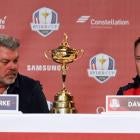
6. Choosing players for matches: U.S. captain David Love III and European captain Darren Clarke get together before each session to release their two-golfer teams. They are not known ahead of time, though, so the matches -- for all intents and purposes -- are random.