May 2 Prospect Watch: MLB fixes the 'Pete Incaviglia Rule'
At long last, MLB has finally fixed the outdated "Pete Incaviglia Rule." That and more is in this week's Prospect Watch.

By
Mike Axisa
•
6 min read
In this week's edition of the Prospect Watch, we're going to look at one pretty significant rule change and also discuss an elite prospect who is dominating Double-A, but isn't quite ready for MLB. We also have a small update on the Diamondbacks and the first overall pick in the 2015 draft.
MLB finally fixes the 'Pete Incaviglia Rule'
Major League Baseball has a lot of weird rules that are either outdated or simply don't make much sense. One of them was the so-called "Pete Incaviglia Rule," which prevented teams from trading players until one year after they signed their first pro contract.
The rule stems from, well, Pete Incaviglia, who couldn't come to a contract agreement with the Expos after being the eighth overall pick in the 1985 draft. Montreal traded him to the Rangers just five months later.
MLB was concerned teams would simply trade their top draft picks instead of paying big bonuses, hence the rule. There was also concern drafted players would have leverage and ask for bigger bonuses or a trade to another organization.
Teams found a loophole and have been including recently drafted players in trades as players to be named later. PTBNL have to be named within six months, so six months after a player is drafted, he is eligible to be included in a trade as a PTNBL.
Drew Pomeranz went from the Indians to the Rockies in the Ubaldo Jimenez trade as a PTBNL soon after being drafted, and, more recently, Padres shortstop Trea Turner was traded to the Rays in the Wil Myers deal. (The Rays flipped Turner to the Nationals for Steven Souza.)
It's an open secret Turner will go to the Nats as the PTBNL, but for now he's stuck with the Padres and that's a problem. He's in an organization that no longer has a stake in his long-term development and may not treat him like they would normally treat a highly regarded prospect.
Thankfully, Turner's situation has led to change. MLB informed clubs of a rule adjustment Friday, which allows them to trade drafted players the day after the World Series. Dave Cameron on FanGraphs broke the news and got his hands on a copy of the memo MLB sent out:
Please be advised that the Commissioner's Office and the Players Association have agreed to amend the Major League Rules in advance of this year's Rule 4 Draft with respect to players-to-be-named-later ("PTBNLs") under Rule 12(e)(2), and the trading of draft picks under Rule 3(b)(6). ... commencing with players eligible for the 2015 Rule 4 Draft, (a) players selected in the Draft may be traded beginning on the day following the conclusion of the World Series, and (b) drafted players cannot be PTBNLs unless they otherwise could be traded pursuant to Rule 3(b)(6), as amended, at the time of the trade.
The rule change doesn't help Turner. He's stuck with the Padres until he can be officially named as the PTBNL in late June. At least now other players won't have to go through the same thing. No one likes to be traded, but it is part of the business, and they don't want to be stuck in limbo like Turner if it does happen.
For what it's worth, I don't expect this to lead to a flurry of recent draftees being traded each offseason. The Turner situation is unique because he was drafted by one GM in June (Josh Byrnes) and traded by another (A.J. Preller) in December. Preller didn't have a connection to Turner -- he wasn't "his player," so to speak. Preller didn't draft Turner.
Teams tend to view their recent draft picks as shiny new toys and like to hold onto them as long as possible. One or two may be traded each offseason, sure, but I think it'll be rare. Teams put in years of work scouting a player before drafting him, and they want to see how he develops. Prospects and draft picks are like children -- every team loves their own more than everyone else's.
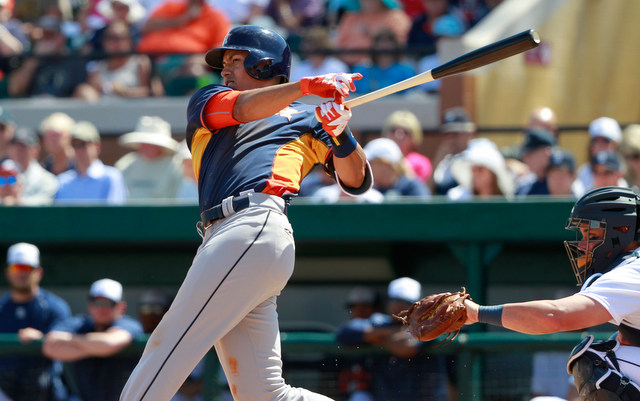
Carlos Correa not yet MLB ready despite Double-A dominance
No prospect in the minors leagues has gotten off to a more dominant start to the season than Astros shortstop prospect Carlos Correa, who was the first overall pick in the 2012 draft. The 20-year-old went into Friday night hitting .385/.455/.744 with five home runs and 22 RBI in 19 Double-A games.
The first-place Astros recently lost shortstop Jed Lowrie for several weeks with a ligament tear in his thumb, and, naturally, there have been calls to promote Correa. GM Jeff Luhnow hedged a bit when asked about calling up Correa, saying "Carlos is getting close ... we will be monitoring the situation closely."
As exciting as it would be see to Correa in the majors, I'm in the camp that thinks he needs more time in the minors to refine his game. Correa missed most of last season with a broken leg suffered sliding into a base, so he has played 82 games since the start of last season. Only 20 of those 82 have been higher than Class A.
This isn't a Kris Bryant situation where the player is so obviously ready for the big-league level. Correa is still working on his defense at short and is still shaking off the rust following last year's injury. Calling him up would be more of a band-aid move than a long-term solution, similar to the Cubs' Addison Russell callup, which hasn't been too pretty overall.
Correa's development timetable shouldn't change because of an injury to Lowrie. He's too special of a prospect to speed things up because of an outside factor. Correa is still extremely young and he has yet to go through the league a second time to see how pitchers adjust to him, and how he has to adjust back. There's more to this than the stat line.
D-Backs GM Dave Stewart very involved in 2015 draft scouting
Thanks to their miserable 64-98 showing last season, the Diamondbacks hold the first overall pick in this June's amateur draft for the second time in franchise history. They selected Justin Upton first overall back in 2005.
Unlike that 2005 draft, when Upton was the clear No. 1 prospect and a no-brainer selection, there is no consensus top prospect for this summer's draft. At least not right now. Someone could emerge in these next few weeks.
According to ESPN's Keith Law, D-Backs GM Dave Stewart has already personally scouted 24 players for that first overall pick. That's an extremely high number. Usually the scouting staff (area scouts, crosscheckers, scouting director) do the legwork and recommend 6-8 players for the GM to see personally. Maybe 10. Twenty-four is unheard of.
Is this a good thing? Should the GM see that many draft prospects? Could it lead to paralysis by analysis? I don't think there's a good answer to that. The first overall pick is a very big deal, one of the few chances a team gets to add a franchise player, so it's understandable why Stewart wants to be so hands on.
At the same time, the scouting staff is there for a reason, and if Stewart doesn't trust his staff to narrow down the top pick candidates to a list of, say, eight players, there might be a bigger problem.
The book is still out on the past two or three drafts, but Arizona's recent history of first-round picks since taking Upton isn't particularly pretty:
2006: RHP Max Scherzer (11th overall) -- traded for Ian Kennedy before he blossomed
2007: RHP Jarrod Parker (9th) -- traded for Trevor Cahill before he blossomed
2008: LHP Daniel Schlereth (26th) -- traded with Scherzer for Kennedy, now an up-and-down reliever
2009: 3B Bobby Borchering (16th) -- hasn't made it out of Class A
2010: RHP Barret Loux (6th) -- didn't sign after physical showed shoulder issue
2011: RHP Trevor Bauer (3rd) -- traded for Didi Gregorius before he blossomed (Archie Bradley was taken 7th overall, with the compensation pick for not signing Loux)
That's a trend the D-Backs need to reverse this year to get back to being competitive. Arizona doesn't have the resources to survive a run of generally fruitless top picks like, say, the Yankees or Dodgers. They need to hit on their picks and it's clear Stewart is taking matters into his own hands to make sure it happens this summer.