New York Yankees 2018 season preview: World Series hopes and a rookie manager
After winning 91 games and going to the ALCS last year, the Yankees won't sneak up on anyone in 2018

By
Mike Axisa
•
15 min read
By the team's own admission, the 2017 season was expected to be a transition year for the New York Yankees. They don't like the word "rebuild" in New York, so everyone from ownership to the front office to the field staff called it a "transition." The Yankees traded veterans (Carlos Beltran, Andrew Miller, Aroldis Chapman, Ivan Nova) for prospects at the 2016 trade deadline, and the goal in 2017 was to inject youth into the roster, even if it meant taking a step back in the standings.
Instead, the Yankees were one of the best teams in baseball last season thanks largely to those young players. Aaron Judge set a new rookie record with 52 home runs -- and, yes, a new rookie record with 208 strikeouts -- en route to being named AL Rookie of the Year unanimously, and runner-up for the AL MVP. Judge led all players in the FanGraphs version of WAR. Rookies and veterans, pitchers and position players.
Judge was the star of the show, understandably, but he was hardly alone. Luis Severino broke out as an ace and finished third in the AL Cy Young voting. Gary Sanchez missed nearly a month with a biceps injury and still led all catchers in home runs and both the FanGraphs and Baseball Reference versions of WAR. Chad Green emerged as a dominant setup reliever, striking out 103 batters in 69 innings. Jordan Montgomery provided stability at the back of the rotation. He led all rookie pitchers in the FanGraphs version of WAR.
The Yankees exceeded all expectations last season and wound up one win away from the World Series. They beat the Minnesota Twins in the AL Wild Card Game, came back from an 0-2 deficit to beat the Cleveland Indians in the ALDS, then lost the ALCS in seven games to the Houston Astros. A disappointing end to an otherwise exciting season for a Yankees team that, frankly, was mired in mediocrity with an aging roster from 2013-16.
Now, going into 2018, the Yankees are no longer a fun underdog story. They aren't going to sneak up anyone this year. They're back to being the Evil Empire. A bona fide World Series contender set up for the present and future as well as any team in the sport. New York has an excellent young core at the big league level, one the best farm systems in baseball, a smart and opportunistic front office, a new manager, and of course gobs of money. Let's preview the upcoming season for the Bronx Bombers.
The vitals
- 2017 record: 91-71 (plus-198 run differential)
- 2018 schedule: Click here.
- 2018 depth chart: Click here.
- 2018 fantasy outlook: Click here.
Probable lineup
The Yankees led baseball in home runs and were second in runs scored last season, then they went out an added 59-homer man Giancarlo Stanton, the reigning NL MVP. Cashman also swapped out Chase Headley and Starlin Castro for Brandon Drury and Neil Walker. These things are always fluid, but here is the starting lineup new manager Aaron Boone figures to run out there on Opening Day:
- LF Brett Gardner
- RF Aaron Judge
- DH Giancarlo Stanton
- C Gary Sanchez
- SS Didi Gregorius
- CF Aaron Hicks
- 1B Greg Bird
- 2B Neil Walker
- 3B Brandon Drury
Bench: C Austin Romine, IF Ronald Torreyes, OF Jacoby Ellsbury, UTIL Tyler Wade
Ellsbury is currently working his way back from an oblique injury and the Yankees have said he may not be ready in time for Opening Day. If that is the case, it clears the way for young Billy McKinney to make the Opening Day roster as the reserve outfielder. Also, it is possible Wade starts at second base with Walker serving as more of a super utility guy who gets regular at-bats while moving around between first, second, and third bases. The Yankees have indicated that may be the case.
Defensively, Stanton has been working out in left field this spring -- he's never played the position at the big league level -- while Judge has only done so on the backfields during minor league games. Boone has said he wants to keep one guy in right field full-time and have the other move around. Based on their spring defensive assignments so far, it appears Judge will stick in right while Stanton moves between right and left, as necessary. (Both will see time at DH as well.) Seems simple enough on paper, and it's easy to see it working in spring training, but we'll see what happens once the regular season begins. It might take a while for Stanton to settle in while moving around so much.

Boone has said his "ideal" lineup would include a left-handed hitter sandwiched between the right-handed Judge and Stanton, though he won't force anything. Give the Yankees a truth serum and I'm guessing they'd tell you they want Bird to have a breakout year and claim the No. 3 spot in the lineup between Judge and Stanton. Me? I say hit Judge and Stanton second and third (or vice versa) and make sure they both bat in the first inning. Squeezing a lefty between them is getting a little too cute. Let the big guys eat.
Probable rotation
The Yankees spent most of the offseason looking for another starting pitcher, and not just a depth arm. They wanted an impact starter. The Yankees were planning to make a major run at Shohei Ohtani before Ohtani shut them out, and once that happened, they shifted focus to trade candidates like Michael Fulmer and Gerrit Cole, and free agent Yu Darvish.
Ultimately, the Yankees came up empty. They re-signed stalwart CC Sabathia to a one-year contract and that was it. Here is the announced Opening Day rotation order:
- RHP Luis Severino
- RHP Masahiro Tanaka
- LHP CC Sabathia
- RHP Sonny Gray
- LHP Jordan Montgomery
There was no fifth starter competition in spring training or anything like that. Barring injury, those were always going to be the five starters the Yankees were going to use to begin 2017. New York's rotation was fifth in ERA and sixth in the FanGraphs version of WAR in 2017, and now they'll have a full season of Gray, who came over at last year's trade deadline.
Probable bullpen
Bullpens are notoriously volatile, but on paper, you're not going to find a better bullpen than the Yankees' bullpen going into the 2018 season. Check out the relief crew Boone will have at his disposal:
Closer: LHP Aroldis Chapman
Setup: RHP Chad Green, RHP David Robertson
Middle: RHP Dellin Betances, RHP Tommy Kahnle, LHP Chasen Shreve, RHP Adam Warren
When Betances, a four-time All-Star, is maybe the fifth best reliever in your bullpen, you're in a great shape. Chapman will close and Green will reprise his multi-inning fireman role -- Green recorded at least four outs in 29 of his 39 relief appearances in 2017 -- otherwise Boone intends to mix-and-match with his relievers rather than assign them set innings. I suspect you'll see Robertson in a "moment of truth" role, similar to Miller with the Indians. He'll be on the mound in whatever Boone deems the biggest moment of the game.
Two sluggers with a nickname to be named later
At some point someone will come up with a good nickname for Judge and Stanton. You can't force a nickname. It has to happen organically and it'll happen at some point. So far, about a month into spring training, it hasn't.
Anyway, in Judge, the Yankees had a towering right-handed hitter with enormous power and sneaky good right field defense. Then they went out and acquired the National League version of Judge in Stanton. The similarities are remarkable.
Judge and Stanton get to Spring Training. pic.twitter.com/Rb5eyhfbBL
— Mike Axisa (@mikeaxisa) December 8, 2017
Only once in history has one team had two players hit 50 home runs in a season -- the 1961 Yankees had Roger Maris (61) and Mickey Mantle (54). Only 30 teams in history have had two players hit 40 home runs in the season. It most recently happened in 2015, when the Los Angeles Angels (Mike Trout, Albert Pujols), Colorado Rockies (Nolan Arenado, Carlos Gonzalez), and Toronto Blue Jays (Josh Donaldson, Jose Bautista) all managed to do it.
Judge and Stanton hit 52 and 59 home runs in 2017, respectively, and both players are still in their 20s. Judge is 25 and Stanton turned 28 in November. They're in their primes and they have the natural power potential to hit 50 homers again in 2018. Now, hitting 50-plus homers is very difficult, but these two can do it. If you had to pick one player to hit 50 home runs this summer, wouldn't you pick Judge or Stanton? Of course you would.
It is entirely possible both Judge and Stanton will dip down into the 40-something home run range this season, which would obviously be excellent, but if that happens they'll be asked questions about why their numbers are down. They set the bar extremely high last season. They are flawed hitters, no doubt. Judge and Stanton will both strike out, and Stanton's walk rate is merely good rather than great relative to other top sluggers. Those flaws will get exposed at times. It's inevitable.
Can they do it again? Sure. Do it once and you can do it again. But, if even both Judge and Stanton take a step back, they can still be very good players, and the centerpieces of a powerful and deep lineup. It's been a while since one team had two prime-aged players with this much power potential. Even with their flaws, Judge and Stanton will be a nightmare for opposing pitchers. And if you get by them, you still have to deal with Sanchez.
The new manager
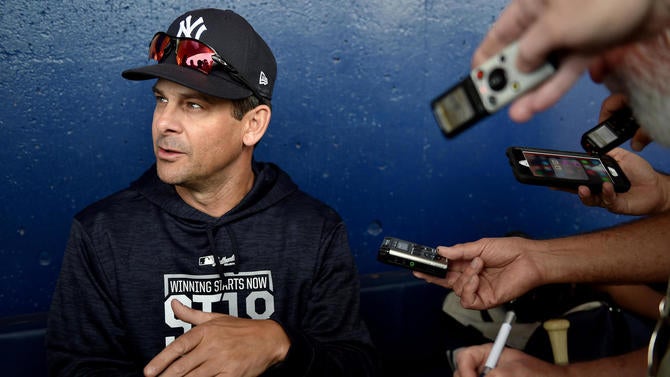
Needless to say, hiring an inexperienced manager to run a World Series contender is a risky move, though it is an increasingly popular move these days. Six teams changed managers over the winter and only one, the Detroit Tigers with Ron Gardenhire, hired a skipper with prior managerial experience. That is the new trend in baseball. Inexperienced managers.
Boone is a true zero experience manager. He went from playing to broadcasting to managing. No coaching experience, no front office experience, no managerial experience. The only other team to hire a true zero experience manager over the last six years is the St. Louis Cardinals with Mike Matheny. All other rookie skippers hiring since 2011 had some coaching or front office experience. Boone, like Matheny, has none.
The role of the manager has evolved. When the Yankees introduced Boone at his press conference, he emphasized communication and relationships with his players, not strategy. That's because the front office is very involved in those strategic decisions. Batting orders, bullpen usage, all that is discussed ahead of time. GM Brian Cashman likened the organizational structure to a NASA mission during a recent television appearance. NJ.com's Joe Giglio has a transcript:
"I liken it to NASA and a space shuttle," Cashman said. "We're building a space shuttle. In our case, it's going to be less than a $197M space shuttle this year. At the end of the day, we're building a space shuttle. We've got a mission. We need an astronaut with specialized skills to fly that space shuttle and take us where we want to go. Expecting--like anything else in life--things aren't going to go the way its planned.
"You're going to stay in touch with mission control all the way. And we'll provide you players along the way--ones you may not even know much about because they'll be playing in Scranton or they're playing in Trenton or acquired in trades or from scouting recommendations. We're going to have to tell you why the guy is here to help close the gap on it."
"But the astronauts specialty is to plug-and-play, in-game decisions," Cashman said. "So we're trying to hire people with the skills to do those things. But we're not turning the keys over. The astronaut isn't the whole space program. I think the industry has recognized that so many things go into this to putting a team on the field.
"The manager is a huge piece of the puzzle, but one piece of the puzzle. The manager isn't the whole space program. I think that's the difference now."
My hunch is Boone's in-game strategy will not be wildly different from Girardi's. So much of that stuff is decided in collaboration with the front office. The difference will be behind the scenes, with the way Boone (and his staff) relates to his players and disseminates information from the front office.
Don't get me wrong, Boone can still screw things up on the field with his in-game decisions, even with the front office involved. A week ago he forgot to warm a reliever up for his scheduled inning during a spring training game, for example. There are going to be rookie mistakes along the way. They're inevitable. The Yankees have a young and impressionable roster. They are banking on everything Boone brings to the table in the clubhouse more than making up for any on-field goof ups. It's risky, sure, but by all accounts Boone is bright and well-respected, and he's a natural with the media, which goes a long way in New York.
Is this the year Greg Bird stays healthy?
The Yankees love Greg Bird. Love love love him. Internally, they ranked Bird as their top prospect a few years ago even when Judge and Sanchez were both in the farm system. Bird has a strong postseason showing last year, hitting .244/.426/.512 with three home runs, one of which was pretty darn important ...
... but the fact of the matter is the kid has played only 94 big league games since his August 2015 debut. He's dealt with lots of injuries the last two seasons, and they were major injuries, not bumps and bruises. Bird missed the entire 2016 season with shoulder surgery and he missed close to four months with ankle surgery in 2017. That's not good. He has potential, but potential doesn't mean much if you're not on the field.
The Yankees will again go into the season with Bird slated to be their everyday first baseman and, if he stays healthy, he's the type of left-handed loft hitter who can pepper the Yankee Stadium short porch. Consider his career rates:
Bird career | MLB average | |
Pull rate | 44.8 percent | 39.8 percent |
Ground ball rate | 28.4 percent | 44.2 percent |
Hard contact rate | 40.6 percent | 31.8 percent |
Hitting the ball hard in the air to right field is Bird's thing, and that bodes well at Yankee Stadium. He's hit 20 home runs in 94 big league games, including 13 homers in 59 games at Yankee Stadium, and that is in no way a fluke. When healthy, Bird can do real damage, and he'd be an excellent complementary player behind Judge, Stanton, and Sanchez. The Yankees just have to hope he stays on the field for a full season for the first time in his career.
Even more prospects are on the way
Within the past 12 months the Yankees have graduated or traded away several top prospects. Green, Judge, Montgomery, Wade, and Clint Frazier all exhausted their rookie eligibility in 2017 and are no longer considered prospects. Also, according to MLB.com, the Yankees traded away the No. 72 (Jorge Mateo for Gray) and No. 99 (Blake Rutherford for Kahnle and Robertson) prospects in baseball at last year's deadline. They also traded their 2015 first round pick (James Kaprielian for Gray) and another fringe top 100 prospect (Dustin Fowler for Gray) at the deadline.
Between trades and graduations, that is an awful lot of talent leaving the farm system. And yet, the Yankees still boast what the scouting community considers one of the top farm systems in the game. Check out their spots on the various farm system rankings this spring:
- Baseball America: 2nd
- Baseball Prospectus: 4th
- ESPN: 2nd
- MLB.com: 2nd
Still a top tier farm system, led by infielder Gleyber Torres, who is on the very short list of the best prospects in baseball. Torres needed Tommy John surgery on his non-throwing elbow last June following an awkward slide into home plate, and the one-year deal for Walker allows the Yankees to send Torres to Triple-A so he can shake off the rust and get back up to speed before taking over the second base job long-term.
Third baseman Miguel Andujar was penciled in as the starter at the hot corner before the Drury trade, so Andujar will head to Triple-A this season to work on his defense as he waits for an MLB opening. Righty Chance Adams and especially lefty Justus Sheffield are among the top pitching prospects in the game and both figure to make their MLB debuts in 2018. The Yankees have done an excellent in the draft and international free agency in recent years, as well as in trades, and their player development system is much improved. They have lots more talent on the way, remarkably.
Will they get under the luxury tax threshold?
Without a doubt. Owner Hal Steinbrenner has said for years he wants the Yankees to get under the luxury tax threshold to reset the team's tax rate, which is currently the maximum 50 percent. They were originally planning to get under the threshold in 2014, but once the Yankees missed the postseason in 2013, that went out the window and they spent big on free agents.
This season the Yankees are in great position to get under the $197 million threshold. Even after signing Walker to a $4 million deal last week, the Yankees still have about $15 million in breathing room under the threshold. They have enough set aside for the inevitable in-season call-ups -- every call-up adds to the final luxury tax payroll number -- and even make some trade deadline additions. The Yankees have been talking about getting under the luxury tax threshold for years and this will be the year they do it. No doubt about it.
The plan to get under the luxury tax threshold is, of course, made possible by the team's young players. Judge, Sanchez, and Severino are providing big production at salaries near the MLB minimum. Green, Montgomery, and Bird belong in this group as well. That's three starting position players, two starting pitchers, and one setup reliever making no more than $630,000 apiece. Without that cheap production, the luxury tax plan would be impossible.
The Yankees are poised for a big trade deadline
Between their financial wiggle room under the luxury tax threshold and their cache of prospects, the Yankees are poised to be a major player at the trade deadline. They have the prospects to acquire pretty much anyone -- even if the Yankees make Torres, Sheffield, and touted outfielder Estevan Florial untouchable, they still have enough pieces to put together a blockbuster -- and because luxury tax "hits" are pro-rated for in-season additions, that $15 million under the threshold could go a long way at midseason.
What will the Yankees need at the deadline? Well, who knows. Pitching is an obvious answer, every team always wants more pitching, and chances are needs will emerge during the season, either through injury or poor performance. The Yankees figure to be in position to pursue long-term additions (Fulmer? Chris Archer?) or high-priced rentals (Cole Hamels?) at the deadline. We have to see how the standings and the market shakes out, and which teams are willing to sell. Point is, the Yankees are very good right now and they'll have the wherewithal to get better and address any roster needs in July.