
Everything to know about Tarik Skubal's contract dispute with Tigers, including impact for potential trade
The Tigers and their star pitcher failed to agree to 2026 salary figure ahead of Thursday's deadline

By
Mike Axisa
•
11 min read
Thursday was one of the most important and, frankly, most boring deadlines of the baseball offseason. It was the deadline for teams and their arbitration-eligible players to file salary figures for the 2026 season. The vast majority of players agree to 2026 contracts before the deadline. Only a handful -- 18 this year -- actually get as far as filing salary figures.
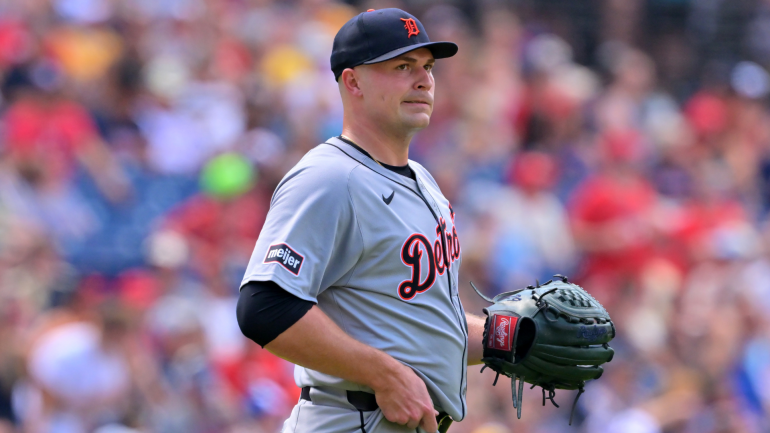
Among those 18 players is Detroit Tigers ace and reigning two-time Cy Young winner Tarik Skubal. The Tigers and Skubal could not agree to terms prior to Thursday's deadline, so they filed. Skubal is seeking $32 million. The Tigers filed at $19 million. The $13 million gap is the largest in salary arbitration history and Skubal's number would be the richest arbitration salary ever.
Here are the largest salaries for arbitration-eligible players who signed a one-year contract:
- Juan Soto, Yankees: $31 million in 2024
- Shohei Ohtani, Angels: $30 million in 2023
- Vladimir Guerrero Jr., Blue Jays: $28.5 million in 2025
- Mookie Betts, Dodgers: $27 million in 2020
- Nolan Arenado, Rockies: $26 million in 2019
Arenado filed for $30 million in 2019, the two sides agreed to a then-arbitration record $26 million contract, then they tore that up and agreed to a new eight-year extension worth $260 million. Skubal is looking to beat Soto's record and also David Price's record for the largest salary for an arbitration-eligible pitcher. Price signed for $19.75 million back in 2015, when he was with Detroit.
Skubal is a Scott Boras client, so it is no surprise then that he's looking to set an arbitration record. Boras did it just two years ago with Soto. Skubal will also be a free agent after 2026, and an arbitration battle may damage the relationship. Corbin Burnes, another Boras client, admitted his 2023 arbitration hearing with the Brewers hurt his relationship with the team.
Arbitration hearings can be unpleasant if not downright contentious. The player argues why he deserves the salary he filed and the team argues why the player deserves the salary they filed, which often means detailing the player's shortcomings. It's business and everyone is professional about it, but there's a reason arbitration hearings are seen as a last resort.
Once each side states their case, the three-person arbitration panel will select either the salary the player filed or the salary the team filed. Nothing in between. Skubal and Tigers could agree to a contract before then and avoid a hearing, though that's very unlikely for reasons I'll explain shortly. Point is, it's one salary or the other once you're in a hearing.
Skubal is set for a landmark arbitration case, one that could raise the salary bar significantly for pitchers in the future (like, say, Paul Skenes). Let's break this all down. Where the Tigers are coming from, where Skubal is coming from, what it means for his future with the Tigers, and more.
The Tigers are a 'file and trial' team


Just to get the easy stuff out of the way first, the Tigers are a "file and trial" team under POBO Scott Harris, meaning they do not negotiate one-year contracts after the filing deadline. They'll discuss a multiyear contract, but not a one-year deal. Boras and Skubal will almost certainly decline any long-term extension offer with a record free agent payday on the horizon.
Two years ago the Tigers and Casey Mize filed at $815,000 and $840,000, respectively, or a mere $25,000 difference. They avoided an arbitration hearing by agreeing to a one-year contract worth $830,000 with a club option. The club option danced around the club's "we only discuss multiyear contracts after the deadline" approach. It's sort of silly, but that's the way the Tigers do things.
Again, Boras and Skubal will almost certainly reject any multiyear offers, meaning the two sides are heading to a hearing. Detroit has been to only one arbitration hearing since 2001 (they beat Michael Fulmer in 2019). Hearings take place in late January and early February. Individual hearing dates are typically reported a few days in advance.
The Price comparison
It is sort of remarkable that the arbitration salary record for a pitcher remains Price's $19.75 million way back in 2015. The position player record has been broken many times since then, but, for pitchers, Price still reigns supreme. And if the Tigers beat Skubal in arbitration, Price will still have the record. Their $19 million filing number is $750,000 south of Price's record.
Price went into arbitration that year with one Cy Young win plus a second-place finish in the Cy Young voting. Skubal has two Cy Youngs, though the career numbers do favor Price. Here's the head-to-head comparison:
| Price going into 2015 | Skubal | |
|---|---|---|
W-L | 86-51 | 54-37 |
ERA | 3.21 | 3.08 |
ERA+ | 121 | 135 |
IP | 1,221 ⅓ | 766 ⅔ |
K | 1,147 | 889 |
WAR | 23.0 | 17.9 |
Only publicly available statistics are admissible in arbitration. If you can't look it up on Baseball-Reference, Baseball Prospectus, Baseball Savant, FanGraphs, or another site you and I can access, you can't use it. Arbitration is also pretty archaic. Wins matter, RBI matter, saves matter. Those stats may not be useful for evaluating players, but they are used to make arbitration cases.
Skubal has two Cy Youngs to Price's one, though the head-to-head numbers favor Price. More wins, one-and-a-half times as many innings, more strikeouts, more WAR, etc. A lot of that has to due with modern pitcher usage. Skubal's career high is the 195 ⅔ innings he threw in 2025. Price threw 248 ⅓ innings in 2014 and had four 200-inning seasons to his name by that point.
Also, Skubal has an injury history, most notably flexor tendon surgery that sidelined him late in 2022 and for much of 2023. Price was very durable through his arbitration years and really his entire 20s. Injuries are considered in arbitration, which is why pitchers who miss a full season with Tommy John surgery usually don't get a raise. They typically get the same salary the next year.
One last thing to consider is Price and Skubal arrived to their big arbitration salaries in very different ways. Skubal is like most other players in that he went through arbitration three times. Price was a Super Two, meaning that his service time level sent him through arbitration four times. He went into 2015 with a higher baseline salary: $14 million in 2014. Skubal made $10.15 million in 2025.
Furthermore, Price signed a major-league contract as the No. 1 overall pick in the 2007 draft, something that is no longer allowed. His early career salaries were higher than the typical player's. Arbitration raises are based on your prior salaries, so if you make more in Year 1, it carries over and you'll make even more in Years 2, 3, 4, 5, and 6 before free agency.
The Tigers filed at $19 million presumably because the head-to-head statistical comparison favors Price. They're willing to pay Skubal very well. Just not a record-setting amount for an arbitration-eligible pitcher. Skubal has the second Cy Young, but just about everything else (stats, All-Star Game selections, etc.) is advantage Price.
The 'special accomplishment' provision
In arbitration, salaries are based on players at the same service-time level. If you have three years of service time, you are compared to other players with three years of service time, etc. That usually explains why you sometimes see an All-Star with a lower salary than a lesser player in a given season. The All-Star has less service time and isn't as far along in arbitration.
Skubal has five-plus years of service time and can compare himself to other top pitchers when they were a year away from free agency, including Price ($19.75 million in 2015), Burnes ($15.7 million in 2024), and Gerrit Cole ($13.5 million in 2019). Fellow Multi-time Cy Young winners like Jacob deGrom, Clayton Kershaw, and Tim Lincecum had signed multi-year deals prior to this point.
Article VI(E)(10)(a) of the collective bargaining agreement includes a "special accomplishment" provision allowing players "to argue the equal relevance of salaries of Players without regard to service, and the arbitration panel shall give whatever weight to such argument as is deemed appropriate." In English, it lets you can ignore service time and compare yourself to any player.
Boras and Skubal will surely argue he qualifies for a "special accomplishment" given their $32 million filing number. It would not only be the largest arbitration salary ever. It would be a $21.85 million raise over his $10.15 million salary in 2025. The record arbitration raise for a pitcher is deGrom's $9.6 million raise from 2018 to 2019. Skubal's looking to obliterate deGrom's record.
The $32 million filing number indicates Boras and Skubal will tell the arbitration panel to ignore service time. That this guy has two Cy Youngs and is arguably the best pitcher in baseball, and deserves to be paid as such. Here are the highest paid pitchers in baseball heading into 2026:
- Zack Wheeler, Phillies: $42 million
- Jacob deGrom, Rangers: $37 million
- Blake Snell, Dodgers: $36.4 million
- Gerrit Cole, Yankees: $36 million
- Corbin Burnes, Diamondbacks: $35 million
- Garrett Crochet, Red Sox: $28.3 million
Crochet signed an extension two years prior to free agency. Wheeler signed an extension a year before free agency, though he was already working on a free agent contract, so it was basically another free agent deal. The other four all signed their contracts as true free agents on the open market. Skubal is seeking to be paid just south of Burnes, Cole, deGrom, and Snell.
In addition to the "special accomplishment" provision, Boras and Skubal will also argue that Price's record $19.75 million salary is not particularly relevant now because it was 10 years ago. Adjusted for inflation, $19.75 million in 2015 is equivalent to $26 million or so in 2026. Boras and Skubal will argue inflation since Price's record was set, plus a bit more for the second Cy Young.
The Tigers filed for $19 million because Skubal doesn't quite match Price's statistics. Skubal filed for $32 million for a few reasons. The "special accomplishment" provision, inflation since Price signed his record arbitration deal, the second Cy Young, etc. Boras and Skubal are shooting for the moon. The Tigers are valuing him more in line with top pitchers at his service time level.
So who's going to win?
This is an unprecedented arbitration case. We're talking about a record salary for any arbitration-eligible player, not just pitchers, plus a raise that would more than double the previous record. You don't file the salary you want. You file the salary you believe you can win. Boras and Skubal wouldn't have filed for $32 million unless they were confident they could argue it.
Skubal is aiming very high and my guess -- I emphasize this is only a guess -- is he and Boras will have a harder time selling the panel on their $32 million number than the Tigers will with the $19 million they filed. The Tigers can simply say "our guy is good, but Price was better, so he deserves less." Skubal and Boras have to defending a record-smashing salary. It won't be easy.
What does this mean for a potential trade?
Because he is a year away from free agency, and because Boras likes to take his top clients out into the open market, Skubal has been speculated as a trade candidate all offseason. The Tigers were top six in payroll every year but one from 2008-17, though these days they're middle of the pack. Signing Skubal long-term will mean raising payroll and winning a free agent bidding war.
Although arbitration hearings can create bad blood, it is highly unlikely Skubal will make a stink if he loses the hearing and makes $19 million in 2026. It would not in his best interests to develop a reputation for being a headache with free agency so close. If he loses, Skubal will put on a happy face, say he's ready to focus on baseball, and go about his business no matter how he truly feels.
Skubal's salary would affect his trade value because the difference between $32 million and $19 million is pretty big, and teams hate nothing more than paying market value for players. If the Tigers decide to trade Skubal before Opening Day, only a few teams would be able to take on the full $32 million (Dodgers, Mets, Yankees, etc.). At $19 million, several more clubs could get involved.
The salary difference at the trade deadline would be less significance. If Skubal wins his arbitration case, he would still have about $10.5 million coming to him at the deadline. If the Tigers win, it would be $6.3 million, give or take. Taking on that extra $4 million or so in late July would be much more manageable than taking on an additional $13 million on Opening Day.
Of course, the Tigers would have to fall out of the race to trade Skubal at the deadline. Either that or risk the fan base revolting. The Tigers are very good and the AL Central is very winnable. If they're not in the race come July, they have much bigger problems than figuring out what to do with Skubal. At that point, they would have little choice but to trade him.
The Tigers have entertained trade offers for Skubal this offseason because why not? It doesn't hurt to listen and you never know when a team will blow you away with an offer. Earlier this week, the New York Post reported the Tigers told the Yankees it would take "half their team" to get Skubal, so Detroit is listening. They've just set the asking price very high, understandably.
All winter, every indication has been that the Tigers will take Skubal into 2026, and deal with his free agency later. They can trade him at the deadline if their season goes off the rails and/or pursue him long-term as a free agent. If the arbitration hearing leads to hurt feelings, well, that's a risk the Tigers are willing to as a "file and trial" team. They'll worry about it when they have to.