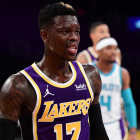

Dennis Schroder on contract negotiations: 'I want to be a Laker for a long time... I just want it to be fair'
Schroder is eligible for an $83 million extension

By
Sam Quinn
•
3 min read
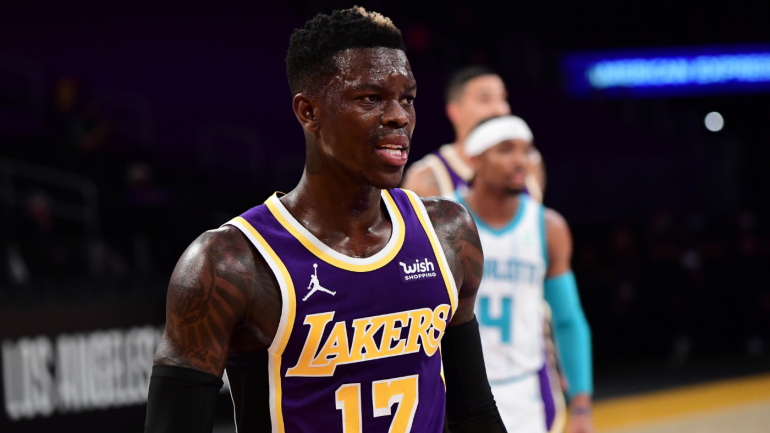
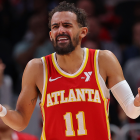
The Lakers took a calculated risk by trading for Dennis Schroder on an expiring contract. The goal in acquiring him was not only to boost their 2021 championship hopes but also to land a long-term point guard to one day replace LeBron James as their lead ball-handler. Schroder's play this season has warranted such a lofty long-term goal, but it won't matter if the Lakers can't sign him to an extension. He has already rejected multiple offers, and on Thursday, he indicated that he expects the Lakers to pay him market value if they plan to keep him.
"I want to be a Laker for a long time," Schroder said according to ESPN's Dave McMenamin. "I just want it to be fair." In the early portion of the season, that wasn't even possible. Because the Lakers dealt for Schroder during the offseason, the Lakers were restricted by the league's extend-and-trade rules. Those rules only allow for two new seasons to be added to an existing contract, and they limit raises to only five percent of the player's present salary. For Schroder, that meant only $33.4 million over the next two seasons. There was no way he was ever going to sign such a small deal.
But on Feb. 16, those restrictions expired. Now he is bound by the far less restricting veteran extension guidelines, making him eligible for a 20 percent raise next season and eight percent raises in each subsequent season. That extension could add four years to his current deal, and in total, would make Schroder eligible for up to $83.3 million in new money. Yet more than a month has passed since the Lakers could legally sign him to that deal, and they haven't. Why? There are two possible explanations.
The first is the simplest: the Lakers are offering some amount below that total, and Schroder believes he deserves more. This is the likeliest explanation. While Schroder is a capable starting point guard, he is not a superstar. Barring a large jump in value during the postseason, the odds of him getting more than $83.3 million in free agency are likely on the slimmer side. Fred VanVleet, a better player by most measures, got $85 million last offseason. The market was depressed, and this offseason should be far friendlier to free agents, but Schroder was a reserve as recently as last season. Rob Pelinka was once an agent. Negotiating is his strength as a general manager. Starting from a lower point would make sense for the Lakers even if they intend to increase their offer.
But there is also the chance that the Lakers have already offered the full $83.3 million, and Schroder has simply said no. If he reaches unrestricted free agency, he won't be limited by anything except for the max. The Lakers could, in theory, pay him anything up to $145 million over four years, or $195.6 million over five. He wouldn't get that much, but the other advantage of getting to free agency is the ability to leverage offers against one another. If multiple teams are bidding on his services, the Lakers might have to pay more to get Schroder to sign. They might even be outbid entirely. The risk in waiting is that his value, through either injury or performance, declines in the coming months.
The Lakers wouldn't have given up a first-round pick for Schroder if they didn't plan to re-sign him. Schroder would be unlikely to find another championship contender capable of paying him as much as the Lakers. An extension, either now or in the offseason, makes sense for all parties involved. But Schroder has made it clear that he isn't planning on taking a major hometown discount. If the Lakers want to bring him back, they're going to have to pay him what he's worth.