Lakers vs. Warriors: Three adjustments that helped L.A. win Game 3, and what they mean for Game 4
The Lakers outwitted the Warriors in Game 3 to take a 2-1 series lead

By
Sam Quinn
•
6 min read
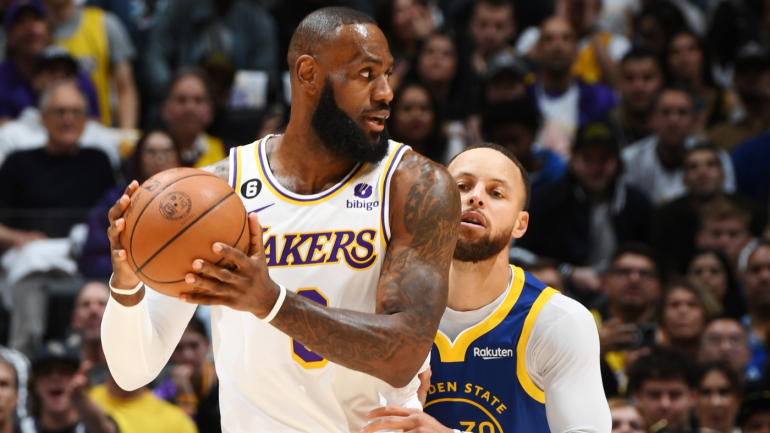
The Los Angeles Lakers may have won Game 1 of their second-round series against the Golden State Warriors, but in the process, they might have picked up an even bigger victory. Coaching can make or break a series this close, and by winning Game 1, the Lakers put the Warriors on the defensive. Suddenly, Game 2 was a must-win game for them, and as such, they were forced to deploy their adjustments first.
The biggest was the decision to start JaMychal Green over Kevon Looney. That move wrecked havoc on the Laker defense, as it made it far more difficult for them to sag off of non-shooters and emphasize rim-protection. The Warriors won Game 2, 127-100, but in the process, they showed the Lakers their cards. Suddenly, the Lakers knew what they were up against for Game 3.
And when Saturday's game arrived, the Lakers were ready. Darvin Ham unleashed his adjustments in response, and the results were spectacular for Los Angeles: a decisive 127-97 victory. So what did he change? And what does it mean for this series moving forward? Here are the three biggest adjustments Ham's staff made on Saturday.
1. They took their best defender off of Stephen Curry
It sounds somewhat counterintuitive, doesn't it? The Lakers largely used Jarred Vanderbilt to defend Stephen Curry in the first two games of the series. Vanderbilt is the best perimeter defender the Lakers have, and stopping Curry is obviously the team's defensive priority. Yet when Game 3 began, it was Austin Reaves, not Vanderbilt, guarding Curry. Instead, Vanderbilt defended Draymond Green.
The logic behind the switch became clear almost immediately. Check out this early first-quarter possession for Golden State.
Sure, Curry no longer had to face Vanderbilt one-on-one every time down the court. That saved him from Vanderbilt's relentless energy, size and speed. Reaves isn't nearly as imposing one-on-one. But with Vanderbilt on Draymond Green and Anthony Davis on JaMychal Green, the Lakers had effectively defanged Golden State's pick-and-roll attack. Whenever Curry called for one of his big men to set a screen, they could simply switch Vanderbilt or Davis onto him and blow up the play.
That is what happens on this play. Curry gets the initial screen from JaMychal Green, and Davis prepares to pick him up in a high-drop, but when he notices the ball heading to Draymond, he knows Curry will get the ball back and allows Vanderbilt to pick him up on the switch. Curry has nothing from there. He can't beat Vanderbilt easily one-on-one, so his only angle is a difficult scoop layup. Scoops are essentially free blocks to someone as long and athletic as Davis. Sure enough, Davis swats this one away.
Versions of this approach to defending superstars are becoming more common throughout the 2023 playoffs. The Miami Heat have deployed a somewhat similar strategy against Jalen Brunson: let Gabe Vincent take the nominal assignment knowing that it frees Jimmy Butler and Bam Adebayo to help more aggressively. There are circumstances in which that approach is dangerous, and ultimately, Curry is Curry. You're not going to stop him for an entire game. But if you can disrupt his rhythm early, you've weakened the focal point of Golden State's entire system. The Curry-Green pick-and-roll is Golden State's cheat code. It's what the Warriors use when they're ready to take an opponent seriously. The Lakers snuffed it out, but it wasn't their only important anti-Curry measure.
2. They attacked Curry on defense
You know how they say the best offense is a good defense? Well, in Curry's case, the reverse is often true. The best defense is a good offense, or at least an aggressive one. Let's take a look at the first-quarter Laker offense. After a few opening set pieces, the Lakers opened the hunt. We have LeBron James seeking out Curry in pick-and-roll...
And then doing so again...
And then D'Angelo Russell got in on the fun...
And it went on this manner, with Austin Reaves and Dennis Schroder taking turns as the game went on as well. You'll notice that only one of these three possessions ends in a made basket. The Lakers weren't hunting Curry because he's a bad defender. He's actually a fairly good one. But he is also a small guard asked to run marathons off of the ball on offense. He only has so much gas in the tank.
This is a tactic James, as well as James Harden back at his Houston peak, unearthed during their many battles with Curry. The best way to slow him down on offense is to tire him out on defense. Making him defend the ball as often as possible. Hit him on screens. Work him in the post. Curry scored just 23 points in Game 3, and while the defense the Lakers played on him was largely responsible, it was the defense they made him play on their own ball-handlers that really sealed the deal.
3. They went back to an old favorite
Lonnie Walker IV started 32 games for the Lakers. Before suffering a mid-season injury, he was shooting over 38% from deep on over five attempts per game. During the darkest days of the Russell Westbrook era, Walker was probably the third-best Laker: athletic and crafty enough to create his own shot, but increasingly comfortable firing away on looks created for him by others. This is the ideal role player for a team featuring LeBron James and Anthony Davis. Walker delivered across the first half of the season.
And then he just sort of went away. He got hurt at the end of December. The Lakers revamped the roster in February. His shooting role had been filled by Malik Beasley. His athletic gifts were replicated by Troy Brown Jr., a better defender. So Walker stayed out of the rotation. Aside from garbage time, he didn't play in the first eight playoff games. But with Beasley missing his shots and Brown failing to draw an ounce of defensive attention on his, Ham turned to Walker. He responded with 12 points in 24 minutes and acceptable defense.
The bar here is low. Brown had grown unplayable offensively and Beasley had grown unplayable defensively. If Walker can just hold his own for 10 or 15 minutes per game, he'll shore up the biggest hole in the rotation aside from backup center. The Warriors have to at least guard Walker from deep. He can punish their closeouts as a ball-handler. He'll make big plays on defense even if he botches little ones. It's not much, but it's better than what Brown and Beasley had provided, and it's evidence for the idea that Ham is willing to make major lineup changes when the situation necessitates them.
So how do the Warriors respond?
The adjustment here is obvious, and our own Brad Botkin has already laid out the case for it: it's time for Steve Kerr to invite the Lakers to a Poole party. Golden State has used the five-man lineup of Curry, Klay Thompson, Draymond Green, Andrew Wiggins and Jordan Poole for just nine minutes in this series. The Warriors have won those minutes by 15 points. Expect to see a lot more of it in Game 4.
Inserting Poole into the starting lineup comes with risks. Unlike Curry, he actually is a poor defender, and giving the Lakers the option to hunt him would only help their stagnant offense. But hunting Poole means they aren't hunting Curry, who would have nearly unlimited space to work with in a lineup featuring Poole. With Green as their only suspect shooter, Davis couldn't hang around the paint and deter every Golden State drive. Players like D'Angelo Russell and Rui Hachimura—whom the Warriors likely would have made unplayable at their peak—would have to play much more defense in space, where they are at their most vulnerable.
The Lakers are likely bracing for this change. Just as they saw Golden State's hand after Game 2, Kerr saw theirs after Game 3. Now it will be up to the Lakers to adjust on the fly in Game 4, and if they can do it, they can take a commanding 3-1 series lead.