NBA overreactions: Lakers' defense historically great; Damian Lillard's Blazers in need of a reboot
We examine what's real and what's not from a wild week in the NBA

By
Sam Quinn
•
8 min read
November is a treacherous time for NBA takes. With the first few weeks of the season in the books, it's time to start wondering if the most ridiculous outcomes of the season might actually mean something. Writing off one game is one thing. When teams start to reach double digits, it becomes a good deal harder.
Balancing short sample sizes against the reality that they represent a large portion of the early season is difficult. If the Phoenix Suns really are going to revert back into ... well ... the Phoenix Suns, it should probably start happening soon. So let's dig into some of the more surprising trends of the past week and try to figure out which are legitimate and which are doomed to fade.
Here are this week's top overreactions, judged on a scale from one (a fair and reasonable reaction) to five (a complete overreaction that is bound to regress).
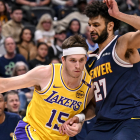
1. The Lakers boast the best defense we've seen in years
NBA teams have been held to 91 or fewer points 15 times so far this season. A full 20 percent of those defensive masterpieces were authored by the Lakers. They have not allowed more than 112 points in a game, meaning they have not allowed one of the 100 highest-scoring games of the season so far. They are allowing 96.5 points per 100 possessions so far. No team in the past 15 years has done that over the full season.
Overreaction Scale (3 of 5): The Lakers are due for some slippage on defense. Opponents are making only 30 percent of their 3-point attempts against them. That is going to rise. They've also played a fairly easy schedule so far at least based on preseason projections, and while their opponents have been better than anticipated, the Lakers still have most of their hardest matchups ahead of them. Dwight Howard will be an injury risk all season. LeBron James turns 35 in December. Rajon Rondo playing any meaningful role will make this team worse defensively.
All of that said, the Lakers have been the best defense in the NBA for a reason. They have multiple All-Defensive team candidates, a coach with a terrific track record on that end of the floor, and a roster struggling enough offensively at the moment to need to fully commit to defense. The Lakers look like a strong bet to be this year's best defense, but we'll need to see how they hold up over more games to know where they'll land historically.
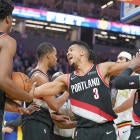
2. It's time for a Blazers reboot
The Blazers lost at home on Friday to a sub-.500 team despite Damian Lillard scoring 60 points. How high is the bar here? Does Portland need Lillard to score 70? Would 80 suffice? He'd better match Wilt and hit triple digits just to be safe.
As amazing as it sounds, there are teams out there that win games when their best players score that much. They're called NBA teams. Over the past 10 full seasons, teams are a combined 7-2 in games in which one of their players scores 60 points. The two losses came from the Charlotte Hornets, who lost Kemba Walker, and the Phoenix Suns, who looked like a lock to lose Devin Booker until Aron Baynes turned into Hakeem Olajuwon.
The basic message here is that teams that can't win when their best players score 60 probably shouldn't have those kinds of players at all. Portland is currently in 11th place in the Western Conference. There is not a small forward to be found on the roster. Zach Collins is going to miss four months. They have the NBA's worst defense at 116.7 points per 100 possessions over the past week. Lillard and CJ McCollum are in their prime. The rest of this roster decidedly is not. So let's break it up.
Overreaction Scale (2 of 5): It depends how seriously you take the term "reboot." Portland has been due for some sort of seismic change for years. It took a rigged bracket to get the Blazers to the Western Conference finals last year. The Blazers were swept out of the first round in the two prior seasons. The former is much closer to their baseline than the latter. Adding some team's reclamation project off of the bench, as has been their tendency since LaMarcus Aldridge left, is not going to repair this broken roster.
Trading CJ McCollum is the easiest fix, and probably the equilibrium of this reaction. Orlando is the most sensible partner given its surplus of defensive-minded forwards. Such a deal, likely built around Aaron Gordon, would make sense for both sides. Anfernee Simons looks ready to start.
This Blazers team probably could salvage some form of contention with a significant trade. They aren't in a position in which they need to consider dealing Lillard and starting from scratch. But this roster, as currently constructed, is no longer viable as a potential winner in the postseason. Something needs to be done.
3. Andrew Wiggins is a point guard now
Andrew Wiggins has been playing the wrong position for his entire career. I submit to you the following statistics:
- Wiggins' first five seasons as a forward: 19.4 points, 44 FG%, 4.3 rebounds, 2.2 assists
- Wiggins' first three games as a point guard: 31.67 points, 51.4 FG%, 3.75 rebounds, 6.0 assists
Wiggins has looked like a true No. 1 overall pick and franchise player with Jeff Teague out of the lineup, but the overall trend of involving him more has yielded positive results. Even before the point guard shift, Wiggins' usage in the early season had risen from 23.9 percent to 26.5 percent. He is making 52.3 percent of his 2-point attempts this season, a career-high by a wide margin.
Overreaction Scale (4 of 5): A good chunk of Wiggins' early-season success, point guard or otherwise, looks unsustainable on paper. Roughly the same percentage of his shots are coming at the rim this year as last year, though he is making slightly more of them. He is also taking slightly more 3-pointers, though at a nearly identical percentage.
The bulk of his improvement as a scorer has come through ridiculous mid-range shooting. Wiggins is taking far fewer mid-range shots, an encouraging trend overall, but he's shooting an absurd 46.2 percent on 2-pointers between 10-16 feet and 42.1 percent on 2-pointers longer than 16 feet. Those are prime Kobe Bryant numbers, and far above Wiggins' normal percentages. They are going to regress.
The playmaking, for now, appears to mostly be circumstantial. Wiggins had zero assists in three of his first six games. Perhaps a more ball-dominant role juices those numbers, but Wiggins has never been particularly interested in setting up teammates. Until he does so over a longer sample, expecting him to keep it up is unrealistic.
4. Eric Paschall is a serious Rookie of the Year candidate
Warriors rookie Eric Paschall finished Monday's win over the Portland Trail Blazers with 34 points and 13 assists. It was his seventh game in the NBA. Here is how many games it took last season's top five MVP finishers to post that exact statistical line:
Giannis Antetokounmpo: 309
James Harden: 569
Paul George: 550
Nikola Jokic: 217
Stephen Curry: 475
Typically, players haven't peaked by their seventh NBA game. Paschall is probably going to improve. If Golden State trades D'Angelo Russell after Dec. 15, this becomes the Paschall show, and in the scoring-based beauty pageant that the Rookie of the Year race tends to turn into, that will put Paschall in position to shoot his way past the field.
Zion Williamson hasn't played yet. Ja Morant is already load-managing. I'm not sure when Darius Garland plans to actually start making his shots. The competition isn't exactly fierce here.
Overreaction Scale (4 of 5): Remove Paschall's 35-point explosion, and he'd be averaging 14.1 points per game. That's good, especially for a second-round pick, but it's not Rookie of the Year-caliber. A Russell trade is hardly a certainty, so relying on increased volume is risky as well, especially if Curry returns this season. Paschall will also have to compete with confirmation bias. Voters expected Williamson and Morant to be good. That makes them likelier to view their success as sustainable and vote for them. Paschall's success could be viewed as circumstantial and fluky.
But Paschall definitely does still have room to grow. He shot over 35 percent from behind the arc in his last two collegiate seasons, but has barely taken any 3-pointers this season. He's making 31.6 percent of his limited attempts. If he adds even a league-average long-range jumper to what he's already doing, he could throw himself into the conversation in a much more meaningful way.
5. Triple-Doubles are easy now
Prior to 2016-17, no single NBA season had ever had more than 78 triple-doubles. Over the last three seasons, the league has averaged 117.3 per year and hasn't dipped below 108. Through the first 131 games of this season, we've seen 14 of them. That puts the league on pace for a new all-time high over 131.5. Luka Doncic, averaging 27.7 points, 10.8 rebounds and 9.1 assists, is making a legitimate push to become the second player in the past four seasons to average a triple-double for the season. Prior to Russell Westbrook, it hadn't been done since Oscar Robertson. From a historical standpoint, it has never been easier to post a triple-double.
Overreaction Scale (2 of 5): There are several possible explanations for this. Positionless basketball has put the ball in the hands of elite scorers more, which inflates their assist totals. As does improved spacing league-wide. More big men are intentionally boxing out rather than grabbing rebounds themselves knowing that allowing their perimeter players to get the board helps initiate fast breaks. The league is faster now than it has been in decades.
All of this has created an environment in which triple-doubles are relatively commonplace. The best players in the NBA are going to post at least a few every year, and averaging one, in itself, is no longer the statistical holy grail. It is never going to be easy to average or even produce a triple-double, but at the same time, they are more commonplace than ever, and there is little evidence to suggest that is going to change.