
That's Pretty Interesting: Nets give Kyrie Irving the kind of stage -- and freedom -- he's never had before
Brooklyn has put Irving in a new context, and he appears to be in his element

•
8 min read
NEW YORK -- Kyrie Irving probably isn't thrilled about the latest referendum on his personality, but on the court he is having a ball. In his first game for the Brooklyn Nets, he dropped 50 points, the most anyone has ever scored in a debut. In his second, he hit the game-winning 3, a similar shot to the legendary one he made in Game 7 of the 2016 Finals (albeit with exponentially smaller stakes). Through three games, he is averaging 37.7 points, 6.3 assists and 5.7 rebounds, and, in stark contrast to his demeanor for much of last season, he seems to be savoring every moment.
"Just a Jersey kid, playing for his home team, there's nothing like it," Irving said after the season opener. "This has been brewing since I was in fourth grade. I didn't know it was going to happen at this point or this age, but it's here and I just want to take full advantage of it and just be happy and just have a sense of gratitude every time I step on the floor wearing a Nets uniform."
When Irving and Kevin Durant signed with Brooklyn, the discussion centered around what this monumental event meant for the franchise. Landing them validated what the front office and coaching staff had been doing for three years. It rebuked the idea that the Nets were destined to exist in the New York Knicks' shadow. Even with Durant sidelined for the season, the presence of Irving put them in a different place. It was immediately obvious that there would be more nationally televised games, more pressure to make progress and more excitement at Barclays Center, with more fans shelling out more money for the chance to see him do something unforgettable.
Less attention, however, was paid to how Brooklyn might help Irving, a 27-year-old star who has, on two different championship contenders, grown dissatisfied with his situation and moved on. Before his arrival, the Nets coaxed breakouts out of three guards: D'Angelo Russell refurbished his reputation, made the All-Star Game and left with a max contract; Spencer Dinwiddie emerged from the scrap heap to put up star-like numbers in isolation; Caris LeVert recovered from two serious injuries and carved up an elite defense in the playoffs. In retrospect, if Brooklyn is something of a Shangri-La for emerging playmakers, we should have been wondering what kind of dreamland it could be for one of the most gifted creators in the game.
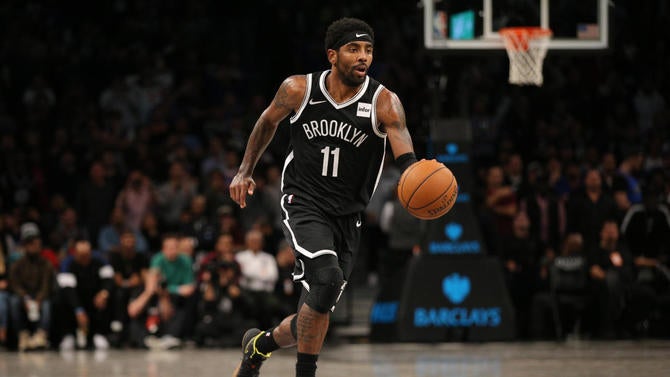
More than any other team he's ever played for, Brooklyn has given Irving a stage to run the team on his terms. At virtually all times, he has played next to three shooters and a screen-setting center, with no confusion over who is The Guy. Early in his career, the Cleveland Cavaliers didn't have the talent to maximize his gifts. Playing next to LeBron James, he had the usage rate of a No. 1 option but the whole world knew James was in control. Irving was the Boston Celtics' primary playmaker, but they liked to run offense through Al Horford and, well, let's just say there was some tension about how they should operate last season.
Brooklyn has other ballhandlers, but not nearly as many as Boston did. It has been a pick-and-roll-heavy team for the entirety of coach Kenny Atkinson's tenure, and there is something elegant about the simplicity of giving Irving the keys to this particular car.
"It's a pistol-based system," Dinwiddie said, and, relative to the shift that is coming when Durant is healthy, the Nets have hardly had to change anything. In simplistic terms, they have merely swapped "one high-usage guy" -- Russell -- "for another high-usage guy," he said.
Last October, Atkinson described his goal on offense to the New York Post as "ultimate optimal spacing." The Nets want to take a lot of 3s, and they want to put pressure on opponents' interior defense with their drives. They never play two traditional bigs together, and late in the fourth quarter against the Memphis Grizzlies on Sunday they played the 6-foot-7 Taurean Prince at "center" next to Irving, Dinwiddie, LeVert and 6-foot-6 sharpshooter Joe Harris. Actual center DeAndre Jordan is adjusting to running wide in transition rather than going to the front of the rim, saying that he likes it because "it kind of makes me feel like a guard for like three seconds."
All of this adds up to a structure that is "point guard-oriented," in Atkinson's words. In a way, it is what Irving thought he would get when he agreed to an extension with the Cavaliers right before LeBron changed everything. The result is pure, unadulterated Kyrie, a ball-dominant wizard playing with freedom and flair.
"I mean, you give this man the rock, you expect he's gonna do good things," Dinwiddie said. "He's been doing it for a minute now. I didn't call 50; I called 40, though. I told everybody. I was like, 'First game, he's gonna have 40.' But I also said dark-horse MVP candidate before the year. Y'all looked at me like, 'What?' I was like, 'Hey guys, you know K.D.'s not coming back, right?'"
If you are a Serious Analyst, then you probably have some issues with the Nets, who lost the opener largely because they were roasted by the Wolves' bench in the first half and really shouldn't have needed a game-winner to beat the Knicks or put themselves in a situation where Memphis' Jae Crowder could break their hearts at the buzzer in overtime. How concerning is their early-season defense? Can Dinwiddie and LeVert be the best versions of themselves next to Irving? In the long run, would it be better if Irving spent more time off the ball? These are all relevant questions.
For maximum entertainment value, though, I suggest that you remove your analyst hat and enjoy the show. This is a chance to see Irving completely in his element, in a system where playing his game is the whole point. When Durant is healthy, this Irving-centric version of the team will be gone. Catch it while you can.
Adjustments aplenty
This is the most confusing time of year in the NBA, and everything is extra wacky because of the extreme amount of roster turnover. Before their 105-98 loss to the Knicks on Monday -- the Bobby Portis revenge game! -- Chicago Bulls coach Jim Boylen casually dropped a stat that you can easily confirm on the league's official website: Last season, 320 players logged 750 minutes or more.
"Forty percent of those guys are with a new team," he said. "That's unheard of."
Five years ago, Boylen was an assistant coach for a San Antonio Spurs team that had brought back 14 of 15 players. This season, he pointed out, the average team is integrating about six new players. Each of them has to adjust to his new surroundings, and almost nobody makes as seamless a transition as Irving. The experience of Bulls forward Thaddeus Young is far more typical.
Young, 31, signed a three-year deal with Chicago in July, and since getting there he has been trying to adjust to the team's way of doing things, rather than the other way around. For the first time since the 2011-12 season, save for an eight-game stretch after a midseason trade in 2015, Young is coming off the bench. His minutes have dropped, but the more drastic change is how Boylen is using him.
Throughout his 12-year career, Young has had a complicated relationship with the 3-point line. Aside from his season with the Process Sixers, though, he has either avoided 3s or only shot them occasionally. Boylen, like Brett Brown, wants him to fire away every time he is open.
"I mean, shit, the last three years, playing with Indiana, I was kind of like the guy who would do everything else," Young said. "You had Myles [Turner], who would step out and shoot the jumpers, you had Vic [Oladipo] shooting jumpers, you had D.C. [Darren Collison] able to make shots, you had Cory [Joseph] out there, Bogie [Bojan Bogdanovic] for sure shooting the shit out of the ball. I'm the guy that's in the middle who's making the passes, making the reads, playing on the baseline, getting dump-offs. It's a completely different game now, where I'm spaced a lot now. And so I have to be ready to shoot. I have to be ready and comfortable to go out there and play on that wing."
Young is known as a do-it-all type. What those players actually do, though, often depends on what their teams need. Coaches, players and analysts talk a lot about "figuring things out," which sometimes sounds like a nebulous, collective act of chemistry-building. A lot of it, though, is simply about individuals working their way through an unavoidable adjustment period. To help his new team come together, Young is retraining his mind so he can instinctively play differently than he did on his previous one.
Excellent commentary, Part I
I have no interest in living in a world devoid of Jake Layman puns. Thank you, Eric Collins.
Excellent commentary, Part II
No broadcaster has more fun at work than Jack Armstrong. I have no idea how Matt Devlin delivered this soccer promo with Jack sitting right next to him and yelling:
10 more stray thoughts: I admit I was skeptical of the Tyler Herro hype, but now I have to surrender -- how can anyone not love watching this guy? … It is cruel that Kevon Looney has been taken away from us right after he hit a 3 … Shoutout to Solomon Hill in general and for this pass in particular … Mike Conley has been through so much worse than a shooting slump … Imagine how deep the Clippers will be if Patrick Patterson holds up … I hate that Zion is injured but I love what it's meant for Brandon Ingram, who I never thought I'd see playing nominal center while Jrue Holiday gets stops against a 7-foot-3 guy … What's more impressive, R.J. Barrett getting to the rim like this despite a cramped floor or Ja Morant dueling with Irving? … I knew Jayson Tatum had struggled to finish in his first few games, but I didn't realize that he was shooting 1-for-18 from midrange, too … Who saw Jevon Carter coming? … A guy who might make a difference in the Eastern Conference Finals: Pat Connaughton.