'The Last Dance' didn't prove Michael Jordan is the GOAT, but it did confirm the power of nostalgia
There are a lot of layers to this discussion, and the documentary really only addressed one of them

By
Brad Botkin
•
6 min read
It's hard to put into words what "The Last Dance" represented for those of us who grew up on Michael Jordan, or really for anyone who followed or covered him through his prime, because it's hard to put into words what that experience was like in the first place. This was before social media. Before athletes had pulled back the curtain on their mortality, exposing themselves as actual flawed human beings. From the mid-to-late 1980s through the better part of the '90s, the Chicago Bulls superstar was something more than human.
This documentary reminded us what that looked like.
What it felt like.
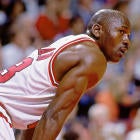
In my lifetime, no athlete has ever captured the world's collective imagination quite like Michael Jordan. It was the basketball, yes. But it was also him. The way he moved. The way he talked. The way he looked with that bald head in those $5,000 suits and black sunglasses. Our attention turned to him like flowers to the sun. You couldn't look away.
When you have that kind of image of a man -- of your own youth in many ways -- resting in the back of your head, and then a series like this comes along and spends five weeks turning those faded memories back into color, the nostalgia becomes like a drug intoxicating your perspective. If you're Shaquille O'Neal, you tell the New York Post that this documentary "cements and dispels the conversation about having anybody else named the greatest player ever."
Shaq isn't the only one saying things like this, of course. Jordan's former agent, David Falk, said you would have to be "legally blind" to watch this doc and not conclude Jordan was the greatest ever. The Jordan romance this doc has created has everyone falling in love all over again. But let's take a step back and ask ourselves: What beyond-a-reasonable-doubt evidence did this series really provide that we haven't seen before?
You didn't need to watch this documentary to know Jordan went 6-0 in the Finals, or that he hit a handful of iconic shots, or that he defied gravity while palming the ball like a cantaloupe, or that he was a borderline psychotic competitor who bent opponents and teammates to his indomitable will, or that he endured a brand of basketball physicality modern stars know nothing about.
For people who grew up on his career, that stuff was all true six weeks ago.
For people who didn't, there are still other layers to this conversation.
And it's those other layers that this documentary spent exactly zero time addressing. For instance, for all the tough-guy talk about the apparently nightly decapitations Jordan narrowly avoided at the hands of the "Bad Boys" Pistons, there was no mention of the fact that his main defender on those Detroit teams was Joe Dumars, who for all his defensive virtues still stood only 6-foot-3.
Without realizing it, this documentary actually made a case against Jordan as the GOAT by showing him doing a lot of his damage on guys like Craig Ehlo, end-of-his-career Byron Scott, good-but-not-great Dan Majerle and Bryon Russell, among other relatively pedestrian foes. The series actually highlighted, in all seriousness, Jordan "dominating" B.J. Armstrong as evidence that he could flip a lethal switch any time someone challenged him.
Later, the series, and Jordan himself, tried to make a clown out of Gary Payton for the nerve to suggest his defense had an impact on M.J. in the 1996 Finals, but the truth is Payton gets the last laugh. Realistically, he comes out looking like the only elite individual defender Jordan faced in any of his six Finals, and he largely held Jordan to 36 percent shooting.
I'm not saying Jordan picked on a bunch of weaklings. I'm just saying, if you did want to make a case for LeBron James as the GOAT, you could pretty easily start with the level of competition. Jordan never, ever, faced a team in the Finals even close to that 73-win Warriors team, and he certainly never faced one as great as that team became once it added Kevin Durant. Even those Spurs teams LeBron played when he was with the Miami Heat were pretty objectively better than any team Jordan faced.
You can only rely on the "physicality" argument for so long before you have to ask yourself: If we all assume Jordan would have been able to adjust to the modern era by figuring out more perplexing defensive coverages, beating more athletic opponents and improving as a volume 3-point shooter, why can we not make the same assumption that LeBron, a 6-9, 260-pound tank of a human, would've adjusted just fine to, and perhaps even benefited from, the physicality of the '80s and '90s?
That goes both ways, too. Jordan was celebrated for being a two-way superstar, and he was, as evidenced by his nine First-Team All-Defense selections. But all that physicality M.J. was having to score against? He got to use his hands, too. Try being LeBron and having to defend prime Kevin Durant and, at times, Stephen Curry without being able to touch them.
Again, this doesn't mean I think LeBron is better than Jordan.
It just means there are cases the documentary doesn't even open, let alone close.
I'm using LeBron as my example because I think he's the only player other than Jordan with a true GOAT argument, but that could just be my bias having watched LeBron's entire career. I never saw Wilt or Kareem play. I'm biased against perimeter players who can't shoot, so Magic Johnson would never be my GOAT. That's just me.
Everyone has their own criteria, and all I'm saying is this documentary didn't present anything other than the same criteria Jordan advocates have been leaning on all along. He never lost in the Finals. He played in a more physical era. He would never join up with his competitors to form a superteam.
To that last point, Jordan lawyers love to make the rules argument, notably the aforementioned defensive rules that forced Jordan to play through contact. But when was the last time you heard about the max-salary rules back then that perhaps kept Jordan's elite counterparts from joining up against him? If Jordan played four of his six Finals against, say, Reggie Miller, Charles Barkley and Patrick Ewing all on the same team, would he still be undefeated? I don't know the answer to that. But I do know it's a real question.
I also know the documentary didn't make a single mention of the illegal-defense rules of Jordan's day, which didn't allow for half help, meaning defenders couldn't just sag off bad shooters and crowd Jordan's driving lanes. In the '90s, defenders either had to commit to a full, easily detectable double team, or they had to stay with their guy and let Jordan play one-on-one. Reading where the help is coming from is objectively more difficult for a modern scorer.
In other words, some of the old rules worked against Jordan.
But some of them worked in his favor, too.
None of this is to say Jordan isn't the GOAT. I think I fall in the same category as most people when I say if I had to pick one guy to win me a game with my life on the line, I'd take Jordan. But I knew that six weeks ago. This documentary didn't prove anything to me I didn't already believe, and it didn't answer any of the questions I still have. It merely escorted me down memory lane, where the nostalgia is thick enough to cover everything and everyone else.