As Aaron Rodgers closes in on Brett Favre's career TD mark, has he fully surpassed his Green Bay predecessor?
Making the call between two icons as Rodgers closes in on Favre's spot on the NFL's all-time TDs list

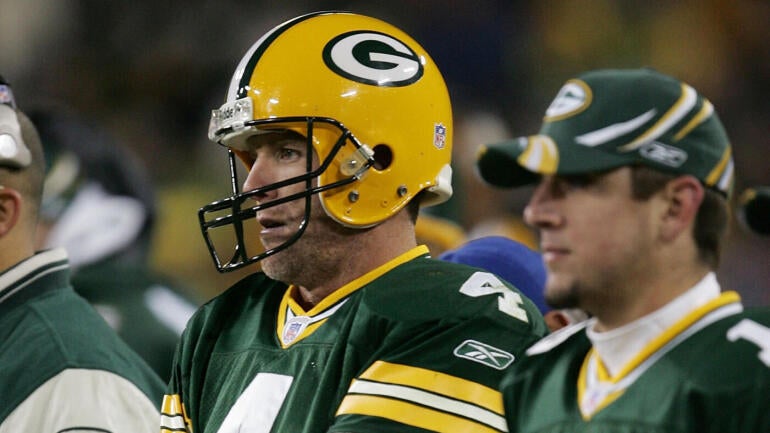
Brett Favre and Aaron Rodgers will forever be a pivotal part of each other's football journey. Rodgers, after all, succeeded Favre as Green Bay's franchise quarterback and continued the Packers' iconic run of greatness at the most important position in sports. Bart Starr started that legacy in the 1960s, before Favre and Rodgers continued it decades later, and passed the torch to Jordan Love.
That's why Favre came up throughout Week 1's CBS broadcast of Rodgers' first victory as the Pittsburgh Steelers' quarterback, a 34-32 win over the New York Jets. Along with throwing four touchdowns in leading Pittsburgh to a season-opening triumph against one of his former teams, Rodgers came within one touchdown pass of tying Favre's 508 on the NFL's all-time list. If he throws two against the Seahawks on Sunday, he'd be the solo occupant of the No. 4 spot (Peyton Manning, Drew Brees and Tom Brady would be the next targets, with Manning the only realistic target this season).
With Rodgers at 507 and about to pass Favre in the record book, fellow CBS Sports NFL writer Garrett Podell and I debated which quarterback has had the better career. I made Favre's argument while Garrett presented Rodgers' case.
We split our debate into five parts: career stats, individual milestones and awards, prime seasons, greatest moments and overall legacy. While it wasn't easy, we ultimately came to an agreement on which quarterback has had the better career.
Favre vs. Rodgers: Tale of the tape
| Brett Favre | Aaron Rodgers | |
|---|---|---|
Seasons played | 20 | 21 |
| Games Started | 298 | 242 |
Career passing yards | 71,838 | 63,196 |
| Career TD passes | 508 | 507 |
| Career interceptions | 336** | 116 |
| TD-INT ratio | 1.51 | 4.37** |
Career completion % | 62% | 65.1% |
Career passer rating | 86.0 | 102.8** |
Pro Bowls | 11 | 10 |
All Pros | 3 | 4 |
League MVPs | 3 | 4 |
Super Bowl MVPs | 0 | 1 |
Super Bowl appearances | 2 | 1 |
| Super Bowl wins | 1 | 1 |
-- ** NFL record
Career stats
DeArdo: It's hard not to go with Rodgers here, although Favre still has him by a considerable margin in terms of career passing yards, which is even more impressive when you consider that Favre played in a more run-heavy era when quarterbacks weren't protected nearly as much.
In fact, Favre held the NFL record for career passing yards at the time of his January 2011 retirement. He is still fourth in that category and three spots before Rodgers, who will likely surpass Philip Rivers and for the No. 6 spot over the next week or two, barring an injury.
Favre also retired as the NFL's career leader in touchdown passes and has since been passed by Tom Brady, Drew Brees and Peyton Manning. Favre still has the NFL record for career picks, though, a record that probably won't be broken anytime soon.
Podell: Rodgers is the most efficient quarterback in NFL history. He possesses the all-time record for career passer rating (102.8) and touchdown-to-interception ratio (4.37, 507 passing touchdowns to 116 interceptions). Rodgers' TD-INT ratio record may never be broken.
Rodgers has five seasons with more than 4,000 passing yards and five or fewer interceptions in his career (2014, 2018, 2019, 2020, 2021) while the rest of NFL history has five such seasons combined. Meanwhile, Favre's career interceptions record will likely never be broken.
Winner: Rodgers
Individual milestones/awards
DeArdo: Favre was the first NFL player to win three consecutive league MVP awards, doing so from 1995-97. Favre was not the MVP of the Packers' Super Bowl XXXI win over the Patriots, although he did deliver a performance that was certainly MVP worthy. He threw two touchdowns and ran for another score against a Bill Parcells/Bill Belichick-led Patriots defense.
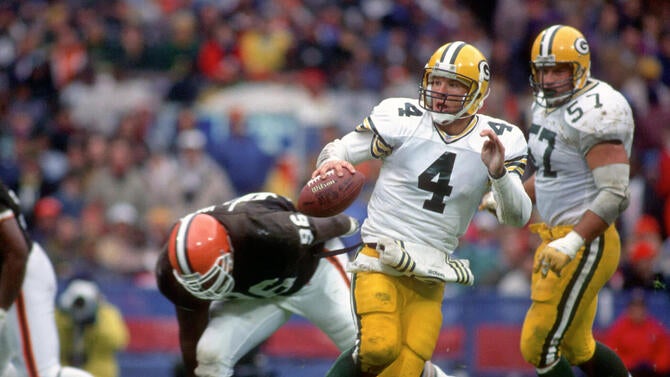
One honor that strengthens Favre's argument is his inclusion on the NFL 100th Anniversary All-Time Team. He was one of just 10 quarterbacks that made the cut. Favre is also a member of the Pro Football Hall of Fame, an honor that Rodgers will also receive as soon as he is eligible.
Podell: There are only two players in NFL history with at least four NFL MVPs and a Super Bowl MVP to their name: Rodgers and Manning. That's the list. Rodgers will be on the league's next major anniversary team. When the NFL 100th Anniversary All-Time Team released as the 2019 season kicked off, Rodgers hadn't yet helped the Packers, from 2019-2021, become the first team in NFL history to win at least 13 games in three consecutive seasons while winning consecutive league MVP awards in 2020 and 2021 to run his career total to four.
Winner: Rodgers
Prime seasons
DeArdo: This was, by far, the toughest category to decipher a winner. What gives Favre the edge, for me, is his unmatched four-year run of success from 1995-98. During that stretch, Favre won three straight league MVPs, led the NFL in touchdown passes for three straight years and paced the league in passing yards twice. The consensus then had Favre as, undeniably, football's best player.
The Packers also won a Super Bowl, appeared in a second and advanced to three consecutive NFC title games over that span. It took a missed Jerry Rice fumble by the officials and an incredible touchdown pass from Steve Young to Terrell Owens in the 1998 playoffs to end the Packers' two-year reign as the NFC's best team.
Podell: Favre's prime was historic, becoming the only player to win three consecutive league MVPs. However, Rodgers' career has two primes with a real argument that the second one was just as good as the first. From 2010-16, Rodgers' age-27-to-33 seasons, he led the Super Bowl XLV title while winning the game's MVP. Following that year, in the 2011 season, he powered the Packers to a 15-1 record while setting the NFL's single-season passer rating (122.5), throwing 45 touchdowns to just six interceptions. He produced a second NFL MVP campaign in 2014, which ended in the 2014 NFC Championship Game, and he powered an injury-plagued Green Bay squad to the 2016 NFC Championship Game by leading the league with 40 touchdown passes.
Fast forward to 2019 when the Packers hired current coach Matt LaFleur. He and Rodgers melded their offensive philosophies to power the Packers to three consecutive 13-win campaigns in league history. Rodgers collected two more MVPs in that run, leading the league in a number of passing statistics. Green Bay appeared in two more NFC title games in this span, narrowly missing out on a second Super Bowl appearance in the 2020 postseason after losing to the Tampa Bay Buccaneers.
Winner: Split decision
Greatest moments
DeArdo: Favre had a slew of unforgettable moments during his career. Among them were his game-winning touchdown pass to Sterling Sharpe in the 1993 playoffs against the Lions and his two successful audibles that led to two big touchdown passes -- and an iconic celebration from Favre -- against the Patriots in Super Bowl XXXI. You also can't forget about Favre's surreal return to Green Bay in 2009 as a member of the Vikings, when he threw four touchdowns while leading rival Minnesota to victory.
Favre's most memorable moment on the gridiron came Dec. 22, 2003, when he played arguably the greatest game of his career roughly 24 hours after his father unexpectedly died. It was a performance that transcended sports as the usual hostile Raiders fans showered the opposing quarterback with support before, during and after the game.
Podell: Rodgers' also has plenty of signature, all-time moments. Multiple 20-point comebacks in the regular season, multiple Hail Marys -- the Hail Mary King hitting two of them in the same drive to force overtime at the Arizona Cardinals in the 2015 NFC divisional round (Rodgers had the misfortune of never touching the football again after Green Bay lost the overtime coin toss).
Rodgers' laser of a throw to hit tight end Jared Cook with while facing a third-and-20 from his own 33 with 12 seconds in a 31-31 tie at the top-seeded Dallas Cowboys in the 2016 NFC divisional round haunts Dallas fans in their nightmares. That's the last time when Dallas felt like they could really win it all. Of course, Rodgers' greatest moment is carving up 2010 NFL Defensive Player of the Year Troy Polamalu and the Steelers' No. 1 scoring defense to the tune of 304 yards, three touchdowns and no interceptions on 24-of-39 passing (111.5 passer rating) to win Super Bowl XLV MVP and thwart Pittsburgh of capping another dynasty.
Winner: Favre
Overall on-field legacy
DeArdo: While he is one of the most prolific quarterbacks in NFL history, Favre's legacy as a football player goes well beyond stats. He is regarded as one of the league's toughest players ever, a title that is supported by his NFL record of 297 consecutive starts.
Brett Favre details 'scary' battle with Parkinson's, progression of disease after NFL career
Brad Crawford
Favre is also considered the NFL's ultimate gunslinger, which made him and whichever team that he played on must-see TV. Favre took chances that very few other quarterbacks were willing to take. Many times, Favre's guile led to breathtaking, eye-popping plays. It also, however, led to some inexcusable mistakes that still haunts some fans to this day.
For better or worse, Favre's cannon-like right arm and fearlessness with a football in his hands made him an immensely popular player during a time when the NFL's popularity continued to rise.
Podell: Favre deserves all the credit in the world for bringing championship caliber football back to Green Bay after Titletown went dormant following the Vince Lombardi-Bart Starr glory years of the 1960s: just two playoff appearances post-Lombardi through pre-Favre from 1968-91. However, Rodgers took what he learned from Favre and mastered the quarterback position, as evidenced by being the NFL's all-time passer rating (102.8) and touchdown-to-interception ratio (4.37) leader. He has one more NFL MVP and Super Bowl MVP and, when he passes Favre on the all-time passing touchdowns list with two more scoring strikes, Rodgers will have more touchdown passes than his Packers predecessor in roughly 50 fewer career starts.
As the cherry on top, seven-time Super Bowl champion quarterback Tom Brady called prime Rodgers "the greatest passer of the football the league's ever seen" earlier this month.
Winner: Rodgers