Colin Kaepernick may not be the right messenger, but his message matters
Kaepernick has guts, he sparked important conversations, and he has every right to do so

By
Bill Reiter
•
9 min read

Editor's note: Be sure to catch "Reiter Than You," which airs LIVE on CBSSports.com Tuesdays, Wednesdays and Fridays at 10:30 p.m. ET, starting next week.
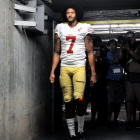
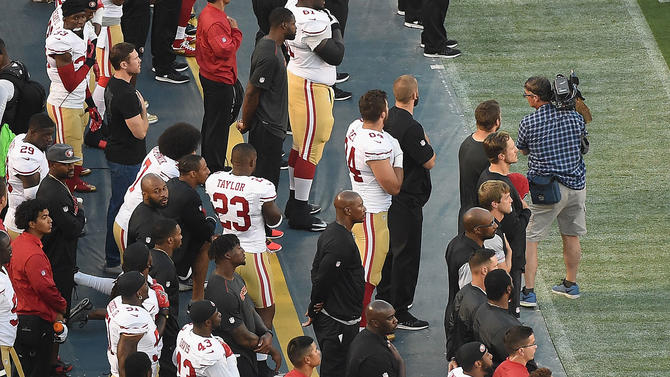
He didn't stand for the national anthem, again. In a military city on a night when his team's opponent, the San Diego Chargers, was saluting the armed forces for the 28th consecutive season. In recent weeks, knowing most of us would be watching, he donned socks equating cops to pigs.
And you know what?
Good for him.
That's what I felt after a week of thought, and after another day in which Colin Kaepernick turned his role as a quarterback in the NFL for the San Francisco 49ers into another platform for his special, divisive brand of protest.
Good for him.
This is a nuanced, tricky, tough topic. And we don't do nuance well, not often enough, certainly not on matters of race, nationalism and those hot-button issues that divide us. Not in America in 2016. We shout. We don't listen. And we're quick to hate.
So let's try, if we can, to start here: Let's not hate those who feel deep, deep offense at Kaepernick's decision. I don't agree with them, at least not entirely, but I respect and admire their perspective. And let's equally try not to slander Kaepernick, or those who mostly support him and his right to do what he's done -- including, certainly, me.
Look, I take no pleasure in watching someone sit during the national anthem, just as I'd take no pleasure in watching someone burn the American flag. And the cops-as-pigs socks were incendiary. But I do take deep satisfaction in being an American. It is a blessing and stroke of great luck to be citizens of this country. And one of the myriad reasons that's true is the right to burn that flag, to sit for that anthem, to talk kindly or with great rage about police brutality, to disagree on politics, and to have to tolerate free speech that makes our skin crawl.
Kaepernick may not be the right messenger. He may, or may not, be choosing this time to stand up because of the current status of his career means there's supposedly less to risk. It doesn't matter. He could be seeking attention, just as easily as he could be solely moved by having processed and watched one too many black men gunned down by officers and decided, Enough. Either way, his motivation is not the issue at hand. Messengers are often imperfect. It's the message that matters.
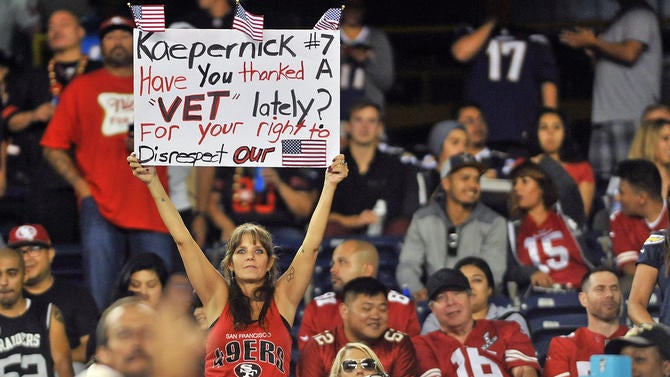
If you love America enough to get emotional during that anthem, you should be able to separate these things. It's our rights that make us great, not the symbols of those rights, or the people who happen to call attention to them. It's what our military defends that makes this the greatest country on earth, not the fact that our military is so powerful, or even heroic. Most men and women in war are heroic, brave, willing to sacrifice for their countries. It's what and who they're fighting for that matters.
It's the message, not the messenger, that counts. It's not even the way that message is delivered. It's the deeper truths behind it. Wearing socks to troll the cops? Distasteful. But protest, that works, sometimes has to be.
And Kaepernick's message is this: I believe this country does not protect black men, and I'm going to do something bold -- or outrageous, or ugly, or whatever it is -- that draws attention to that.
And the deeper truth might just be: It takes startling acts to, in ways incremental or monumental, affect real change.
If you really want to argue this country doesn't have an issue with how its police officers treat black men, then the national anthem is the least of your concerns. Not long ago, a relatively famous and influential person here in Los Angeles tried to tell me that all these black men being killed by police officers for, well, being black must have had it coming, must have mouthed off, must have offered some disrespect that sealed their fate. This is an influential person. Pointing out there was video, proof, the opposite was true had no effect. They must have had it coming.
If you share that same view, stop reading. Go away. You're not welcome here.
If you don't, please simply recognize that there really are some strong and ignorant forces out there that those who fear the police are trying to push past. And we can disagree on solutions while being on the same page about the problem.
There is understandable rage in the black community over their sons and fathers living in fear. Kaepernick and others like him are speaking -- rightly or wrongly -- to something deeply personal to them. There's a real issue here, and real anger. And that an athlete with money and fame and a comfortable life -- the American Dream -- would still care enough to act has real value.
A quick diversion, a story that may offer some perspective here: I'm white, I'm privileged, and but for a one-in-a-million stroke of bad luck I might see this topic differently. About a decade ago, on a gloomy December day coming back from covering a Nebraska football story in the Midwest, I hit a patch of black ice on an interstate highway, lost control of my car, spun several times, and T-boned a parked police car that had pulled to the side to help someone.
Glass exploded. The car crashed in on me. My lung punctured, I broke most of my ribs, and when the car stopped I was in the middle of that interstate. There was a lot of blood, and when I got through the shock and pain and took my bearings, I looked up to see ice falling, and cars coming over that ridge I'd just crossed. Many lost control, and veered past me. There were several close calls. I could barely breathe. Certain I was going to die, I reached for my phone -- it was on the floor -- to try and say goodbye to my wife. I couldn't reach it.
I found out later the officer whose car I'd hit on accident was hurt, though not as badly as I was. Then another officer arrived, and barley able to breathe I begged him for help. I felt incredible relief. He was there to protect me. He'd call an ambulance. He'd make it all right. He'd help. Instead, he told me I'd hit a cop. I was in pain and in shock, and I missed his anger, his contempt. I asked him again: Help me, please. His last words before walking away: "Go f--- yourself."
Needless to say, I lived. Medics arrived much later, pulled me from that car, saved my life, and accused that officer of nearly doing the opposite.
My point is this: I felt a deep, deep rage at the police for a long time. I felt unsafe around them. I understood that some people with badges can and will let you die. How many? No idea. I just know there's at least one of them out there, and we crossed paths at the wrong time. For a long time, I distrusted all of them. And this is despite having family members I love and respect who have been or still are in law enforcement; despite, earlier in my life, having covered police departments and seen real heroics, and met real heroes, with a badge.
But our life experiences shape us, and that, for me, was one. After that, long before the videos and the proof, when I heard stories of black men feeling like their lives were often in real jeopardy around cops, I thought, Of course that can be true. I've seen it, in another form.
It happened to me one time, once, in a lifetime. It doesn't even scratch the surface of what others can face all the time. It can happen to Kaepernick and other black men every time they leave the house, every time they run the risk of running into that one, bad cop.
So why wouldn't, as Colin Kaepernick watched video after video of black men being murdered by police, he feel the same? It is no secret that in the black community there comes a time when parents must have the talk with their children, particularly their sons, about police officers in this country and what it means to interact with them as a black American. Me? When my two kids asked me about police officers years ago I got to tell them, with insouciance and, yes, privilege, "that they help people." Seemed right. Is right, often. My kids, even today, see police sirens and squad cars rushing by and say, "They're going to help people!" But we now know that's not always true. The black community has known it longer.
So I'll say it again: Good for Kaepernick. He stood up. He made a choice. He had anger and a perspective shaped by his life and he reacted. Or overreacted. Or reacted badly. Either way, the national zeitgeist has turned to race, to national anthem and its origins, to Jackie Robinson and Muhammad Ali, to our military and their bravery, to the differences between wrapping yourself in the flag and engaging in the nuances of the greatest country on earth and whether they matter, on how we argue and how we disagree, on where sports do and should converge -- all topics we avoid too often.
I don't care if Kaepernick was the right messenger, or if his message was artfully or politely done. He had guts, he sparked important conversations, and he had every right to do so. And for good measure, on Thursday after the game, he offered to put up $1 million of his own earning this season to help spark change.
I respect if you disagree. We have family who serve, and have served. I love this country, and its flag. But my love for that flag exists because it represents rights and privileges few others have. Including the right to disrespect it.
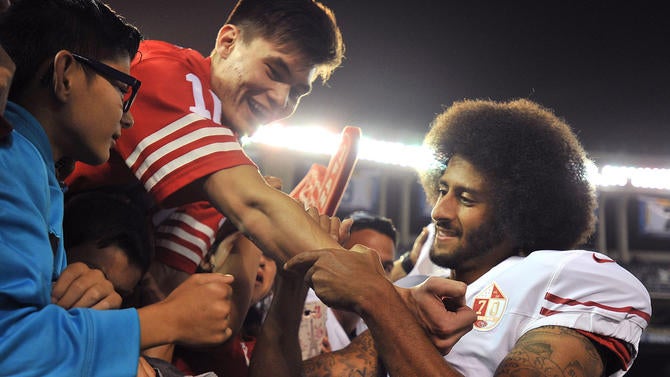
Colin Kaepernick plays in a league that has welcomed back players who have beaten their wives or girlfriends, beaten their sons, faced serious and legitimate accusations of rape, driven drunk, killed people while driving drunk, on and on it goes. And we want to use our moral outrage on this guy? Really?
Many friends and former colleagues I've argued with on television have sat across me and publicly pushed for second chances for all or most of these examples. They've asserted that in America you get second chances, that mistakes are made, that accusations aren't facts and that sins aren't unforgivable. Fine. Then apply that same logic to a player who has done nothing wrong in the true sense of the word -- nothing illegal, nothing hurtful, nothing evil, nothing that damaged another human being -- to fight for a cause he believes in.
He offended you? He offended a hallowed group? He did it as a form of protest over a topic that is heated, difficult, divisive, and ultimately too important to ignore?
What could be more American than that?