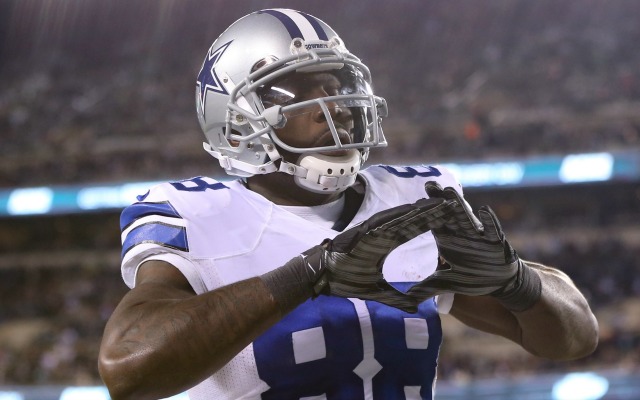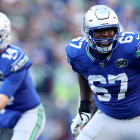

Dez Bryant on contract holdout: '13 Mil is cool' but where's my security?
Dez just wants what every unhappy franchise tag recipient has ever wanted: a long-term deal.

By
Jared Dubin
•
5 min read

Dez Bryant has revealed his reason for not signing the franchise tag and reporting to Cowboys mini-camp, and for anybody who has ever paid attention to how protracted contract negotiations have played out in the media, that reason should come as no surprise at all.
Everybody voicing opinions..13 mil is cool but Where is my security? I'll wait ...5 years without complaining..So how am I selfish? #family1
— Dez Bryant (@DezBryant) June 17, 2015
Dez's comments come in the wake of, and presumably in response to, his being called out by former Cowboys fullback Darryl "Moose" Johnston, who said on Tuesday that Bryant is being selfish and putting himself above the team.
Here's the thing: Bryant's reasoning for not having signed and reported is, essentially, the same reasoning that has been relied on by every unhappy franchise tag recepient since the invention of the franchise tag. It is not a new situation, nor is it even a unique situation in the NFL this year; the exact same thing is playing out in Denver with Broncos wide receiver Demaryius Thomas and in New York with Giants defensive end Jason Pierre-Paul.
What's frustrating for fans and observers is that Bryant and the Cowboys both profess to want the same thing: for Dez Bryant to play the rest of his career with a star on the side of his helmet. Bryant has said multiple times that he wants to retire as a member of the Cowboys, and Jerry Jones said as recently as Wednesday afternoon that he wants Dez to be a Cowboy for life.
The issue, as Jerry's son Stephen Jones said, is that nobody really knows what a long-term contract for a top-tier wide receiver such as Dez should look like under the new CBA.
“I'm not a good speculator, but I will say this is the tough side of our game -- the side that the fans don't probably love to talk about,” Jones said on SiriusXM NFL Radio, via the team's website. “But there is a business side of it, and we're doing what we can do, our goal ultimately being to sign Dez to a long-term contract -- and I know Dez would like to have one. But this is an environment right now with a receiver market that's not exactly easy to get your hands around.”
Specifically: Larry Fitzgerald and Calvin Johnson, the league's two highest-paid receivers, make north of $15 million per season -- and then there's everybody else.
“It's been well-documented that both Fitzgerald and Megatron both got their deals based on their rookie contracts because they were high draft picks and the franchise tag dictated that,” Jones continued. “But since then all receivers, the top ones, have pretty much been paid in the $11.5-12.5 million range, and there's a big disparity there.
“I don't think anyone quite knows what that market is, and that makes it difficult. I think once we figure out what that is, then there's a way for us to get something done with Dez. But until that happens, it's what teams think versus what players and their representatives think. There's a wide gap right now.”
As Jones said, Calvin Johnson set the market for Dez-like receivers back in 2012 with a seven-year, $113.45 million contract. The difference is that Calvin was coming off a rookie contract that paid him significantly more than players like Bryant, Thomas, A.J. Green or Julio Jones, who have joined Calvin in the top tier of receivers and are eligible for extensions this year or next.
Bryant and Thomas's franchise tags guarantee them $12.823 million this year, nearly $3.5 million less than the average annual value (AAV) of Johnson's contract. No other receiver has signed a contract with an AAV higher than Mike Wallace's $12 million in the three offseasons since Calvin signed.
Dez, obviously and rightly, feels his talent level is closer to that of Calvin Johnson than it is to Mike Wallace. He is inarguably correct.
Since he was drafted in 2010, nobody in football has more receiving touchdowns than Bryant's 56, and the only two players with more overall scores are Arian Foster and Marshawn Lynch. Despite ranking just 11th in targets, Dez led the NFL with 16 receiving touchdowns in 2014, three more than the next closest player.
He's raised his touchdown total in every season of his career has not accumulated fewer than 88 catches, 1,233 yards or 12 touchdowns in any of last three years. Only seven players in NFL history have hit or exceeded each of those three threshholds in a single season multiple times; Bryant has done it three times in a row. One more, and he ties Marvin Harrison and Jerry Rice. And he's only 26.
He's arguably the best wide receiver in football, Johnson included, and he wants to be paid that way. It makes sense, especially when you consider – as Bryant alluded to in the tweet above – that he was almost certainly significantly underpaid throughout his first five NFL seasons (though, it should be noted, that is simply the nature of rookie-scale contracts).
If he's franchised this year, next year and the year after that (the three-year guarantee is the number that is most relevant in NFL contracts), Dez would make a guaranteed total of $50.369 million due to the new escalating franchise tag rules, so there's no real incentive for him to accept a contract with a guarantee less than that amount. That guaranteed sum, though, is north of the guarantee Johnson received on his contract, which was $48.75 million.
But even if the Cowboys agree that Bryant is the NFL's best receiver (probable, all things considered), they're unlikely to pony up that much guaranteed cash because they've seen how wide receiver salaries have become depressed over the last few years, and they don't want to be the ones to set the new market for the Bryant-Thomas-Green-Jones class. They've also been burned by giving their own players massive new contracts before (ahem), particularly at the wide receiver position (though of those receivers, only Terrell Owens compares to Bryant in terms of sheer talent). Their position is also perfectly understandable.
That's how you wind up in a stand-off where neither side wants to blink first, where the sides are less than a month away from the July 15 extension deadline and haven't had substantive negotiations in months. And that's why the franchise tag exists. It allows teams and players to stay together on a year-to-year basis while they work out the kinks on a long-term deal.