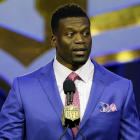

Man of the Year finalist Ben Watson has a message for divided America: Listen, learn
'We have a great opportunity to really bridge the gap through listening and learning,' Watson said

•
7 min read
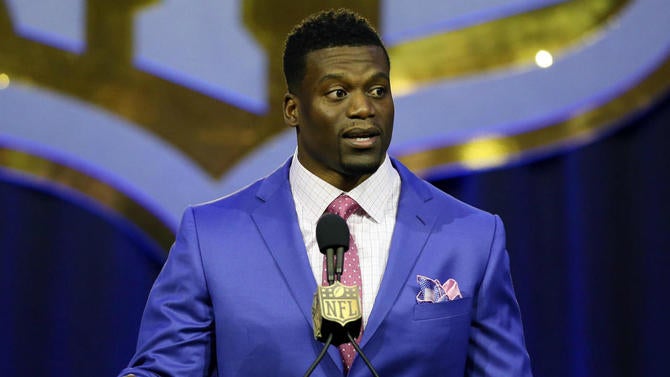
What may be the most quintessential moment of the 2017 NFL season happened far away from any stadium. It occurred, in fact, in complete obscurity, a private moment shared between one of the league's more celebrated activists and a Ravens fan reacting to the ongoing player movement of taking a knee during the playing of the national anthem.
Benjamin Watson, being honored by the NFL in Minneapolis this week as one of three finalists for the prestigious Walter Payton Man of the Year award, had just returned with the Baltimore Ravens from a starcrossed trip to London in Week 3. The Jaguars had destroyed the Ravens, 44-7, before an international audience, and back home in Baltimore some fans reacted with scorn after a host of Ravens kneeled at Wembley Stadium before the game during "The Star Spangled Banner" in the aftermath of president Donald Trump attacking protesting players in public remarks.
"Wouldn't you love to see one of these NFL owners, when somebody disrespects our flag, to say, 'Get that son of a bitch off the field right now," Trump said. "Out. He's fired. He's fired."
Tensions were at their highest in a season that will long be remembered for the president and vice president politicizing player protests, and for Colin Kaepernick failing to secure a single workout -- let alone a contract offer. Ravens officials, in the face of diminished attendance during their playoff chase, would later point to that scene in London as one of the reasons so many ticket holders opted to stay away.
Shortly after flying back across the Atlantic, Watson was leaving the team's facility when he saw a man planting flags outside the headquarters. Watson, who has been honored for his outreach work both around the United States and abroad, felt compelled to pull his car over and stop.
"I got out of the car, and I don't know what he was thinking at that point, but I got out of my car and asked him what he was doing," Watson told me during a wide-ranging chat on The B-More Opinionated Podcast. "And he said he was planting these flags here because this organization and these people needed to respect America, and he kind of just told me how he felt.
"And I told him that I was a player, and that I was in London, and I told him that many of the guys in that locker room are some of the most patriotic people that I know, and the reason they did what they did wasn't an attack on America or on veterans or anything like that, it was just their way of expressing themselves. And although we left the conversation really not agreeing on the method, there was an understanding there, and there was a respect there. And that guy can go and tell his kids, 'Hey, I met a football player, and although I thought they were all this way, he was really this way.'
"And I think that one of the most important things we can learn from this whole time we've had over the last two years is how to engage with each other, and to understand where we're coming from."
Watson has taken a cerebral and holistic approach to his community work and outreach, whether it be writing an essay in the aftermath of the Freddie Gray uprising in Baltimore or writing a book about the police-shooting events that led to similar events in Ferguson, Missouri. He is generally moved and enthused to help others, and is a Walter Payton finalist for the second time in three years. He's looking forward to this week in the Super Bowl city, engaged in community work there and getting to spend time with the other finalists -- Greg Olsen and J.J. Watt -- as well as Payton's family.
Watson's "One More Foundation" has become entrenched in Baltimore in just two years with the Ravens (including a 2016 season he spent rehabbing from a torn Achilles). In the past year, the tight end's travels to the Dominican Republic led to him partnering with an anti-slavery organization there, and he met with Syrian refugees in Lebanon, where he aimed to better understand the Middle East refugee crisis.
After 14 years in the NFL -- entering the league originally as a first-round pick of the Patriots in 2004 -- Watson has continued to gain a greater appreciation for the world beyond football, and he's very much a man of this time. Never before have the worlds of politics and activism intertwined so deeply in this game, as the movement for social justice led to player/owner meetings and a $90 million leaguewide initiative "Let's Listen Together," which launched late in the season.
"This season was unique in that the issues of race of justice of patriotism, all of those things kind of got boiled up into a pot, and it really got hot, so to speak," Watson said. "There were times when there was a lot of hate going back and forth, and lot of things I've seen and read from people who don't know us personally, things that were said. But it also created a great opportunity, because conflict is going to happen in our lifetime, but really it's how we approach it and how we move on from it, and what we do in the midst of it that defines us.
"And when you look at the last two or three years and look at some players taking a knee during the national anthem and take a look at the reaction of some fans -- not all fans -- and take a look at the reactions of some veterans -- but not all veterans -- and look at police-citizen relations, I think we're at a point where we have a great opportunity to really bridge the gap through listening and learning from one another and being able to empathize with one another."
Watson is a father to five and comes from a large family himself. Speaking out for what he believes in and thinking beyond himself are virtues that were instilled in him at an early age. He believes it's important to impart that to his children as well. Service for others is at the heart of that.
"My parents had a huge role in that," Watson said. "I'm the oldest of six, and my father is a pastor in South Carolina and my mother stayed home with us most of our childhood. And we always addressed certain issues of the day and we always tried to do it from a place of understanding and of love, while also not compromising on truth. And that's one thing I learned from them was speaking the truth, but saying it with love, and that's one thing I've really kept with me. Especially in the times we're in, in a time of so many viewpoints on different issues, it's okay to disagree, but it's important how we disagree; we shouldn't ever be at a place where we are condemning one another or calling each other names and disrespecting each other's humanity simply because we differ on a political point."
The nexus of football and community service this week comes at a time of deep reflection for Watson, who at age 37 knows he has much to offer the world beyond the gridiron. He made a remarkable return from the Achilles tear to become one of the Ravens' most valuable and reliable pass catchers inn 2017. He led the team with 61 receptions, was second in receiving yards and tied for the team lead in receiving touchdowns, hitting the market as a free agent market off a bounceback year.
The Ravens have virtually no proven pass catchers under contract for 2018, and Watson remains in tremendous shape. It's hardly out of the question an opportunity might arise to continue contributing on the field, and it's possible as well that Watson – who could have an impactful second career as a writer, speaker, politician, lobbyist; whatever he set his mind to – may have already played his final game.
He seems at peace with the situation, regardless of the final outcome, and if this is the end than there is no better way to spend it than doing what he loves so much: reaching out to others via the avenues football has provided, trying to be a good role model for others, and sending time with some of the league's other most notable men for others this week.
The full interview with Watson can be heard online at the B-More Opinionated website and on iTunes.