Patriots-Ravens key matchup: Tom Brady vs. Baltimore's No. 2 pass rush
The Baltimore pass rush has a history of disrupting Brady's timing with his receivers.

By
Jared Dubin
•
5 min read
It's no secret that quarterbacks perform worse when under pressure from the opposing pass rush. You hear it on every NFL broadcast and every talking head pre-game show. Good as he is, Tom Brady is no different. He's obviously more than capable of making game-changing plays when hit or hurried -- he's Tom Brady, after all; but on the whole he's not nearly as effective throwing the ball while staring down rushers as he is when he has a clean pocket to throw from.
Pro Football Focus has broken down passes by "Under Pressure" and "No Pressure" for every season since 2007. Brady, obviously, has been active for all of those seasons, though he only threw 11 passes in 2008 when he was knocked out of the Pats' Week 1 game with an ACL tear.
(Note: the following "Under Pressure" numbers include both regular season and postseason games since 2007)
When throwing with a clean pocket, Brady has been unsurprisingly terrific, nearly impossible to stop. The numbers are incredible: 70.3 completion percentage, 8.10 yards per attempt, 222 touchdowns, 47 interceptions and a 110.1 passer rating. When under pressure, not so much. Since 2007, he's completed only 47.2 percent of his passes for 6.23 yards per attempt, with a still very good 46 to 31 touchdown to interception ratio, but only a 69.6 passer rating when pressured. That's like going from Aaron Rodgers to Kyle Boller.
Obviously, this is to be expected. Again, every quarterback gets worse when pressured. Over the last three years, though, the differences have become more pronounced, the equivalent of going from Rodgers-esque performance to that of, say, Heath Shuler.
| Brady Under Pressure | ||||||||
| Comp | Att | Comp % | Yards | YPA | TD | INT | QB Rating | |
| No Pressure | 1,028 | 1,502 | 68.4% | 11,633 | 7.75 | 84 | 16 | 105.6 |
| Under Pressure | 218 | 504 | 43.3% | 2,784 | 5.52 | 13 | 14 | 56.2 |
As Brady has gotten older, he's lost a tad of the superior pocket mobility he had in his late 20's and early 30's. He's still quite good at it (certainly better than most quarterbacks), but he's now more prone to throwing off his back foot or trying to get the ball out too quickly when he sees pressure in his face than he was before. Throwing off your back foot results in more interceptions (note the 14 picks under pressure in the last three years are nearly as many as the 17 he threw from 2007 through 2011), while trying to get the ball out too quickly before the rush hits home can drive down completion percentage and yards per attempt.
All of this brings us to Saturday's Patriots-Ravens game. Baltimore has one of the NFL's best pass rushes, with Terrell Suggs, Elvis Dumervil and Pernell McPhee having combined for 36.5 sacks -- more than 12 whole teams -- and the rest of the defense chipping in with 12.5 more. Those 49 sacks tied for second in the league, and they added an additional 83 quarterback hits and 186 hurries.
Last week against the Steelers, PFF credited the Ravens with having pressured Ben Roethlisberger on 25 of 54 passing plays, an absurd 46.3 percent pressure rate. Considering the Steelers ranked 16th total in sacks allowed, fourth in Football Outsiders' Adjusted Sack Rate and seventh in PFF's Pass Blocking Efficiency, that amounts to an incredibly dominant performance from Baltimore's rushers. It undoubtedly helped that they were able to tee off against the pass because of the absence of Le'Veon Bell, but it is dominant nonetheless. The New England offensive line will have their hands full with this bunch, especially if guys like Chris Canty, Haloti Ngata and Courtney Upshaw play the pass as well as they did last week.
Depending on what numbers you look at, the Pats this season were either one of the best pass-protection units in the league or merely an average one. They allowed only 26 sacks all year, fourth-fewest in the league. Football Outsiders credits New England's offensive line with a 4.6 percent Adjusted Sack Rate, tied with Seattle and Pittsburgh for fourth-best in the league and significantly better than the league average of 6.6 percent. Pro Football Focus, though, notes that New England allowed 52 quarterback hits (second-most in the NFL) and 108 hurries as well, giving New England only the 20th-best Pass Blocking Efficiency.
No matter which of those numbers you take as gospel, there's no doubting that Brady's worst games came when under heavy pressure. The two most notable games where Brady was constantly under fire were Week 1 against the Dolphins and Week 4 against the Chiefs, both of which New England lost. Brady was a combined 43-of-79 (54.4 percent) for 408 yards (5.16 per attempt), two touchdowns and two picks in those games. He was pressured on an amazing 37 of 93 passing plays in those games. That 39.8 percent pressure rate is significantly higher than the 25.6 percent rate New England allowed in its 14 other games this season.
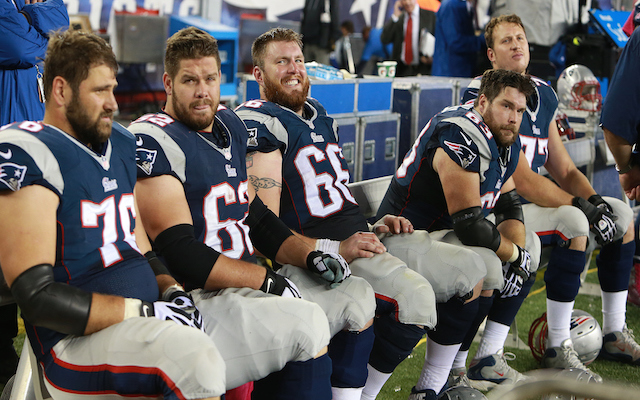
New England re-shuffled its offensive line multiple times early in the season, but they've settled on a Nate Solder - Dan Connolly - Bryan Stork - Ryan Wendell - Sebastian Vollmer grouping since around Week 8 or so. They'll sometimes bring in an additional lineman or two -- Cameron Fleming and/or Marcus Cannon -- to go with heavy sets for running plays, but the pass-blocking crew is those five guys for the most part. From Week 8 through Week 16 (New England used a bunch of subs for parts of the Week 17 game against Buffalo, and Josh Kline may have even moved ahead of Connolly at guard), that crew improved the Pats from 27th to 12th in Pass Blocking Efficiency, allowing pressure on 24.7 percent of pass plays as opposed to 31.0 percent in Weeks 1 through 7.
If they can keep Suggs, Dumervil, McPhee and the rest of the pass rush at bay and out of Brady's face, he can sit back and pick apart what's mostly been a below-average Ravens secondary thanks to injuries and ineffective play from backups and cast-offs. Rob Gronkowski is uncoverable when Brady has time to work him the ball over the middle, Brandon LaFell emerged as a dangerous new target for Brady at times this season, Shane Vereen is still a threat coming out of the backfield, and Julian Edelman should be able to take advantage of a defense that was vulnerable all year to passes to slot receivers, but all that depends on Brady having time to stand straight up and deliver the ball from a clean pocket.