Marta on women's soccer landscape after playing in World Cup with Brazil: 'The level is very high now'
The Brazil star and advocate for the women's game played at her sixth and final World Cup

•
3 min read
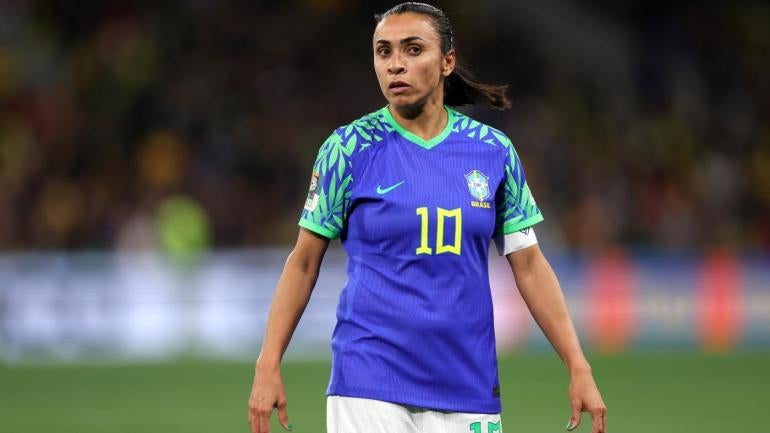
Brazil forward Marta confirmed what many people were saying long before this year's Women's World Cup began: it is, in fact, the most competitive edition of the tournament yet.
"This competition is like a box with so much surprise," Marta said on Wednesday after a training session with the NWSL's Orlando Pride. "[Women's] soccer has become so competitive."
One of the many surprises at this edition of the World Cup included early exits for high-ranked teams including the U.S. women's national team, Germany, and Marta's Brazil. The group stage elimination also meant her sixth and final World Cup ended earlier than expected, which Marta described as disappointing. True to form as an advocate for the women's game, though, she also said the results are indicative of a meaningful step in the right direction.
"It's positive because if you look in the past, every competition, the last teams, it was the same teams," she said. "We need to adapt to the moment now and just have more variation, improve more because you never know [what's] going to happen."
Marta's experience means she's had a front row seat to watch the evolution of women's soccer, and said the 2023 World Cup had a different on-field feel to it than any tournament before it.
"If we see the games, the games [were] open, never know who's going to win the game," she said. "Maybe you cheer for the strong team but in the end, the best team always did win. I think it was the most [competitive] because the level is very high now. We see many good players in different teams and it's amazing to see.
"You can see organized teams," she added. "They play together. It's not like one or two players in the teams and in the past, there was more, 'This player's going to finish this game.' Now you see more collective teams, so it's good. It's good to see."
Colombia, a first-time quarterfinalist and a regional rival for Brazil, exemplified that evolution in Marta's eyes.
"We had [the] chance to see a team [like] Colombia, how people didn't expect they should be one of the last teams to see in the competition," she said. "I was impressed about the technique, the organization in the team and when I saw that, I just feel like, 'Wow. Everything can happen.'"
The 37-year-old has also enjoyed the World Cup from the comfort of her own home despite efforts to disconnect. "Terrible" jet lag meant she was up at 3 a.m. to watch several matches, and though she thought Sweden would go all the way, she expects an entertaining final between Spain and England.
"When we take the flight back, I was cheering for Sweden," she said. "I was thinking they have the team to go to the final, to fight for the title. … Now it's another time, it's very, very high level so you never know. I'm not surprised about anything after that, but of course it's interesting. These two teams in the final, Spain and England, [it's] going to be a nice game."
Though Marta called time on her World Cup career, she is still carving out a place on the field in women's soccer's new landscape. The forward recently returned to training with the Pride, with a spot in the NWSL playoffs on the line, which she said helped "very much to disconnect from the World Cup and everything that happened there." She also has not ruled out playing for Brazil again.
"Soccer has been everything for me," she said. "I'm not going to play another World Cup but I [didn't] say I'm not going to play the next Olympics. I don't have the answer yet but I work on feeling, day by day, if I still have that power and can share with the team, with Brazil, and fight for a gold medal."