Sweden's Women's World Cup semifinals loss is the latest near miss for one of soccer's most consistent teams
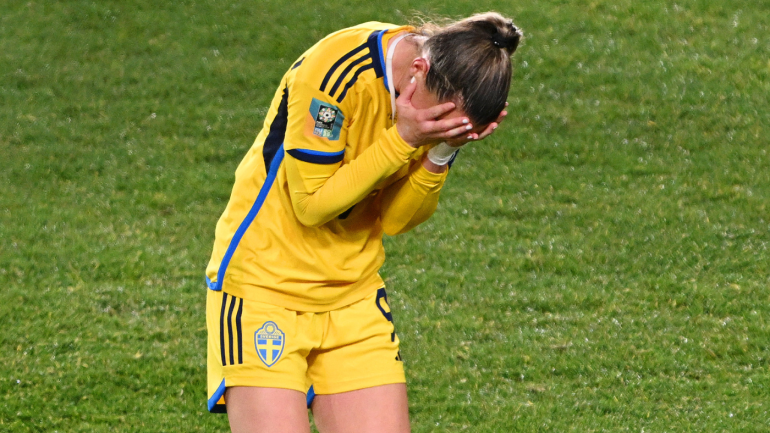
After another elimination star Kosovare Asllani summed it up saying, "I'm tired of crying big tournament tears"

•
3 min read
Though the champion will be new, Sunday's Women's World Cup final in Sydney will feature a few familiar sights, namely pictures of celebratory players hoisting a trophy with a bed of confetti at their feet. The moment they take their victory lap will be narrated by many heaping praise on the players and the team, and how their win makes a statement about the sport itself.
For the first time all tournament, there will be no other teams to see on the field. Their storylines will abruptly but unsurprisingly fade into the past, indicative of the sentiment that everything builds up to this singular moment of victory. That championships matter more than anything else is a harsh truth of sports; it's also an overly simplistic view of what happens on the field.
Take Sweden as an example. The team played in their fifth World Cup semifinal on Tuesday, and though they were the more experienced side, they eventually lost to a Spain team considered the favorites to advance to the final. It marked a fourth loss in the World Cup semifinals for Sweden, which elicited an emotional reaction from vice-captain Kosovare Asllani after the game: "I'm tired of crying big tournament tears."
Sweden's loss, though, completes a run that is impressive in its own right. The team played in back-to-back World Cup semifinals, played in the Women's Euro semifinal just a year ago, and picked up a silver medal at the Tokyo Olympics in 2021. They have arguably been one of the most consistent teams in women's soccer over the last four years, maintaining the high standard they've always boasted despite the opposition raising their game considerably.
Don't miss CBS Sports Golazo Network's Morning Footy, now in podcast form! Our crew brings you all the news, views, highlights and laughs you need to follow the Beautiful Game in every corner of the globe, every Monday-Friday all year long.
At this year's World Cup alone, Sweden were a well-coached side that showcased some tactical flexibility en route to the semifinals. The team put together a trio of attack-minded, complete performances in the group stage and were one of a few top teams that did not falter in the first round of the tournament. Sweden then reaped the rewards of goalkeeper Zecira Musovic's individual brilliance in the round of 16 win over the United States, which allowed the trip Down Under to serve as a breakout tournament for the new first-choice showstopper for her country. They also showed a world-class ability to score on set pieces, which afforded them chances in any given game regardless of the game state.
They impressed over the last four years with a golden generation, and this year's World Cup likely served as a last run for a handful of veterans including Asllani and captain Caroline Seger. Though the teams that beat Sweden en route to their championships over the last four years were all also deserving, it is cruel that a group as consistent as this one never had the chance to do a victory lap of their own.
Though Sweden will be absent on Sunday in Sydney, it is worth remembering that perhaps no one got closer to becoming top dogs in a new era for women's soccer than they did. It will no doubt be a challenge to maintain that standard as the quality gap closes rapidly in the women's game, but a crop of young players with experience making deep runs will aim to continue the team's legacy. Sweden's recent success, above all, proves they were the lone titan of the game that were up for the challenge at the most competitive Women's World Cup ever. It may not be a trophy, but it is not a feat that should be overlooked.