USWNT's Alyssa Naeher, Kristie Mewis aren't afraid of a narrowing gap at Women's World Cup: 'We want this'
The 2023 World Cup is expected to be the most competitive edition of the tournament yet

•
4 min read
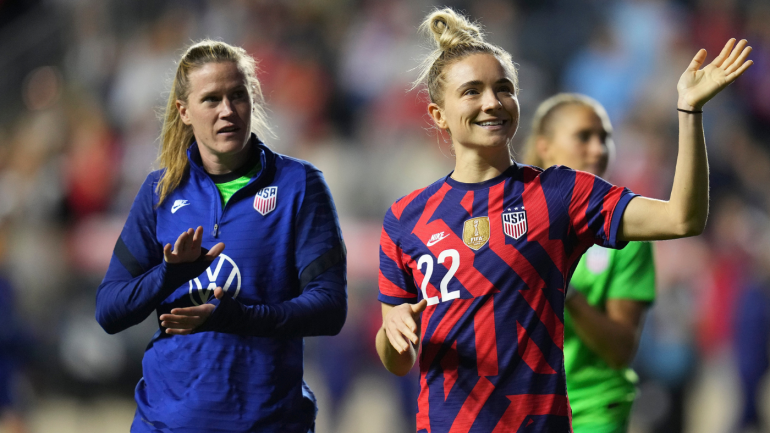
Winning the Women's World Cup may be harder than ever before considering the strides that women's soccer has made in the last four years, but the game's closing quality gap does not scare the U.S. women's national team as they chase an unprecedented three-peat.
"I think it's such a good thing," USWNT midfielder Kristie Mewis said Monday. "We want this. We want all women's teams to get better and better, and we want to get better and better."
Soccer federations around the world have increased investment into their women's national teams since the 2019 World Cup, especially after FIFA chose to expand the field from 24 to 32 teams for the 2023 edition. Mewis said that it speaks to the global rise of women's soccer and provides extra motivation for the reigning champions to maintain a high level of quality as they prepare for competition Down Under.
"I think that it's super special and such a time right now to be in women's sports and to be following women's sports, so it's a really, really good thing," the midfielder added. "We encourage it but we obviously still want to be the best. We're going to keep pushing the limit and everybody else can try to follow us."
The team will lean on its experience as perennial favorites to navigate the what will likely be most competitive tournament the USWNT has ever played in.
"This team, starting in 1985, set the standard way back when and each year, each World Cup, we have had the opportunity to build on the groundwork," goalkeeper Alyssa Naeher noted. "That's something that previous generations of players have started, and now it's our responsibility to continue that mindset and that mentality of the U.S. women's national team."
Naeher was the starting goalkeeper during the team's championship run in 2019 and attributed the team's success to "taking everything one game at a time," and believes that approach will be key as they aim to win the World Cup yet again.
The fight for equal investment
Federations are pumping more money into women's soccer than ever after noticing the rising popularity of the sport, but primarily because players around the world continue to be their own best advocates. The USWNT and several other teams head into this World Cup with equal pay agreements, but there's still plenty of room for improvement when it comes to providing equal support for the men's and women's games.
Several women's national teams spent the run up to this World Cup demanding equitable investment in a variety of ways. England used their platform as the Women's Euro champions to highlight funding discrepancies in youth sports, which resulted in the U.K. government allocating an additional £600 million for girls' programs. France, meanwhile, underwent a managerial change in March after Wendie Renard threatened to boycott the World Cup if ex-Corinne Diacre stayed in charge to preserve her mental health.
Many of these fights will likely continue after this year's tournament. Renard also said at the time that the federation's actions were "far from the requirements of the highest level," while Spain players sat out much of their World Cup prep to protest their governing body's lack of interest in the women's team. Canada also entered a labor dispute with their federation before the SheBelieves Cup over budget cuts, and struck a temporary agreement before the World Cup. Japan's SheBelieves Cup campaign, which was not available to watch to fans back home, also highlighted how the country's power players have stunted the sport's growth.
The USWNT's biggest competition
A handful of countries hope to end the USWNT's World Cup-winning streak, and Germany serves as one of the most likely contenders to do so. The two-time World Cup winners are rebounding nicely since a disappointing quarterfinal exit four years ago, and like the U.S. boast a mix of veterans like forward Alexandra Popp and rising stars such as midfielder Lena Oberdorf. The team showed off its potential at last year's Women's Euro, where it lost to hosts England in the final.
England also cannot be counted out after last year's European triumph, but will be without a handful of important players after they picked up injuries in the spring, including midfielder Leah Williamson and forward Beth Mead. The team still traveled to Australia with a strong squad that includes veteran defender Lucy Bronze and midfielder Keira Walsh, who's emerging as one of the best center midfielders.
Brazil is also making its strongest case yet to win the World Cup thanks to a talented attacking unit. Though Marta will return for her final World Cup, the team's star this time around is no doubt Debinha, who effortlessly couples impressive goalscoring ability with stylish play. Young forwards Kerolin and Gabi Nunes are expected to continue Brazil's reputation for attacking flair, and could enjoy a breakout tournament Down Under.
Co-host Australia can throw its hat into the ring with talent like Sam Kerr and Ellie Carpenter at their disposal, while Spain and France are also in the conversation, though each would have to overcome rocky conditions as they prepared for the tournament. Just three of the 15 Spain players who protested the federation this year return for the World Cup, and new France manager Herve Renard has only had three months to work with his new team.