Blake Sims: From unlikely QB to unquestioned leader for Alabama
Doubters have always been there for Alabama's Blake Sims. But with zero self-doubt and a little help from a QB school, the quarterback who waited his turn has the Tide rolling.

By
Jon Solomon
•
14 min read
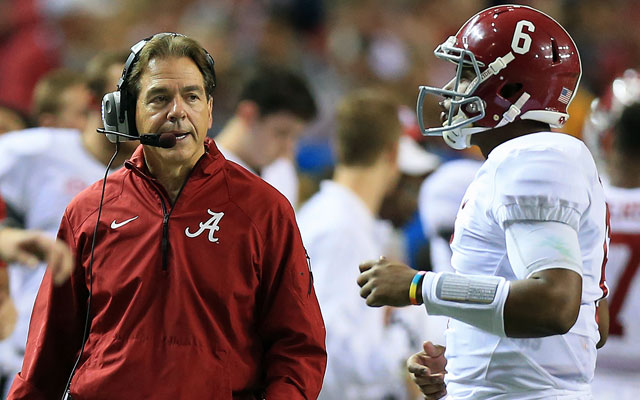
NEW ORLEANS -- Blake Sims wasn't supposed to be sitting at a Sugar Bowl podium this week. Jacob Coker, the transfer quarterback from Florida State, was pegged to lead Alabama into the first College Football Playoff.
Sonny Sims, Blake's father, and other family and friends worried for Blake due to Coker's high-profile presence. Blake acknowledged the talk about Coker motivated him. To most pundits and fans, the writing was on the wall: Coker would win the starting job and Sims would morph into the life of a fifth-year player who never seized his opportunity or ever got a real shot.
When Coker arrived in Tuscaloosa, Sonny peppered Blake with questions about the challenger. Could he throw? Is he better than you? Who's winning the competition? Blake wouldn't answer, telling his dad those issues stay internal at Alabama, just as Nick Saban's "process" demands.
"I don't think it rattled Blake, it rattled me and his family," Sonny said of Coker's transfer to Alabama. "I was upset. But Blake said, 'Dad, don't worry about it. That's what goes on. I've got to compete, I've got to be ready.' I used to kid him and say, 'Well, Coach Saban is your dad now?' Blake was right, I was wrong. Coach did a good job with Blake. Blake got processed."
A funny thing happened to conventional wisdom. Blake Sims turned it upside down, just as he set aside challenges throughout his life when his academics and quarterbacking abilities were questioned.
In his last chance to be a starter, Sims emerged as the leader of No. 1 Alabama as it heads into the national semifinals against No. 4 Ohio State. Sims not only led, he reinvented himself to become one of the nation's most-efficient passers with a school-record 3,250 yards and 26 touchdowns.
Until this season, Sims was considered a terrific athlete who often changed positions and threw 39 passes in four years. To outside observers, he might have been best known more for getting caught by TV cameras on the sideline gesturing to LSU fans after Alabama's winning touchdown in 2012.
But to people inside Alabama's football program, Sims was the superb teammate whose turn finally came.
"The maturation of Blake Sims has been something special to watch," said Alabama defensive coordinator Kirby Smart, who recruited Sims out of high school. "It will always be, wherever I'm a coach at, a speaking point to the team."
Motivated to be more than a scout-team player and a footnote in Crimson Tide history, Sims ranks seventh nationally in passing efficiency and fourth in yards per pass. He hasn't always been perfect, but nothing about Sims' story was ever rooted in perfection.
"It's kind of refreshing," said Ken Mastrole, Sims' personal quarterback coach. "The way people look at Blake and their own situations, people want to root for the underdog. He's the working-class type guy. People who are putting in those long hours maybe get a glimpse of hope they may move up. He embodies that."
In today's college football universe, Sims is an anomaly. How many four-star players toil behind a former star quarterback (AJ McCarron), get used sparingly at running back, and don't throw in the towel and transfer?
Sonny Sims wanted Blake to transfer after his sophomore year. By his own admission, Sonny has been overbearing at times about Blake's career. The father and son disagreed about Blake's future.
"There were a couple schools I thought were a better fit for Blake, Auburn being one of them," Sonny said. "You teach a kid not to quit and hard work pays off, but sometimes as a parent we want to say there's times when you can quit. He wouldn't hear that, man. He threw it right back in my face."
Blake Sims had been told no before. This was one more time to prove people wrong -- even his own father. Sims was scared to leave Alabama, scared that the unknowns would top the possible benefits.
"Maybe if I went somewhere else I probably wouldn't know the playbook as well as I do now," Sims said. "I wouldn't know my teammates, my coaches. I wouldn't know my teammates' body language -- the communication, the relationship, all the things I probably wouldn't have had the same thing."
Academic eligibility questions
Sims' career at Alabama almost didn't start a couple times. Once because of academics; once because of -- of all people - Lane Kiffin, who is now the Crimson Tide offensive coordinator putting Sims in the right spots.
In August 2010, Sims waited in limbo to be approved academically by the NCAA Clearinghouse before preseason camp started. Sims faced academic questions throughout his high school career. Sonny attributes his son's early high school struggles to his wife suffering brain swelling and impacting the kids' schooling.
"She was educator in the house," Sonny said. "Blake probably wasn't working as hard as he needed to be."
Sims started at quarterback as a sophomore at Cass High School in Cartersville, Ga., and led the team to a 4-0 start. But the Simses became concerned that Blake wasn't receiving interest from colleges. Sonny claims a coach at Cass told Blake he wasn't Division I material and the best he would do is play junior college.
"Blake called me, crying," Sonny said. "I had never saw him cry like that before. I should be telling those coaches thank you. That put a fire under Blake. It turned around after that academically and athletically."
Said Blake: "Back in my hometown of Cartersville, Ga., a lot of guys doesn't make it to the next level. Maybe that's what [the coach] just saw, somebody who could be there for four years and maybe go to the streets or whatever. Everybody has their own opinion. You can't be wrong for forming your own opinion. That just motivated me to be the guy I am today."
Sonny did research for a spread offense and moved the family to the district of Gainesville (Ga.) High School. It was there that two teachers, Tony Aiken and Allison Worley, worked with Sims to put him on a demanding path to become academically eligible for college.
At a basketball game once, opposing fans spelled out "J-U-C-O" on their T-shirts to mock Blake's grades, according to Sonny. "Blake's the wrong person to do that too," Sonny said. "He had 28 [points] on them. After the third quarter, I don't think I heard it that much anymore."
For more than a year, Sims was committed to play at Alabama. Sims reopened his commitment when Kiffin and Ed Orgeron, then at Tennessee, spent a day with the Sims family. Kiffin sold a Vols offense similar to what Sims now plays in for Kiffin at Alabama. Within a day or two of the visit, though, Kiffin left Tennessee to take the USC job.
"It's really just a crazy story," Kiffin said. "Here's a kid we were going to be together at Tennessee, leave, who would ever thought you circled all around everything that's happened and now you're together or one year here? I just wish we had longer. To see what he's done in such a short time and to see how we've adjusted to him and to think, 'Boy, what if we had another year with him?' "
Sims said "there's no telling" if he would have signed with Tennessee had Kiffin stayed. Once Kiffin left for USC, Sims returned to Saban to recommit to Alabama.
"It was hard for Blake because he had given his word to Coach Saban all that time," Sonny said. "It was kind of a blessing for Coach Kiffin to go to USC and Blake had a chance to apologize. I saw real relief come over him when he called Coach Saban."
Talk to Alabama players and coaches and they rave about how Sims' leadership and how his personality helped team chemistry. This is a player who just a year ago was the No. 2 quarterback and served as the scout-team quarterback when Alabama prepared for spread offenses.
"He played those [scout-team] plays like he was playing the game," Smart said. "He looked at the card, he did the play, he didn't have a bad attitude about it, and then he sprinted over to the offense and got his reps in over there. It's just infectious to be around a guy who doesn't complain about being on the scout team. He just likes playing football."
Sims can be so likable that his Gainesville High School coach, Bruce Miller, once detached an assistant coach to make sure Blake got on the plane during a three-hour layover in Chicago while flying back from Oregon for a 7-on-7 passing tournament.
"He's so friendly, he'll talk to anybody and everybody," Miller said. "I was worried sick Blake wouldn't be on the plane until we got on the plane safely back to Atlanta."
Lately, two people motivate Blake more than anyone: his 5-year-old daughter Kyla and his 11-year-old niece Perrin Scott. Sims was a high school senior when Kyla was born. Sims and Kyla's mother, Rafaela Souza, were married for four years before they divorced in 2013. Kyla lives with her mother and has attended Alabama games this season, sometimes watching as her dad gave post-game interviews.
"I have been doubted my whole life," Sims said. "I used it as motivation. I just try to use my little girl to keep me calm and positive and just keep working hard."
Perrin suffers from severe cerebral palsy and can't walk or speak. Recently, family members noticed that when Blake appears on a TV interview, Perrin perks up.
"Her eyes shoot up and she smiles and she starts kicking," said Barbara Harris, Blake's great-aunt and Perrin's grandmother. "Blake calls her a lot. Blake has a heart. He's a kind-hearted and normal person."
One shot to be a quarterback
The story could have ended with McCarron gone, Coker in and Sims trying to help as a career backup. "The only thing I ever asked for was an opportunity," Sims said.
Sims' chance nearly came and went last spring. It's always dangerous to read too much into spring games. The offense is vanilla, the quarterback can't be hit, and the public doesn't see 14 other spring practices compared to one day before a large crowd.
Still, Sims had a bad spring game. He completed only 13 of 30 passes for 178 yards with one touchdown and two interceptions. As the story goes, a 10-year-old boy even asked Saban after the scrimmage if Alabama has another quarterback besides Sims.
After the spring, Sims went to his dad and asked for money to get significant quarterback training for the first time in his life. Sims had spent some time at the Mastrole Passing Academy in Florida after Alabama's offseason weight program ended, but he wanted more tutoring.
It wouldn't be cheap for the family. Sonny, a former warehouse worker, said he is unemployed and on disability since a steel plate fell and crushed his leg.
Mastrole's academy costs $390 for a six-session quarterly package or $300 to $750 individual private training programs, according to the academy's website. Just the plane tickets alone for Sonny and his son to Florida cost $1,000, not to mention hotel and food expenses. Friends and family chipped in, even $100 from a pastor, according to Sonny.
"I didn't even think about the money because I saw Blake's eyes the last week we were there," Sonny said. "Something happened down there and he told me, 'Daddy, you know what? I can play quarterback for real.' I was like, 'Go for it then.' He said, 'I'm going for it.' He figured out some things on how to make playing quarterback easier."
When Sims first started at the academy, Mastrole saw a quarterback with a very elongated release. Sims threw off-balanced and flat-footed. The challenge for Mastrole was to be as efficient as possible in trying to remake Sims while knowing there was no time for revolutionary changes.
"You're taking a very raw athlete and trying to mold him very late in the game," Mastrole said. "Guys get to the point where the clay is hardened and you can't mold it anymore. It's hard because he has one year left and you basically have one week to work. In one week, you want to make a lasting impression, but you've got to do tweaks and I also have to get to know him and figure out what he needs the most."
Over three weeks last spring and summer, Mastrole worked with Sims for about 100 hours. They spent as much time in the film room as on the practice field. Mastrole applied a throwing motion technique with Sims that Mastrole likens to being a golf coach.
"It's funny," Mastrole said. "He still brings it up in pre-game and we call it breaking glass."
Breaking glass refers to where the quarterback's arm position is located. Mastrole has studied almost every NFL quarterback in the past several years that gives him visual cues on how to correct a throwing motion. In Mastrole's teaching, a throwing motion by a quarterback isn't much different than a golf swing. The football throw is a series of chain-reaction events to generate the needed rotational force, but everything must time up and fall into sequence, rhythm and balance to be effective in full speed.
In the case of Sims, Mastrole taught him to open his hips and face his receiving targets. The idea was that creates lag in Sims' throwing motion, falling in line with Mastrole's comparison to how a golfer swings a club.
Sims had to trust Mastrole to do isolated movements over and over again for video analysis. Sims had to trust that the repetitions, often without a football, would mold new muscle memory. Sims had to trust himself.
"I learned I really could trust my arm, I do have an arm, and I can be the best quarterback I want to," Sims said.
Mastrole believed before the season Sims could be an effective starter. But even Mastrole is surprised by the results and now believes Sims has a "good shot" at making an NFL roster next year as a backup quarterback with the athletic ability to play elsewhere.
Said Kiffin of Sims' NFL chances: "He has shown he can run a system that's part NFL and part spread, when a year ago I don't think anybody would have thought he could potentially be drafted, and now he should be drafted given the performance he has done."
Doubts about Sims don't disappear overnight, of course. Sims took the attitude that he is always fighting for his job. Even in the regular-season finale against Auburn, Sims threw three bad interceptions and Coker began lightly warming up on the sideline while wearing his helmet.
Was Saban actually going to pull his quarterback? Was Saban playing psychological games to motivate Sims? Saban said he didn't really think about yanking Sims unless things kept going wrong.
"I didn't notice until the end of the game somebody had told me," Sims said. "I was like, 'For real?' I hadn't noticed. I didn't get mad about it. Coach Saban was trying to do what's right for the team."
Sonny believes his son saw Coker warming up. "I'm pretty sure it did motivate him," Sonny said. "Whatever triggers him on the inside must have triggered because he looked like a different person after that. That's his thing. When the chips are down, that's when he's at his best."
Sims threw for 312 yards and four touchdowns in Alabama's 55-44 victory over Auburn to remain alive for the College Football Playoff. Most noticeably, Saban chose to ride the struggling quarterback on a critical fourth-down pass than to punt the ball and play defense.
Mastrole watched from the Alabama sideline that night beaming with pride as Sims recovered from his disastrous interceptions.
"About 90 percent of quarterbacks don't bounce back from that, even myself," said Mastrole, who played QB at Maryland in the 1990s. "They usually go in the tank. He trusted his instincts. Those were huge strides for him and his future and for the rest of the season. That night summed up everything that has gone on in his career at Alabama."
Today, Sims is the unmistakeable leader at Alabama. He felt his role change after Alabama's loss to Ole Miss on Oct. 4. "I thought I could be a better leader for this team," he said. "When I did speak, I felt my teammates listened and that's when I felt my words could move a lot of things."
Sims realized his words carried meaning. He was no longer the backup quarterback splitting time with scout team. He was no longer the quarterback seen as a place-holder until Coker emerged.
No, Blake Sims made himself into the quarterback who's two wins away from a national championship.