Inside College: Should NCAA make grad players take tougher classes?
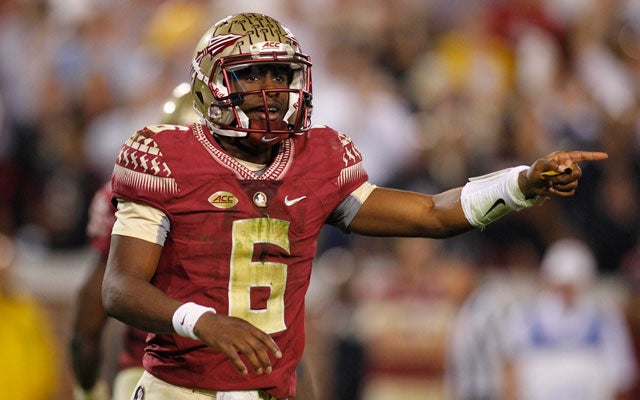
Graduate transfers are all the rage in college athletics, but should the NCAA make players that wish to continue their collegiate careers take tougher classes? CBS Sports' Jon Solomon takes a closer look in this week's Inside College Sports.

By
Jon Solomon
•
9 min read

Of all the issues facing the NCAA, what types of classes graduated athletes take as they continue to play sports would seemingly rank low on the list. They have, after all, graduated. These athletes got their degree and still have eligibility left, so to keep playing, the NCAA currently requires them to enroll in six hours of academic credit in graduate school or some other post-graduate studies.
Along comes a new proposal by the Division I Committee on Academics that was rolled out last week. The committee wants to require graduate and post-baccalaureate students to declare a specific degree program and complete at least six hours of degree-applicable credit per semester. Are we actually getting closer to an Academic Progress Rate monitoring how close athletes are towards getting graduate degrees?
The proposal came on the heels of the NCAA’s first-ever study of the academic behavior of post-graduate athletes. Post-graduates made up 2 percent of Division I athletes in 2014, up from 1.4 percent in 2007. Nearly 4 percent of all football and men’s and women’s basketball players in 2014 competed as post-graduates.
These may sound like small numbers, and in some ways, they are. We’re talking about 2,185 post-graduate Division I athletes in 2014, an average of 12 per school. But the big-picture issue appears to be this: If the NCAA can’t connect all aspects of college sports to academics in any meaningful way, does its stated educational mission become vulnerable as a defense to keep players from getting paid?
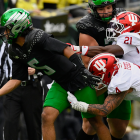
The increasing number of post-graduate athletes isn’t disappearing. Nor is litigation going away that attacks the NCAA’s educational model. Nor are opinions by some people in college sports who want the graduate-transfer rule to be eliminated because of the so-called “hired gun” mentality that allows Oregon to sign Vernon Adams from Eastern Washington, even though it may be a better opportunity for him.
More athletes arrive on campus earlier, spend their summers training and taking classes at school, and fly through undergraduate degrees with one or two years of playing eligibility left. Graduating is a good thing, although it’s fair to wonder how pockets of players labeled academic risks get degrees so quickly while juggling 40-plus hours a week spent on their sport. Look at academic fraud scandals for some of those answers.
How many post-graduate athletes flocking into graduate school programs without doing degree-applicable work does it take before the academic community pushes back? Apparently, now we know.
“The recommendations proposed by the committee would make sure students seeking additional educational opportunities after earning a degree remain academically engaged,” Indiana faculty athletics representative Kurt Zorn, the chair of an NCAA academics subcommittee that made the proposal, said in a statement from the NCAA news release. “They also would provide academic accountability for students who continue to compete.”
According to the NCAA, 85 percent of all post-graduate athletes compete for the same school and 73 percent pursue graduate degrees rather than post-baccalaureate programs. Sixty-two percent of athletes who stay at their undergrad school for grad school earn grad degrees, compared to 51 percent who go to grad school elsewhere. Athletes who pursue a post-baccalaureate degree or second major earn a degree 23 percent of the time.
College football has the most post-graduate athletes (36 percent), compared to football comprising 16 percent of overall Division I participation. Women’s track and field/cross country (10 percent) and men’s basketball (8 percent) are next for post-grad athletes. Not surprisingly, football (38 percent) and men’s basketball (35 percent) have the lowest rates of post-graduate degree completion, following their trend in undergrad degrees.
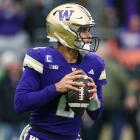
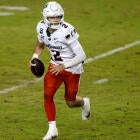
The NCAA acknowledged the study was spurred by a conversation about graduate transfers. Men’s basketball has the most graduate transfers (32 percent) and it's becoming increasingly popular for football quarterbacks to leave and be eligible right away on a different campus. Previously, the NCAA showed that only 24 percent of grad transfers in football and 32 percent in men’s basketball had earned a graduate degree two years after they transferred. What the NCAA couldn’t answer until now was that rate for graduated players who keep playing at their undergrad school. The rates aren't that much different between a graduate transfer and a graduate who stays.
If the Division I Council sponsors this legislation, a vote would occur in April 2017 and the new rules would be effective Aug. 1, 2017. Given the increase of grad transfers, the Division I Committee on Academics is also considering adjusting the APR retention point that’s earned when a player graduates. Currently, players who graduate automatically earn that APR retention point for their team, even if they transfer. Let’s hope this doesn’t turn into a situation where schools can hold the threat of lost APR points over the head of a player who has graduated and wants to play elsewhere.
 |
Why midseason coaching changes are up
|
|
Minnesota coach Jerry Kill’s retirement for health reasons and Miami coach Al Golden’s dismissal means there already are eight head-coaching vacancies in the Football Bowl Subdivision. There were 15 after all of the 2014 season. The coaching carousel this year figures to be intense, leading to some mid-season firings to give schools an earlier start. “Some people feel they can get a jump on the field,” said Chuck Neinas, who has helped match schools, coaches and agents for years. “Of course, once it’s known you’ve got an opening, you’re going to be contacted by a lot of people you probably won’t have interest in. Be that as it may, some people feel this gives you an opportunity on the front end.” Several athletic directors, who wished to remain anonymous, said they understand the early rush since it will be a crowded market. But like many things in college sports, some ADs are also conflicted about what it says of the industry. “I totally understand why ADs do this,” one AD said. “On the other hand, you’re supposed to be a team and you wish you could finish the year as a team. College sports has changed.” Translation (my words, not the ADs’ words): How is this amateur sports when there are these many mid-season firings? |
|
 |
Ninth Circuit strongly considers O'Bannon review
|
|
The Ninth Circuit Court of Appeals ordered the NCAA to file a response to the Ed O’Bannon plaintiffs’ request for en banc review. This indicates the Ninth Circuit is strongly considering taking on another appeal in the O’Bannon case over commercialized use of athletes’ names, images and likenesses. Federal appeals rules state en banc cannot be granted without a response from the non-requesting party. The Ninth Circuit could have rejected O’Bannon’s petition without seeking a response from the NCAA. If en banc review occurs, the O’Bannon case would be heard before 11 judges as opposed to a three-judge panel. The Ninth Circuit in September struck down a federal judge’s plan to allow universities to pay about $5,000 per year in deferred compensation to football and men’s basketball players. Also this week, US District Judge Claudia Wilken set a pre-trial schedule for the damages portion of the Shawne Alston class-action lawsuit against the NCAA and its conferences over not allowing cost of attendance stipends for decades. The pre-trial schedule runs through April 2017. In other words, litigation in college sports isn’t going away anytime soon and billable hours will prevail. |
|
 |
Mixed reviews on Pac-12 proposal |
|
Pac-12 commissioner Larry Scott said there is mixed reaction around the country over his conference’s NCAA proposal that would allow athletes to promote their own non-athletic business ventures while using their names, images and likenesses. Under current NCAA rules, athletes cannot accept any money or permit the use of their name or picture to advertise the sale of a commercial product or service. “It’s preliminary, but the initial reaction I hear is intrigue, a lot of interest, but a lot of questions,” Scott said of the Pac-12 proposal. “People want to make sure it’s not a gaping loophole that you can drive a truck through in terms of it being an avenue for boosters or donors to indirectly funnel money to student-athletes based on their athletic success. … There are mechanisms in place where compliance officers have to vet proposals for athletes’ summer work and other jobs. I think we’ve made a lot of progress in reviewing some of the questions we’ve gotten (about the Pac-12 proposal).” Scott said the Pac-12 athletes who now serve in the conference's governance structure are “completely on board with the idea you shouldn’t trade in your athletic status for compensation.” When asked why the Pac-12 athletes feel that way, Scott said, “I didn’t hear a lot about why. I think they accept that’s a fundamental premise of amateurism and they mostly support it. I don’t want to say unanimously. I have talked to some student-athletes that disagree with that position.” Sponsors of NCAA autonomy proposals have until Nov. 1 to make any modifications to their proposals. Final NCAA autonomy proposals are due Nov. 15 and get voted on at the NCAA convention in January. |
|
 |
Read 'em
|
|
* Jason King of Bleacher Report wrote the NCAA is investigating the relationship between highly touted Purdue freshman basketball player Caleb Swanigan and a Purdue alum who adopted Swanigan prior to his eighth-grade year. * More NCAA investigations: The NCAA is examining allegations of academic misconduct by a former Pacific men's basketball coach, according to Gary Parrish of CBS Sports. * UCF will pay recently-retired football coach George O'Leary $200,000 a year through 2020, Steve Berkowitz of USA Today reported. * And in case you missed it, I wrote about new Conference USA commissioner Judy MacLeod becoming the first female FBS commissioner and examined why more women aren't in college sports leadership positions. |
|
 |
Quote of the week
|
|
“It’s a terrible setup down there. It’s bush league. They shouldn’t have two teams going out the same place. You got bickering and all this stuff going on and the distraction before the game. … You got all this stuff in the game, and now we got to all run in the same (tunnel). It’s just not smart. My thing was that we were going to stay right here until they get off the field.” -- Clemson coach Dabo Swinney on teams sharing the same tunnel to reach the locker room at Sun Life Stadium in Miami. Swinney kept his players on the field at halftime until the Miami Hurricanes left through the tunnel. |
|
Follow and read more from Jon Solomon on Facebook and Twitter.