Referee in Oklahoma's upset loss to Kansas State explains crucial onside kick call
The Sooners recovered a key onside kick late in the game, but it was called back for illegal touching

•
2 min read
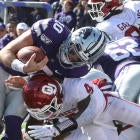
No. 5 Oklahoma's stunning 48-41 upset loss at Kansas State has already created ripple effects throughout the Big 12 and the College Football Playoff landscape. However, the near-comeback by the Sooners was gashed when an otherwise perfect onside kick was called back for illegal touching. The fallout of the call has immediately become the focal point of social media and message board postings among Sooners fans.
Below you can see the onside kick at the center of the controversy. Oklahoma recovers in plus territory, but after a lengthy review, officials overruled the call on the field by saying wide receiver Trejan Bridges illegally touched it before it went 10 yards. If the officials hadn't reversed the call, Oklahoma would have had the ball down a touchdown in plus territory with 1:43 remaining in regulation.
Oklahoma's onside kick, touched before 10 yards pic.twitter.com/APtb0HrUGA
— CJ Fogler (@cjzero) October 26, 2019
The question at hand, though, is whether Bridges was blocked into the ball. According to the NCAA's rulebook, "A player blocked by an opponent into a free kick is not, while inbounds, deemed to have touched the kick." Afterward, referee Reggie Smith met with pool reporters where he briefly addressed the call.
"We did consider all aspects of forced touching," Smith said. "However, based on Rule 2-11-4-c, this is why we came to the decision that we came to. Rule 2-11-4-c was the primary determination for considering forced touching."
Rule 2-11-4-c: Forced touching results when a player’s contact with the ball is due to (i)an opponent blocking him into it or (ii)the ball being batted or illegally kicked into him by an opponent. If the touching is forced, the player in question by rule has not touched the ball
— Kelly Hines (@KellyHinesTW) October 26, 2019
So the subject is not necessarily whether Bridges touched the ball -- he did -- but if there was enough evidence to suggest he did so illegally or not. That the officials overruled the call on the field of a recovery by Oklahoma indicates they did not see evidence that Bridges was blocked into the ball. You can decide for yourself whether that's true.
After the game, Oklahoma coach Lincoln Riley expressed his frustration at the call.
"I don't know," Riley said. "We had the same situation at Baylor a couple of years ago and they ended up giving them the ball where they said we blocked one of their guys into it. To me it was the same play. We were a little surprised."
The referee's explanation isn't going to satisfy angry Sooner fans, but rarely is such an explanation going to satisfy anyone who feels (justly or otherwise) that they were robbed. The larger point, as always, remains that if you let a game come down to one play, then you run the risk of coming out on the wrong side of a well-intended, but imperfect officiating system.