

Sixteen Vols coaches defend culture but miss mark in support of victims
Sixteen coaches from Tennessee banded together to hold a press conference Tuesday in which they insisted that allegations in a recent Title IX lawsuit don't match the Vols culture they know.

By
Jon Solomon
•
6 min read

One by one, the University of Tennessee’s 16 head coaches passed the microphone around during an extraordinary news conference Tuesday. They spoke of solidarity, stereotypes, resources shared by gender, team logos, reducing sexual assault and recruiting challenges. Most of all, they insisted that allegations in a recent Title IX lawsuit don't match the Tennessee culture these coaches know.
“Instead of us continuing to lay down and just kind of take it and take the beating,” soccer coach Brian Pensky said, “we felt as a coaching unit we want our administration to know that we have their back and that we have each other’s backs and that we have our student-athletes’ backs. It was, in a word, it was time.”
The news conference, which aired nationally on the SEC Network, was a unique, emotional, surreal, awkward, tone-deaf (pick your adjective) event. Coaches whose programs presumably haven’t had players accused of assault (i.e., almost every Vols team but football) banded together to compliment football coach Butch Jones and sell their university. That’s their right. I won’t judge how they feel about Tennessee’s culture based on their own experiences.
Still, if you wonder why more rape victims in society don’t come forward, Tuesday offered a glimpse. Presumably, it’s not the Tennessee coaches’ intent to silence women from speaking out. But look at it from the perspective of a woman who has been assaulted or will be in the future.
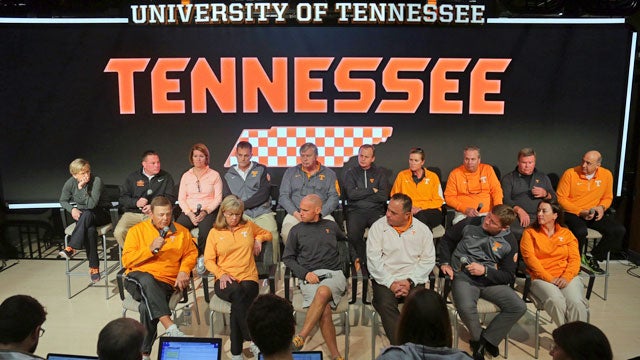
While expressing sympathy for the alleged victims, 16 Tennessee coaches circled the wagons to show unity that the accusations are the exception, not the rule. Where was this press conference through the years when football players were accused of rape? Or does unified support only occur once the culture gets challenged in a lawsuit that could impact everyone’s recruiting?
Two weeks ago, six women alleged the school violated Title IX regulations and created a “hostile sexual environment” through a policy of indifference toward assaults by athletes. The lawsuit named Jones as one official to blame for the indifference. It also claimed Tennessee’s policies made students more vulnerable to sexual assault and the university interfered with the disciplinary process to favor male athletes. Tennessee has denied the allegations.
Since the lawsuit was filed, one current and one former Tennessee football player have been arrested. Defensive lineman Alexis Johnson was charged with aggravated assault and false imprisonment, and ex-offensive lineman Mack Crowder was charged with five felonies in a child sex sting.
“If you want to go back 20 years and accumulate incidents, I would imagine you could look at a lot of schools like Tennessee and come up with a similar story,” softball coach Karen Weekly said. “And I think what’s happened here, and that’s the part that I feel is unfair, if you look today, the culture here now, the culture we’re all talking about, the culture our student-athletes are a part of, they love it. I think they’re probably surprised at what’s being said about Tennessee in the national media.”
Swimming and diving coach Matt Kredich said the coaches welcome the microscope put on their campus so fans believe Tennessee is raising athletes of “exceptional” character.
“The issues that we’re talking about culturally go way beyond the University of Tennessee, and if we’re going to make changes as a society, we welcome the opportunity to show we lead this discussion and this change,” Kredich said. “I hope that in 10 years people will look back and say that a lot of the changes have come, and some of the issues we’re talking about have really started with the University of Tennessee discussion. Not because we did anything wrong, but because you put the microscope on our athletic department and you see the way things are being done and it’s good.”
Mostly, the lawsuit against Tennessee revolves around football. It includes allegations about former football players A.J. Johnson and Michael Williams, who were indicted on aggravated rape charges last year and have separate trial dates this summer.
Jones said his players are unfairly stereotyped. “Have we had individuals make some poor choices? Absolutely,” he said. “But I think anyone who is a father or a mother, and if you’re real with yourself and your parenthood, they’ve also made choices that maybe were inappropriate and it’s our job to continue to educate them and hold them responsible for their choices. But we have good people, and it’s easy to judge when you don’t live our day every day.”
Jones mentioned that other schools are using the lawsuit allegations against Tennessee. And if Tennessee is being honest, that’s really why the news conference was called. The coaches wanted to tell their stories of the Tennessee they know so future recruits aren’t scared away.
“I think there’s going to be a perception today that this is a big kumbaya love fest up here so that would be a little bit of a negative connotation of what this day is about,” Pensky said. “But I think it’s time for us.”
Curiously, Tennessee athletic director Dave Hart wasn’t at the news conference. An athletic department spokesman said Hart was out of town and Tuesday was the only opportunity for all 16 coaches to attend.
Toward the end of the session, a reporter finally asked the question that struck at the heart of why hold this news conference: “How are sexual assault victims and future sexual assault victims supposed to feel when six women, who don’t want to be named, finally have the courage to come together and speak up and they’re met with 16 coaches at one of the biggest schools in the nation saying, ‘No, the culture here is great?’”
Replied Jones: “I don’t want to diminish, and I don’t want you to think -- any way, shape or form -- that we don’t feel for the alleged victims. We feel for them. I hurt for them. We all hurt for them. I want to make sure you understand that. That hits at our soul.”
It should. Campus rape isn’t just a Tennessee problem or a Baylor problem or a Name Your School problem.
But as well-intentioned as Tennessee coaches may have been to collectively talk, that’s not the message many people will get. The message sounded like 16 university employees are tired of Tennessee being painted in a negative light.
If a Tennessee athlete assaults a woman in the future, I won’t hold my breath waiting for 16 Vols coaches to hold a joint news conference.
Follow and read more from Jon Solomon on Facebook and Twitter.