2021 Fantasy Baseball Draft Prep: Strategies from the early, middle, and late parts of the draft order
How you attack the draft depends largely on which slot you get, but don't worry, we have you covered

By
Chris Towers
•
11 min read
You can do all the research to prepare for your Fantasy baseball draft you want, but until you know where you're picking in the draft, you don't really know what kind of strategy you're going to go for. Scott White can you tell you to push aggressively for starting pitchers, while I can tell you to be patient, but if you're picking No. 1 overall, you probably aren't taking a pitcher in a standard 12-team Roto league; conversely, if you pick No. 1 in a H2H points league, you're probably taking a pitcher no matter what.
The further down the draft board you go, of course, it's harder to say with certainty who might be available at any given spot. The more picks there are, the more chances there are for someone to throw you a curveball. And, as Gary Sanchez could probably tell you, curveballs can be tricky.
Every year for Fantasy football, we do a series where we break down what your strategy should be from every spot in the draft order, and it's relatively easy to do. There are only four positions to consider until the last two rounds, and the draft is usually much shorter than a baseball draft. You can really make a gameplan once you know your spot.
In baseball, it's trickier, and league type and size, as well as personal preference will play a bigger role in determining what path any drafter takes from any given spot. But we can still provide a sort of rough outline, at least for the first few rounds. Scott and Frank Stampfl did that on a recent episode of the Fantasy Baseball Today podcast, and you should listen to their advice below:
My view tends to differ a bit from that of Scott or Frank, however, and since I wasn't on that episode of the pod, I'm going to give you my two cents. I won't go draft slot by draft slot, but I'll break down how you should approach at least your first few picks from the early, middle, and late parts of the draft order. Once you hit Round 5 or so, your approach should be based more on team needs and draft flow than any specific plan, but hopefully this can get you started on the right path.
Dominate your Fantasy Baseball draft with our free Draft Kit, which gives you must-have sleepers, breakouts, busts, and rankings. Plus see the top players at each position, complete with winning projections. Get the Draft Kit in your inbox completely free here.
Roto leagues
Picking 1-5
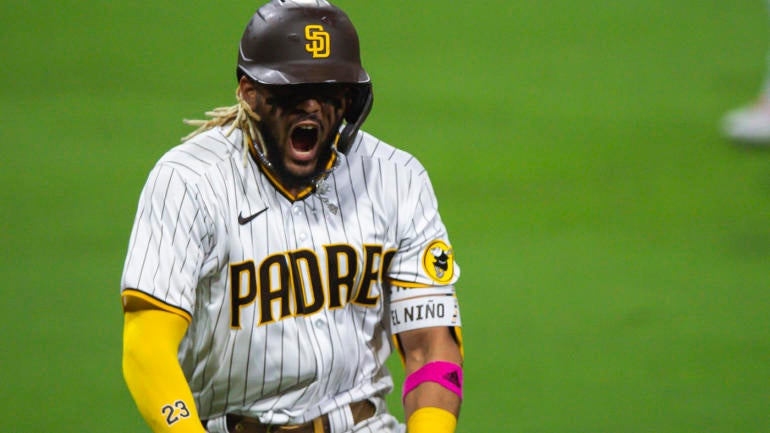
At least in the first round, and at least in a Roto league, the choice in the top five is fairly obvious for me: I'm taking one of Ronald Acuña, Mookie Betts, Juan Soto, Mike Trout, or Fernando Tatis. Those are the five best hitters in Fantasy entering 2021, with each carrying elite potential in at least four categories -- and all should contribute something in steals. There is very little difference between this group in my eyes -- Betts and Acuña are $44 players, while Soto, Trout, and Tatis are $43 in my salary cap draft values.
I'd like to get a starting pitcher with my second pick, and you could have the likes of Walker Buehler, Aaron Nola, Max Scherzer, Luis Castillo, and Jack Flaherty available in that range. Scherzer is my favorite of the group and Buehler is last for me, but you can't really go wrong with any of them, and doubling up in Rounds 2 and 3 is a totally viable option. Having a five-category contributor with your first pick makes it a little easier to stomach passing on a hitter until your next pick in the 45-50 range. Though if I do that, I'm probably only taking another two pitchers in the first 10-12 rounds. I want four in my first 10 picks, ideally, but if I got two legitimate aces, I'm more willing to wait a little longer for my No. 3 and 4 starters.
Picking 6-8
The deeper you get in the first round, the less control you have over who you'll be able to pick. If one of those top-five hitters drops to No. 6 or later, I'm taking him. If Jacob deGrom is there instead, he's the pick. That's my decision-making process for the No. 6 pick, and it's pretty straight forward.
If the top five hitters and deGrom are gone, I'm going back to the hitter well here, with either Jose Ramirez or Trea Turner. I have both as $42 players along with deGrom, so they're just behind those top five. Ramirez's swing looks completely fixed after his weird funk from the second half of 2018 to the 2019 All-Star break, and he was the No. 4 hitter in this format last year. Turner is the speed specialist of the first round, but he seems to have taken a step forward as a hitter in recent years, posting a .200 ISO in 2019 and then following that up with a .253 mark last season. If he's a .300 hitter with 25 homers, he could be just as valuable as any of the top five picks if he keeps running.
My preference here would be deGrom, and I'd like to pair him up with another high-volume starter within the first four rounds -- Max Scherzer in Round 3 would be ideal for me. If I pulled that off, I wouldn't mind having just those two in the first 10 rounds while I load up on hitting. If I go for Turner or Ramirez, then the approach is a lot like it is for taking one of the top five hitters: You could double up on pitchers in Rounds 2 and 3 rather easily. If you do take Turner, you might want to focus on grabbing a high-end slugger pretty early on to make up for his just-OK power profile. You could also snag Gerrit Cole or Shane Bieber in the first and follow the same approach as with deGrom, and though I have them ranked 11th and 12th overall, I've reached for them in the middle of the first before.
Picking 9-12
But my preference would be to get Cole or Bieber here. If I can, the first round was a success in my eyes, especially if I get the chance to pair them with Freddie Freeman, Trevor Story, or Christian Yelich. If they aren't there -- and their ADP are both inside the top nine -- Yelich is my priority. I think he very well could be the No. 1 player in Fantasy again.
I'm willing to double up on hitters if I'm drafting in this range, but that could be a risky approach, since you won't pick again until 34-36 overall, and your pitching options may be a little slim. If I could go Yelich + Freeman and then get Brandon Woodruff to anchor my rotation, that's a great start, but there's a risk that Woodruff won't be there when you pick -- his ADP is 38.8. You start to get into the Zac Gallen/Blake Snell/Kenta Maeda range beyond him, and that's a much shakier rotation anchor -- and you'd probably be reaching for any of them there.
So, if you go with a hitter in the 9-12 range, you probably want to pair them with Yu Darvish or Trevor Bauer here, and it's not unreasonable to reach for Lucas Giolito or Aaron Nola if you are ninth and the rest of the starters are gone when you pick at 16. That's earlier than I have them ranked, but the hitters at the Round 3-4 turn are just a lot better than the pitchers, generally. Starting out a draft with Christian Yelich, Trevor Bauer, Corey Seager and Luis Robert/Kyle Tucker is pretty close to an ideal start, and Cole/Bieber, Bauer, Seager and Luis Robert/Kyle Tucker is pretty awesome, too.
H2H points leagues
Picking 1-3
Starting pitchers are going to get pushed up in points leagues, and while I think that seems to be getting taken too far this season, I do have Jacob deGrom, Gerrit Cole, and Shane Bieber as my top three overall players in points leagues, so I'm taking one of them if I'm picking in that range. The top handful of pitchers every season provide a significant advantage over the rest of the field, even over the top hitters. In 2020, Bieber was the No. 1 player in points, and Yu Darvish matched Jose Ramirez for the No. 2 spot; Trevor Bauer, Kenta Maeda, Gerrit Cole, and Lance Lynn all scored between 225 and 236 points, nearly 20 behind Darvish, and all behind the top seven hitters.
You see similar trends in 2019 (Justin Verlander and Gerrit Cole outscored all other pitchers by at least 125.5 points) and 2018 (Verlander, Scherzer, Kluber, and Jacob deGrom all outscored all but the top hitter), but you'll note that I'm talking about less than three players per season on average who truly stood out. There's typically another 12-15 or so who get to 500 points, a mark 28 hitters have reached on average over the last three years (pro-rating 2020 numbers).
Which means, while I'm happy to take one of those top three starting pitchers, I'm not quite on board for the rest of the starting pitcher group getting inflated. I probably want four or five starters in my first 10-12 picks in H2H points as well, but with one of those three aces locked in, I'll focus on hitting for a while. With the rest of the pitchers getting pushed up (unnecessarily, in my opinion), you could end up with two of Francisco Lindor, Manny Machado, Xander Bogaerts, Rafael Devers, or Corey Seager to anchor your hitting, and I think all are pretty much first-round caliber players.
Picking 4-7
Once you get past that top three of starters, I'm taking Trout, Soto, Betts, and Ramirez in that order. I have them all with a $48 salary and would be happy with any of them in any order. You might see someone push up Trevor Bauer to this range, and you might see Ramirez fall to eighth, but both would be mistakes in my opinion. If you're in this range, you should be taking a hitter, and you should be thankful you get the opportunity to.
The second round is where it gets trickier. Ideally, I would follow up with Scherzer, but in a recent 12-team points mock we did, Scherzer went 18th overall, so only the No. 7 picker had a chance. I wouldn't want to reach for Castillo or Flaherty as a result, so I'm probably going with a hitter here again. You might be one of the only people in your league to double up on hitters with their first two picks, but if you end up with Lindor or Harper, you've locked in two hitters who have outscored every pitcher over the last three seasons with the exception of Cole, deGrom, Scherzer and, amazingly, Justin Verlander. It would be nice to get a high-end starting pitcher, but in that H2H mock I mentioned earlier, I actually tripled up on hitters with Juan Soto, Bryce Harper, and Manny Machado. Sometimes, you can't worry about positions and you've just gotta take the best players. In this spot in the order, that can certainly happen, and zigging when everyone is zagging is always a viable strategy.
Picking 8-12
The biggest decision comes if you pick eighth and those four and the big three starters are gone. I've got Acuña ahead of Tatis, and if the gains he made in terms of his walk rate in 2020 stick, he could absolutely join that elite tier of hitters, whereas Tatis still profiles as definitively better in Roto than points.
In fact, my preference here -- no surprise! -- would still be to draft a hitter in every spot. But knowing how pitching tends to be pushed up, I'd prioritize Trevor Bauer with any pick from 10-12, knowing I can get one of Freeman, Yelich, or Harper on the way back. And doubling up on Bauer and Scherzer is a viable strategy in points, too, with the likes of Ozuna, Bregman, and George Springer often available at the 3-4 turn. That's one of the ways in which picking from the ends is really great: You can really dictate your own strategy rather than relying on certainly players to drop.
When picking on the end, the way to approach it is pretty simple: When you think hitter is deeper than pitcher, you go after pitchers; when you sense a significant drop-off is coming at either position before your next pick, you prioritize that. Maybe you guess wrong, grab two pitchers at the three-four turn, only to find Tyler Glasnow or Corbin Burnes fell further than expected. In that case, you take Burnes too! Scott White and I don't disagree about needing to draft pitching early, we just disagree about whether you should do it at all costs.
So which Fantasy baseball sleepers should you snatch in your draft? And which undervalued first baseman can help you win a championship? Visit SportsLine now to get Fantasy baseball rankings for every single position, all from the model that called Will Smith's huge breakout last season, and find out.