Fantasy Football Draft Prep 2021: Wide receivers are cheaper than ever, but should you be buying the dip?
Here's how Chris Towers is approaching the receive position in 2021

By
Chris Towers
•
6 min read
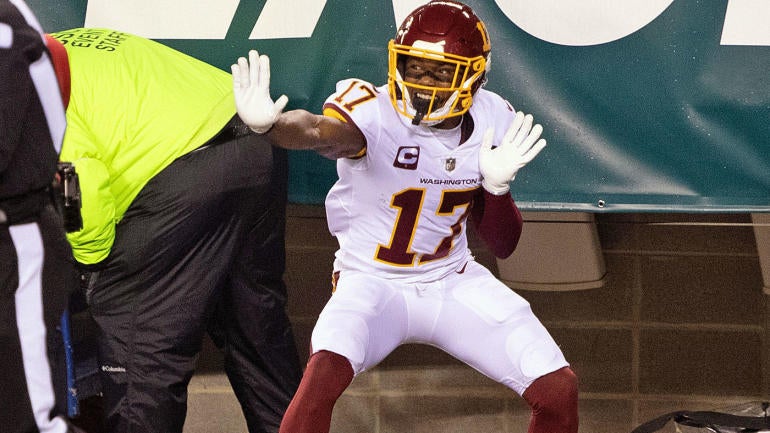
Chances are, your Fantasy Football team is going to have more wide receivers in the lineup than any other position most weeks. Obviously, that's especially true in three-WR leagues, but it should probably be true more often than not in two-WR leagues, as well; the No. 24 RB in points per game last season averaged 13.5 PPR points per game, a mark that 33 wide receivers either matched or surpassed.
That's not to say wide receivers should be the key to your draft strategy, of course. The depth of the position is such that, no matter how you draft, you should be able to find enough viable starting options. In his WR tiered rankings and strategies piece, Dave Richard makes the case for working your WR around the rest of your strategy, rather than the other way around.
And that's good advice. It makes sense with how the player pool looks this season, and it's how most people seem to be drafting right now. Just take a look at this chart comparing WR ADP to the overall player pool for the past four draft seasons, based on historical NFC data:
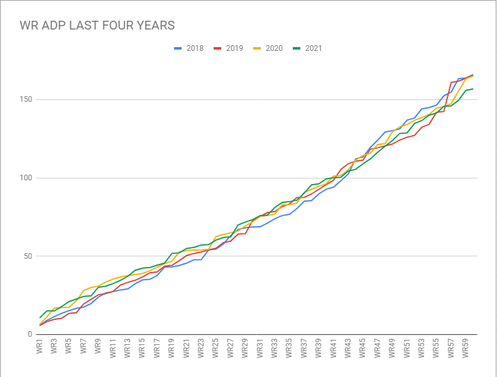
As you can see, wide receivers have been cheaper at pretty much every point in the draft this offseason than any year over the previous three, especially once you get past the WR15 range. That's because running back and quarterback prices are being relatively inflated, especially at the top. 12 running backs are being drafted inside the first 18 picks and 16 are going inside the top 30, on average, while seven QB are going inside of the top 65 and a whopping 13 are going inside of the top 100.
Do you love Fantasy Football and want to deep a bit deeper into Daily Fantasy Football? We've got you covered! The Fantasy Football Today DFS crew will get you ready to crush Daily Fantasy Football. Join host Frank Stampfl alongside DFS analysts Mike McClure and Sia Nejad twice a week for the most well-rounded analysis in the industry. On Tuesdays the crew will focus on optimized lineups, pricing, stacks and more. On Thursdays they'll deep-dive each game, focusing on perceived ownership, leverage plays, matchups, and updated lineups.
Head on over to Spotify, Apple, or wherever else you consume podcasts to FOLLOW Fantasy Football Today DFS:
This is a reaction in part to a season where the elite quarterbacks were unusually dominant, as 56.2% of all top-12 weekly finishes among QBs came from guys who finished in the top-12 at the end of the season, compared to 49.5% in 2019; additionally, the top-six finishers at the end of the season had 45% of all top-six weekly finishes this season, compared to 33.3% in 2019. Having one of the elite quarterbacks was a true advantage in 2020, more so than most years.
It's also a reaction to an RB crop that looks unusually deep with young, three-down players. Those are historically the most valuable assets in Fantasy -- the players most likely to give you one of those truly elite, 300-plus point seasons in PPR. It makes sense that those players are being pushed up draft boards, and my ideal draft day plan involves ending up with one of them in the first two rounds, along with one of the three elite tight ends.
So, I'm part of the trend that is pushing the price of wide receivers down, too! But it's worth keeping in mind that, while the wide receiver position is obviously the deepest in the game, the elite wide receivers are still incredibly valuable players. Let's take a look some results for wide receivers over the last five seasons based on draft order:
- Top three in ADP among WR: 7/15 had 300-plus points, 13/15 had 200-plus
- Top six: 9/30 had 300-plus points, 21/30 had 200-plus
- Top 12: 13/60 had 300-plus points, 47/60 had 200-plus
- Top 24: 15/120 had 300-plus points, 75 had 200-plus, 94 had 150-plus
The truly elite WR have been nearly guaranteed to be must-start players, and have about a 50-50 chance of a truly elite season -- a better success rate in both regards than the top-three running backs. RB4-6 actually fared slightly better than their wide receiver counterparts, but you still have a very good chance of hitting with a top-six wide receiver.
And from then on, the wide receivers are clearly the better choice at basically every point. And you see something similar in the results by round, as well:
First round
- RB: 2/40 had 400-plus points, 12/40 had 300-plus, 23/40 had 200-plus
- WR: 6/21 scored 300-plus points, 15/21 had 200-plus
Second round
- RB: 3/26 had 300-plus points, 14/26 had 200-plus
- WR: 7/30 had 300-plus points, 18/30 had 200-plus
Third round
- RB: 1/21 had 300-plus points, 8/21 had 200-plus
- WR: 2/30 had 300-plus points, 16/30 200-plus
Fourth/Fifth round
- RB: 8/35 had 200-plus points, 20/35 had 150-plus
- WR: 1/49 had 300-plus points, 29/49 had 200-plus, 40/49 had 150-plus
Sixth-Eighth round
- RB: 1/45 had 300-plus, 7/45 had 200-plus, 15/45 had 150-plus
- WR: 13/66 had 200-plus points, 36/66 had 150-plus
Running back is arguably the better investment in the early rounds, but by the time you hit the third, WR already have the advantage, and by the fourth/fifth round and beyond, wide receivers hit at a much, much higher rate -- 49.5% of WR drafted from the fourth through eighth round scored at least 200 points, compared to just 18.8% of running backs. WR drafted in the sixth through eighth round over the last five years were about as likely to score 200-plus points than RB in the fourth and fifth rounds.
You might be thinking to yourself, "Well, surely, this means waiting on wide receiver is the obvious choice." And, in some ways, it is. There are always going to be starting-caliber wide receivers available through at least the top-100 picks, so you won't have any problem filling out your lineup. I did that myself in my FLEX League draft this weekend, waiting until the fifth round to take my first wide receiver, and I ended up with Ja'Marr Chase, Will Fuller, Curtis Samuel, Mecole Hardman, Emmanuel Sanders and Rondale Moore with six of my next seven picks. I should be able to wring four or five quality starters from that group every week, and there's plenty of upside in that group to boot.
But it's also a risky group. In order to get potential top-12 WR upside that late, I had to target Fuller and Samuel, who are both presently injured, and two unproven rookies in Chase and Moore. My "safest" guy might be Emmanuel Sanders, who switched teams this offseason and is 34 years old. You can find must-start wide receivers if you wait, but the most likely outcome is still that they'll mostly just be fine starters, not difference makers. If you want to chase upside, you're inherently inviting risk into your profile.
It's a tough balance to strike, especially in a snake draft, where you are limited by which spot in the order you have and where every pick necessarily means you are passing on other players in that same range. Snagging one early-round RB and a tight end means you could still reasonably expect to end up with someone like Terry McLaurin, Keenan Allen, or Allen Robinson as your No. 1 wide receiver, and you'll still have the opportunity to add another top 15-20 wide receiver in the fourth. That's pretty close to my ideal start to a draft, because I've locked in (hopefully) one elite running back, one elite tight end, and two high-end, potentially elite WR.
In fact, if I've got at least one elite RB with my first two picks, I'm perfectly happy to go with four or even five wide receivers before I take my next running back, especially in a three-WR league. If you can manage to snag someone like Chase as your No. 4 WR, now you're not just adding that huge upside without the risk, and it's reasonable that it could work out that way.
Ultimately, there's no one right way to draft a team. Past results don't dictate future results, but now you've got some concrete evidence about how the wide receiver position has generally tended to work out in the past. It's up to you to draft your team, and there's no one right or wrong way to do it.