Fantasy Football: How can a quarterback's average throw depth help us in Fantasy?
How deep quarterbacks throw their passes on average impacts their Fantasy potential.
By
Ben Gretch
•
5 min read
We've started to talk a lot about average depth of target (aDOT) for pass-catchers here at CBS Fantasy and on Fantasy Football Today, and there are several pieces of the throw depth puzzle that have Fantasy implications. Today, I want to take a quick look at it from the quarterback perspective, and talk a little about what we know and can expect from quarterback throw depth.
As we look at things from the quarterback perspective, we need to be aware that aDOT "belongs" to the receiver, as air yards guru Josh Hermsmeyer likes to put it. That is to say: How deep the average pass between a particular quarterback and receiver combination is has more to do with the receiver than the quarterback.
But many quarterbacks retain similar receiving groups year over year, and I thought it would be interesting to dig into average throw depth to see if we could find any useful information about passing yardage and touchdown upside on the quarterback side. The short answer is there are too many variables, so no, we can't. But the long answer is there are some interesting things to consider.
Over at FantasyADHD.com, we can pull full-season quarterback data including throw depth metrics for each season dating back to 2012. In that span, there have been 229 quarterback seasons where the passer threw at least 300 times, and 150 season pairs where a quarterback threw at least 300 passes in two consecutive years.
Some quick tests on those samples tell us a few things. Perhaps unsurprisingly, sheer pass attempts explained a high degree of the variance in passing yardage (0.83 r-squared), while there was essentially no correlation between aDOT and passing yardage. Volume will explain volume better than a rate stat will. The r-squared between passing air yards and passing yardage was 0.66, which is solid but still not close to as strong as just looking at passing attempts.
And even when we control for passing attempts, the average depth of a quarterback's throw didn't explain much of the variance in passing yardage (or, looked at slightly differently, aDOT and YPA don't correlate well, with a 0.04 r-squared). All of this is essentially also true for passing touchdowns, though the variance in touchdowns is less explainable across the board, including for attempts.


But all of that does make quite a bit of sense. Completion percentage plays a big role, and quarterback skill and accuracy are going to be drivers of success regardless of how deep they throw. Josh Allen is a downfield passer, but because of his mobility, he rarely racks up high volume, and because of his accuracy issues he's never thrown for more than 270 yards in a game. Drew Brees has some of the highest passing yardage seasons in this span, but he's always been a low aDOT quarterback. He still throws down the field, but even before Michael Thomas his offense has always included a high volume of short passes that brought down his average throw depth, but pushed up his attempt numbers.
That doesn't mean there's nothing here. In looking at the 150 season pairs, a quarterback's Year N and Year N+1 aDOT have an r-squared of 0.33. Maybe one would expect that to be higher, but there are enough personnel and schematic changes every offseason. It's still the case that a decent percentage of how far down the a field a quarterback will throw can be explained by his prior season's aDOT, especially if circumstances haven't changed much for the quarterback.


In fact, of the 10 largest year-over-year changes in quarterback aDOT in this sample, the quarterback had a new highest-targeted player in the second season all 10 times. In several cases the change could be easily explained by a major acquisition, like Carson Wentz's aDOT rising after Philadelphia added Alshon Jeffery, or Cam Newton's falling when Christian McCaffrey was drafted and immediately became Newton's most-targeted player. And that's because, again, aDOT belongs to the receiver.
But if quarterback aDOT doesn't tell us much about how many yards or touchdowns a quarterback will throw for, why should we care? Well, the trends are what they are, but as I noted in the Allen and Brees examples, every quarterback's situation is unique. In prior years, we could have applied this to Jameis Winston, always a downfield thrower who maintained much of his same personnel. All things being equal in terms of overall volume, Winston's willingness to throw downfield and rack up air yards certainly helped him build a passing yardage ceiling.


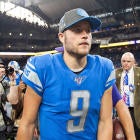
Truth be told, I looked into this largely because of Matthew Stafford. Stafford's aDOT had been at 8.0 or lower every season from 2014 through 2018, essentially since the tail end of Calvin Johnson's career and stretching through the Golden Tate and Theo Riddick years. But in 2019, with Tate and Riddick gone, Stafford's aDOT jumped to 10.6, and he was pacing for just shy of a 5,000-yard passing season, a number he hadn't approach since his early years with Johnson. Given this information, and given Stafford returns Kenny Golladay and Marvin Jones as his top two receivers — both downfield threats — it's easier to buy into the eight-game sample we got from Stafford in 2019 that looked a lot different from his prior seasons. Stafford will remain one of my favorite later-round quarterback targets for 2020, but I do think the career highs in yards per attempt and passing touchdown rate he was pacing for will be difficult to repeat.


Another quarterback to watch for 2020 is Tom Brady, whose 2017 aDOT of 9.1 was more than a yard higher than any of his other seasons since 2013. Brady has come to be known as a dink-and-dunk passer, but 2017 is the one year he played with Brandin Cooks, who was the last legitimate downfield threat he played with. Brady led the NFL in passing yardage that season and finished as Fantasy's QB3. In the Bruce Arians offense in Tampa featuring a high-aDOT weapon in Mike Evans as one of his main targets, we should probably expect to see Brady's throw depth rise significantly in 2020.
Check out FantasyADHD.com for more information on quarterback aDOT and see if you can identify other quarterbacks who might be expected to make a leap similar to Stafford's in 2019.