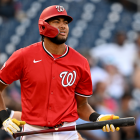
Despite his greatness, Coors Field effect keeping Larry Walker out of Hall of Fame
Walker was a tremendous all-around player, but Coors Field undoubtedly inflated his career numbers

By
Mike Axisa
•
3 min read

Few players in recent baseball history were as well-around as Hall of Fame hopeful Larry Walker.
In parts of 17 big league seasons (1989-2005) with three teams (Expos, Rockies, Cardinals), Walker produced a career .313/.400/.565 (141 OPS+) batting line with 383 home runs and 230 stolen bases. He is one of only 21 players in the prestigious .300/.400/.500 career batting line club.
Furthermore, Walker is 21st among all outfielders in history with +72.6 WAR, and he is top five among all outfielders over the last half-century:
- Barry Bonds: +162.4 WAR
- Rickey Henderson: +110.8 WAR
- Ken Griffey Jr.: +83.6 WAR
- Reggie Jackson: +73.8 WAR
- Larry Walker: +72.6 WAR
Five All-Star Games, seven Gold Gloves, three batting titles, one MVP award -- Walker hit .366/.452/.720 with 49 home runs in 1997 en route to that NL MVP award -- and MVP votes in seven other seasons. And he had an .860 OPS with seven home runs in 28 career postseason games.
Walker did it all in his career, and yet, this is his eighth year on the Hall of Fame ballot, and he's not come close to the 75 percent threshold needed for induction in his previous seven years of eligibility. Here are his voting percentages over the years:
- 2011: 20.3 percent
- 2012: 22.9 percent
- 2013: 21.6 percent
- 2014: 10.2 percent
- 2015: 11.8 percent
- 2016: 15.5 percent
- 2017: 21.9 percent
According to Ryan Thibodaux's public ballot tracker, Walker has already been mathematically elimination from induction this year, and as of this writing he has appeared on 41.0 percent of public ballots. On one hand, that represents a big improvement! On the other hand, the non-public ballots tend to drag down each player's voting percent, so it's unlikely Walker's final number will be that high.
For what it's worth, Walker clears the established Hall of Fame standard for right fielders according to Jay Jaffe's JAWS system. Why, then, is he so far away from the 75 threshold? There are two main reasons.
Injuries
Walker missed many games in his career due to a variety of injuries. From 1996-2004, his age 29-37 seasons, Walker played in 1,083 of 1,458 possible games. That is 375 missed games, or the equivalent of two and a half seasons. With good health, Walker's career numbers would be better and he's likely over 400 homers and +80 WAR. He missed a lot of time in his peak.
Coors Field
Injuries are part of baseball and I don't think the Hall of Fame voters are docking Walker that much for his missed time. The bigger issue is Coors Field and Walker's inflated batting numbers.
Without question, playing at altitude boosts offensive numbers. It's not just home runs either. The outfield at Coors Field is massive, and because outfielders tend to play deep, more bloops fall in. Walker played 10 of his 17 seasons with the Rockies. Here are his career numbers:
At Coors Field: .381/.462/.710
Outside Coors Field: .282/.371/.501
With Rockies: .334/.426/.618
With Expos and Cardinals: .282/.361/.489
Walker's career numbers at Coors Field and with the Rockies overall are out of this world. His numbers outside Coors Field, and with the Expos and Rockies, are merely excellent. Hall of Fame worthy? Eh, probably not, but they're very good.
One thing to keep in mind: Walker had 8,030 plate appearances in his career, and only 2,501 of them came at Coors Field. Roughly 31 percent. He played most of his career away from Coors Field and still compiled numbers that were borderline Hall of Fame caliber.
Given his voting trends, it sure seems Hall of Fame voters are docking Walker heavily for playing in Coors Field. His numbers are inflated by that ballpark. Absolutely. The voters see that ballpark as the difference between great and Hall of Famer, apparently.
Is it fair to consider Walker's career numbers inflated by Coors Field? Without a doubt. At the same time, stats like OPS+ and WAR are park adjusted, and they still put Walker on the very short list of the best outfielders in baseball history. Even adjusting for the Coors Field effect, he was outstanding, both offensively and defensively, and on the bases too.
Given the voting trends, it is unlikely Walker will be voted into Cooperstown before his 10 years on the Hall of Fame ballot are up. He'll be an interesting case for the Today's Game Committee down the road. Walker is the first player with ties to Coors Field with a legitimate shot at the Hall of Fame, and the Today's Game Committee will give a 16-person panel of Hall of Fame players and executives a chance to weigh in on his candidacy.
Clearly, the Baseball Writers Association of America voting body considers Walker's career too "tainted" by Coors Field to put him in the Hall of Fame. The Today's Game Committee will show us how Walker's peers view him.