Franchise bests and worsts: Los Angeles (Calif.) Angels (of Anaheim)
The Angels have undergone many changes -- to their team name alone -- in their 54 seasons on Earth. Who are the Angels? Where do they play? Los Angeles. California. Anaheim. Los Angeles of Anaheim. Tustin? It's all so unsettled.
By
Dave Brown
•
10 min read
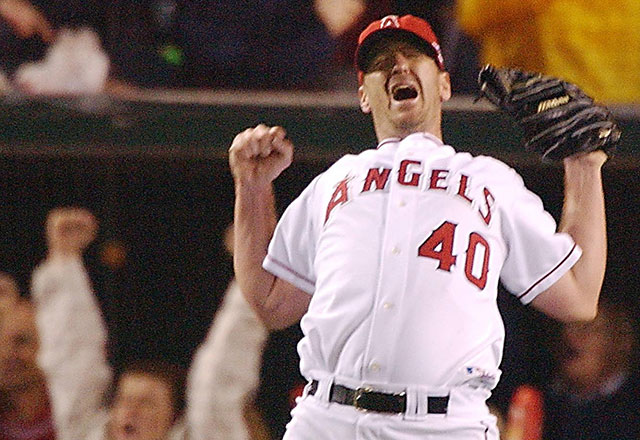
We're almost done venturing through the history of each of the 30 Major League Baseball franchises, discussing some of the best and worst moments, players, teams, etc. It's more of a fun snapshot for discussion purposes than a be-all, end-all declaration. Next-to-last stop: the Los Angeles, Calif. Angels of Anaheim.
Best team: 2002
The team that finally won it all, in the franchise's 42nd season. The 99-game regular-season winners were led by sluggers Tim Salmon, Troy Glaus and Garret Anderson, and Mike Scioscia's squad also got career years from the likes of David Eckstein, Adam Kennedy and Scott Spiezio. The starting pitching was solid, with rookie John Lackey, left-hander Jarrod Washburn and Ramon Ortiz posting above-average seasons, and the bullpen was deep. Troy Percival closing, along with Scot Shields and rookie Francisco Rodriguez setting him up, all stifled teams down the stretch and in the playoffs. Thanks to this team and the Rally Monkey phenomenon, the franchise finally had an identity. Two years later, of course, the team went and changed its name again, to the Los Angeles Angels of Anaheim.
Best player: Mike Trout
He just turned 23 and has 98 home runs and 102 stolen bases in 498 career games. He's led the league in runs scored in each of his first three full seasons. He's been a stolen-base champ, an RBI champ, a bases-on-balls champ and a total-bases champ. Already, he has compiled more wins above replacement than Garret Anderson in about one-quarter of the plate appearances. At his current pace, he'll become the team's all-time WAR leader sometime in 2016. His defense has slipped according to some metrics, if you're looking for something to nit pick, but those predictions saying he could be the next Mickey Mantle haven't been proved wrong yet.
Next best player (hitter): Jim Fregosi
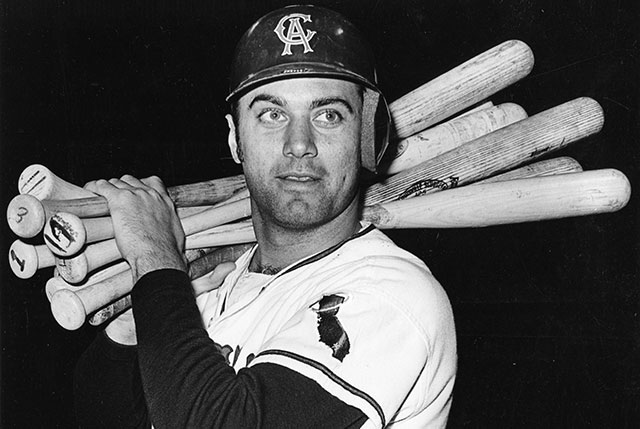
A combination of Alan Trammell and Troy Tulowitzki, Fregosi was a marvel on defense at shortstop and a very good hitter in a bad era for hitting. A six-time All-Star until injuries took him off a Hall of Fame track, he returned in 1979 — eight years after a trade to the Mets for Nolan Ryan — to become the club's manager, and they won the AL West.
Best trade: Fregosi for Nolan Ryan, Frank Estrada, Don Rose and Leroy Stanton
Fregosi had started to slip in his final Angels season (1971), and yet new general manager Harry Dalton managed to swindle the Mets for Ryan, who at 25 was just starting his prime. Ryan struck on 329 in his first season with the Angels, tossing nine shutouts along the way, and followed up with a similar season in 1973. On May 15, he threw his first career no-hitter. On July 22, he threw the second. Ryan threw four no-hitters for the Angels, all by 1975, and finished with seven for his career.
Best pitchers by WAR: Ryan, Chuck Finley, Jered Weaver, Mike Witt, Frank Tanana
Best player with one hand: Jim Abbott
Worst trade: Mike Napoli and Juan Rivera for Vernon Wells
Oh, good heavens. Wells was 32 years old and coming off a bounce-back season for the Toronto Blue Jays in 2011 when the Angels took on $86 million in salary and gave up 29-year-old Mike Napoli. Wells posted a career-worst season with the Angels, and he didn't get any better thereafter. He retired after a trade to the Yankees, and after the contract ran out in 2014. Napoli is still slugging, still winning World Series. But even if it had just been Rivera for Wells, the deal would have stunk for GM Tony Reagins.
Ken Rosenthal and/or Jon Paul Morosi of Fox Sports wrote at the time of the Toronto trade:
The addition of Wells... reduces the sting of a difficult offseason for the Angels, who failed in bids for free-agent outfielder Carl Crawford and third baseman Adrian Beltre.
It's strange how having too much money makes people do things they shouldn't.
Worst free agent: Gary Matthews Jr.
Oh, good grief. After a lucky career year with the Rangers in 2006, the Angels gave Matthews Jr. $50 million over five years. Matthews regressed to the mean his first season with the Angels, but he also got caught ordering performance-enhancing drugs by mail. His play continued to regress from there and he was out of the league by 2010.
(Note: Some say the Mo Vaughn deal was worse, but the Angels got two full seasons from him and later got Kevin Appier for Vaughn in a deal with the Mets, who also paid the final two years of Vaughn's contract. So it worked out better than it seemed when Vaughn was hurt in 2001. They should make another trade with the Mets one of these days.
Worst team: 1994
The Angels haven't had many bad teams; only 11 times have they lost 90-plus games. The '94 squad finished only 5 1/2 games out of first place because the "first-place" Rangers went 52-62 before the strike canceled the season. The '94 Angels had the second-lowest winning percentage in team history, finishing last in the AL in runs scored and 12th in ERA. Salmon and Chili Davis were great, and Spike Owen managed a fluky great season at third base. Bo Jackson and Rex Hudler were solid part-timers, but the rest — yeesh.
Worst moment: The killing of Lyman Bostock on Sept. 24, 1978
A rising star, Bostock was visiting family and friends in Gary, Ind. when a man fired a shotgun into the car in which Bostock was riding. The bullets were intended for the man’s estranged wife — a childhood friend of Bostock’s — who also was in the back seat. A jury decided the gunman was not guilty by reason of insanity. Bostock’s lifetime batting average was .311, and his adjusted OPS 123. He was 27 years old.
Also not to be forgotten: Nick Adenhart
Worst terminology: What do we call them?
Los Angeles Angels (1961-1964); California Angels (1965-1996); Anaheim Angels (1997-2004); Los Angeles Angels of Anaheim (2005-present). Warning: Team owner Arte Moreno would like to build a new stadium in Tustin, Calif., a small town about 10 minutes away from where the team plays now. “Los Angeles Angels of Tustin, Orange County”?
Best mustache: Bobby Grich
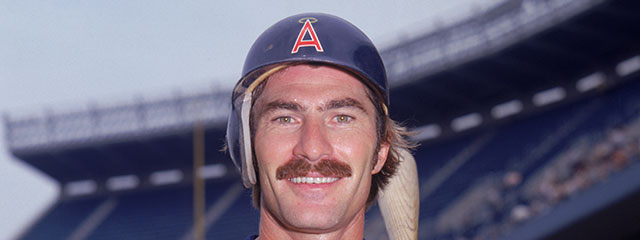
Perhaps the most underrated second baseman in major league history, Bobby Grich played great defense and often hit like a corner infielder for the Orioles and Angels. He was the best hitter in the majors in 1981, and his career adjusted OPS of 125 is 11 points better than that of Ryne Sandberg. But sure, he got one crack at Cooperstown and was dropped from the ballot for insufficient votes. Someday, they'll get it right.
Best actor: Reggie Jackson, "The Naked Gun"
"I must kill... the queen."
Best home ballpark: Wrigley Field II
In South Central Los Angeles, where the Angels played in their inaugural 1961 season. Built in 1925 and named after the same family that operated the Cubs, and the original Wrigley Field in Chicago. Its first home club was for the Los Angeles Angels of the Pacific Coast League. Wrigley resembled the first Wrigley Field — largely because of the ivy covered outfield fence in left — but it also included a 150-foot clock tower that resembled Chicago’s famous Wrigley Building. The park seated about 20,000 — bigger than original Wrigley at the time it was built in 1914 — and had lights by 1930, some 58 years before its namesake. It was demolished in 1969 after the Angels moved a county over. Today, there’s a youth baseball field on the property, a baptist church across the street (Angels!), and ivy grows from several fences in nearby alleyways.
Best place to crash: Dodger Stadium
From 1962-1965, where the Angels played until Anaheim Stadium was ready in ’66.
Best ballpark feature: 'The Big A' scoreboard
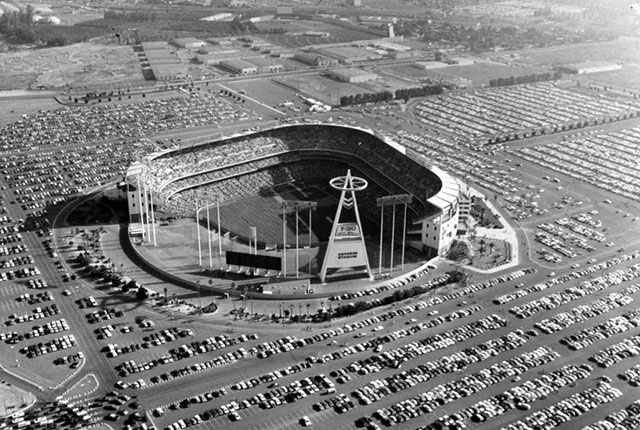
The park’s first scoreboard was basically a giant “A” with a halo, like the logo on the caps of today. Moved to a parking lot during the stadium’s renovation for the NFL’s Los Angeles Rams in 1979, today it greets passersby on the nearby I-5 freeway. Oversized, but elegant and simple. Big, broad and sassy. It was why the ballpark was nicknamed “The Big A.”
Best primate: The Rally Monkey
Worst ballpark feature: 'Ballpark Extravaganza'
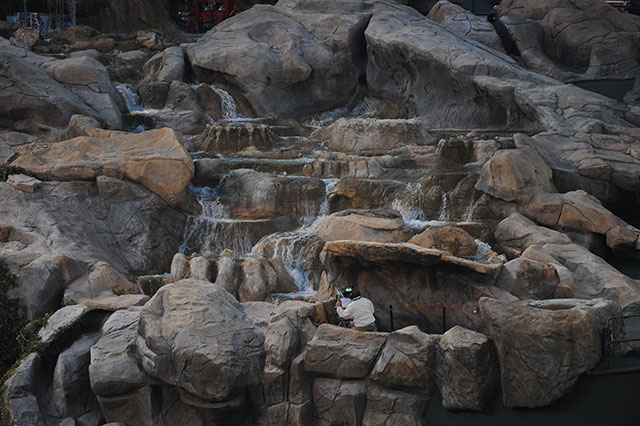
The rock fountain formation in left field at Angel Stadium seems misplaced. Was it transplanted from the Matterhorn ride at nearby Disneyland? It's probably better suited for somewhere like Coors Field. At first glance, from far away, it looks like an exploded quiche. Upon closer inspection, it looks like the original "Planet of the Apes" village. "A planet where apes evolved from ballplayers?" It's probably where they make the Rally Monkey sleep.
Best hitting performance: Adam Kennedy’s three-homers in Game 5 of 2002 ACLS
Best All-Star performance: Fred Lynn hits first grand slam in All-Star history
Best pitching performance: Mike Witt’s perfect game in 1984
Best catch: Jim Edmonds on June 10, 1997
Edmonds earned a reputation for turning his back to the infield, running down fly balls and making unholy diving catches. Sometimes the theatrics were warranted, sometimes they weren't, but at this particular moment — running down a long drive to center by li'l David Howard — Edmonds needed all of his superpowers. It's probably as good of a play as an outfielder can make.
Best cowboy and horse: Gene Autry and Champion
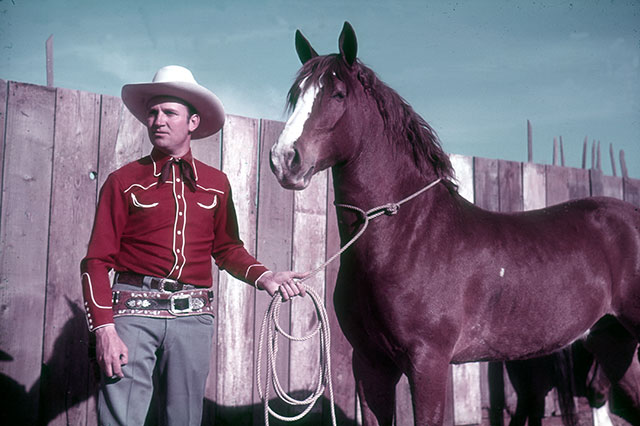
A radio and TV singing star from the 1930s through the '60s, Autry bought into the American League when it first expanded in 1961, and the Los Angeles Angels were born. In 1992, the team retired No. 26 for Autry, who a few years later began selling the team to Disney. He still owned a piece of the Angels when he died in 1998. Never a major league champion, but not for lack of effort and enthusiasm.
Worst disappointment: 1986 ALCS
Everybody talks about the agony of the ball going through Bill Buckner's legs during Game 6 of the World Series in 1986, but the Angels were three outs away from eliminating the Red Sox in five games in the ALCS. And then Dave Henderson connected against Donnie Moore for a go-ahead two-run homer to flip the score. The Angels came back with a run in the bottom of the ninth to tie, but the Red Sox won in 11 innings, and then won Games 6 and 7 back in Boston. Autry's best chance to win had come and gone, as did the best chance for manager Gene Mauch.
Second-worst disappointment: The 1995 collapse
It was the worst late-season collapse in major league history. On Aug. 16, the Angels led the Rangers by 10 1/2 games, and the Mariners by 11 1/2 games. Two nine-game losing streaks later, the second from Sept. 13-23, knocked them out first place, before the Angels won their final five games of the regular season to force a one-game tiebreaker with the Mariners. With left-hander Randy Johnson on the mound at the Kingdome, Seattle won 9-1 in Game 163 and advanced to the playoffs.
Best manager: Mike Scioscia
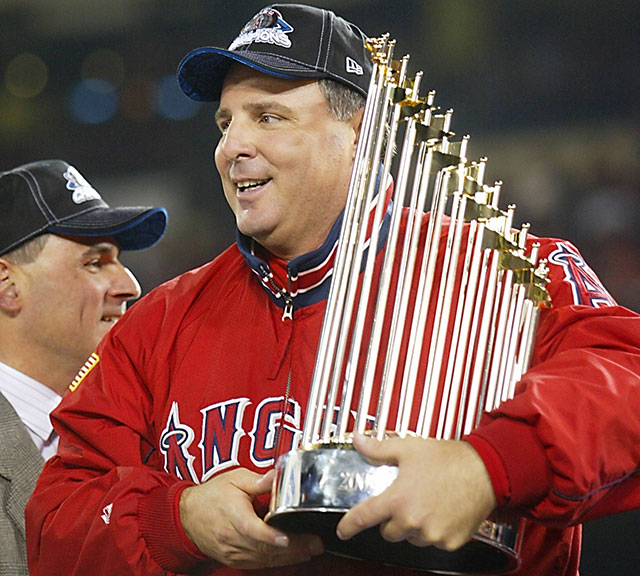
His teams have won at least 89 games nine times, and finished under .500 just four times, in 15 seasons.
Best coach: Jimmie Reese
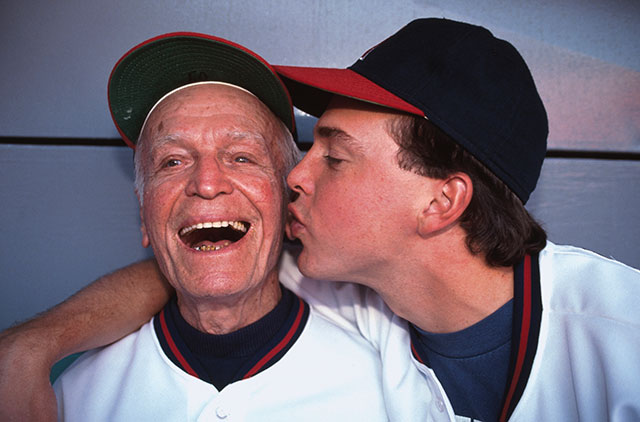
There might not be a more beloved figure in Angels history. Reese served the Angels for the final 23 years of his life, and devoted 77 years, in all, to baseball. A 28-year-old rookie with the Yankees in 1930, Reese was befriended by Babe Ruth and became his roommate for a time. Reese played three years in the majors and began coaching in 1938. He started coaching for the Angels in 1972 at the age of 71, and didn't stop until he was ready.
Best player not already mentioned: Devon White
Up next: We end our 30-team series Wednesday with the Texas Rangers.
>> Want more franchise bests/worsts? CHC | MIL | STL | CIN | PIT |CLE | DET | MIN | CHW | KC | NYY | BOS | BAL | TOR | TB | MIA | WAS | NYM | PHI | ATL | COL | LAD | SF | ARI | SD | OAK | SEA | HOU | LAA | TEX