

In the age of big velocity, Masahiro Tanaka has become the anti-fastball pitcher
The Yankees starter has been throwing fewer and fewer fastballs over the last year or so

By
Mike Axisa
•
2 min read
Everywhere you look, the modern game of baseball is all about power. Power hitters and power pitchers. Long homers and high-90s gas. That is the game today. It seems you can't watch a game without at least a long monster homer or a reliever pumping 100 mph.
Although baseball is all about big velocity now, New York Yankees right-hander Masahiro Tanaka is becoming the anti-fastball pitcher. Tanaka made his first start of the new season Friday night, holding the Toronto Blue Jays to one run in six innings in his team's 4-2 win (box score). Tanaka struck out eight and walked zero.
Just some really, really good stuff. #TanakaTime @t_masahiro18 pic.twitter.com/lOevdnhKb2
— New York Yankees (@Yankees) March 31, 2018
The most amazing number from Tanaka's start: 16. That's the number of fastballs he threw. Tanaka threw 77 pitches total -- the Yankees are easing their starters into things early in the season after last year's postseason run resulted in larger-than-usual workloads -- and only 16 were fastballs.
Here, via Brooks Baseball, is Tanaka's pitch selection Friday night:
- Sliders: 40 (51.9 percent of all pitches)
- Splitters: 15 (19.5 percent)
- Four-seam fastballs: 13 (16.9 percent)
- Curveballs: 6 (7.8 percent)
- Sinkers: 3 (3.9 percent)
Thirteen four-seamers and three sinkers equals 16 total fastballs. Pretty remarkable, huh? Tanaka faced 21 batters Friday night, so he averaged fewer than one fastball per hitter.
Tanaka has never been a blow-you-away type pitcher. He's always succeeded by deceiving hitters with his array of secondary pitches, including his knockout slider and trademark splitter. The fastball is basically a show-me pitch. Something to keep hitters honest, basically.
A low-90s sinker has been Tanaka's primary fastball over the years. Here are his usage rates for the sinker, slider, and splitter the last two years, via Brooks Baseball:
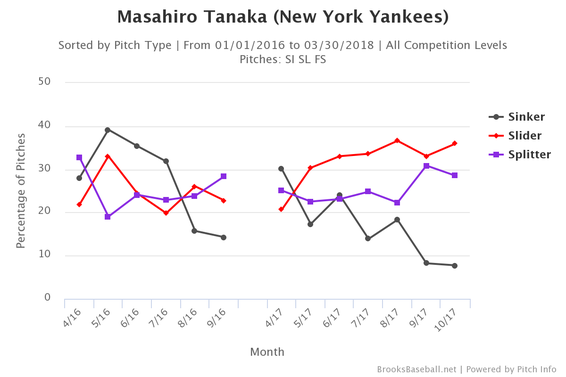
Not coincidentally, Tanaka pitched much better in the second half last year, when his fastball rate really plummeted. He had a 5.47 ERA before the All-Star break and a 3.77 ERA after the All-Star break. His home run rate also dropped from 2.0 HR/9 in the first half to a still high but better 1.4 HR/9 in the second half.
Tanaka is throwing fewer fastballs now because, frankly, his fastball stinks. Last season opponents hit .347 with a .638 slugging percentage against Tanaka's fastball. The MLB averages were .279 and .466, respectively. His 35 home runs allowed were the second most in baseball and 16 of the 35 came on fastballs. (Eight came on splitters and 10 came on sliders.)
Last year Tanaka threw a fastball only 32.2 percent of the time, easily the lowest rate among full-time starters. Yankees teammate Jordan Montgomery threw the second fewest at 41.9 percent. Simply put, Tanaka has acknowledged his fastball stinks, so he's leaning heavily on his slider and splitter. He throws enough heaters to keep the hitter honest and that's it.
Can this work long-term, throwing so few fastballs? I'm not sure, but Tanaka seems determined to find out. He's always been a bit home run prone, but the juiced ball really exacerbated the problem early last year, so something had to change. The adjustment Tanaka made was leaning on his two best pitches and putting the fastball in his pocket. He did it last year and he did it again in his 2018 debut Friday.