
Pirates rookie Bryan Reynolds won't win Rookie of the Year, but he might break a longstanding hitting record
Reynolds entered Tuesday with a .413 BABIP, which would be a new single-season record

•
5 min read
Pittsburgh Pirates rookie outfielder Bryan Reynolds hasn't yet received as much attention as his performance this season demands -- in ways both obvious and not. He entered Tuesday hitting .335/.402/.531 with 14 home runs and 35 other extra-base hits -- marks good enough for a 142 OPS+. You wouldn't know it, but the only rookie position players with more Wins Above Replacement than Reynolds this season are Pete Alonso and Fernando Tatis Jr.
As such, Reynolds is unlikely to win the National League Rookie of the Year Award. He might, however, do something cooler by breaking a longstanding obscure record.
Coming into Tuesday, Reynolds possessed a .413 batting average on balls in play -- that is, for those unaware, a player's average in at-bats where the end result wasn't a strikeout or home run. As Matthew Trueblood, the first to discover Reynolds' place in history, noted on Baseball Prospectus in August, the single-season record for BABIP in the post-expansion era belongs to Rod Carew, who hit .388 with a .408 BABIP back in 1977. Only three players -- Jose Hernandez (in 2002); Manny Ramirez (2000); and Roberto Clemente (1967) -- have so much as topped .400 during the same time period.
What has allowed Reynolds to flourish like so? Let's examine five contributing factors.
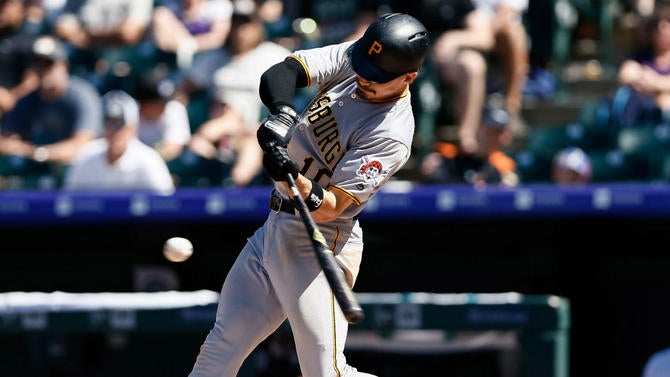
1. Switch-hitting
To state the obvious: The platoon advantage remains important. On a league-wide basis this season, right-handed hitters have a .782 OPS against lefties and a .736 OPS against righties; left-handed hitters, meanwhile, have an OPS of .787 versus righties and .724 versus lefties. Switch-hitters -- legit ones, anyway -- should have a leg up. Reynolds sure does.
Reynolds has hit .354/.425/.558 against right-handed pitchers this season, and .287/.341 /.461 when tasked with facing a left-hander. Whichever way he's facing, he's been an above-average hitter. Reynolds, unsurprisingly, has a higher BABIP as a lefty (.441 as opposed to .341), but both are well above the league-average mark for their respective hands.
2. Hitting the ball hard
If you were building a batter to post a high batting average on balls in play, you might start with the switch-hitting component. You'd probably then necessitate they make hard contact.
Reynolds entered Tuesday with an average exit velocity of 90.1 miles per hour. The league-average mark is 87.5 mph, meaning he's in the 70th percentile, according to Statcast. For some added context, Ronald Acuna Jr.'s average exit velocity this year is 90.2 mph.
Reynolds's average launch angle is around 10 degrees, which is lower than both Acuna's and the league-average mark. That launch angle is in concert with the likes of Buster Posey, Hunter Pence, and other batters who are thought of as line-drive hitters.
Interestingly, Reynolds doesn't grade well through the lens of the "barrels" metric -- a measure looking at how often a batter hits a ball a certain speed within a certain angle range. Make of that whatever you will (or won't).

3. Running well
Another obvious physical component that goes into posting a high BABIP is being able to run well, thereby positioning oneself to beat out otherwise harmless ground balls.
Reynolds isn't a burner -- he's attempted four stolen bases all year -- but he does grade as an above-average runner per Statcast's sprint speed metric. He checks in around the 74th percentile, putting him in a class with the likes of Mookie Betts, Jose Peraza, and Kevin Pillar.
Truthfully, Reynolds's ability to leg out hits hasn't been that much of an outlier this season. He's notched 15 infield hits, which is tied for the 46th-most in baseball.
4. Feel
We've talked about physical traits so far -- what about the innate? Is it possible Reynolds is succeeding because he has a better feel for the strike zone or for contact than the normal hitter? Maybe, but they predictably don't show up on the stat sheet.
Reynolds has posted roughly league-average rates as it pertains to making contact, swinging, and expanding his zone. Ditto for pulling the ball, going the other way, and hitting line drives. To Reynolds's credit, he has done a great job of avoiding pop-ups -- he's hit an infield fly about 3.8 percent of the time, as compared to the league-average mark of 7.1 percent.
Obviously there's something to be said about the limitations of aggregate data. Maybe a more granular approach would reveal that Reynolds is especially skilled at going with the pitch, or making in-sequence adjustments, than the typical hitter and than his overall numbers indicate. We're not ruling any of that out; we're just saying those effects aren't being captured here.

5. Luck
And finally, we arrive at luck. It's a four-letter word, and one people don't take well to whenever it's prescribed to an historic performance. Even so, it should not be treated as an insult. Every great season involves some degree of luck, right? If anything, it makes the season more special, since it suggests fate smiled on (and rewarded) the player in question.
Whenever we're talking about BABIP, it's important to remember that the sample is smaller than it appears -- thus there's more room for fluctuation. In Reynolds's case, the denominator in his BABIP calculation is 298 -- meaning, simply, that the difference between his .413 BABIP and a .399 BABIP is exactly … um … four hits ... over roughly 300 batted balls that weren't home runs.
Luck can show its face in numerous ways. A ball scooting under a glove; a generous scorer who assigns a hit when they should've marked down the fielder for an error; a misstruck ball that lands just in front of an outfielder; and so on. It's not hard to envision a batter catching four lucky breaks over 300 batted balls, is it?
The feat Reynolds may accomplish is special, and there's enough in his game to envision him continuing to hit for a decent average -- he is a switch-hitter who makes good contact and runs well, as noted. But make no mistake: He's benefiting at least a little from luck as well. And that's fine; it should be celebrated, even, because it's cool when everything comes together like this.
If Reynolds' luck can hold out a while longer, he's going to set a new record. Maybe he'd rather have the Rookie of the Year Award, but this isn't too bad of a consolation prize.