Royals flip the script in Game 1 of ALCS, beat Orioles with their power
Despite hitting the fewest home runs in MLB in 2014, the Royals used their power to beat the Orioles in Game 1 of the ALCS.

By
Mike Axisa
•
3 min read
BALTIMORE - On paper, the 2014 ALCS is an offensive mismatch. The Orioles led MLB with 211 home runs during the regular season -- 15 more than the second place Rockies -- while the Royals finished dead last with 95 home runs, 10 fewer than any other team. Baltimore is much better equipped to change the game with one swing.
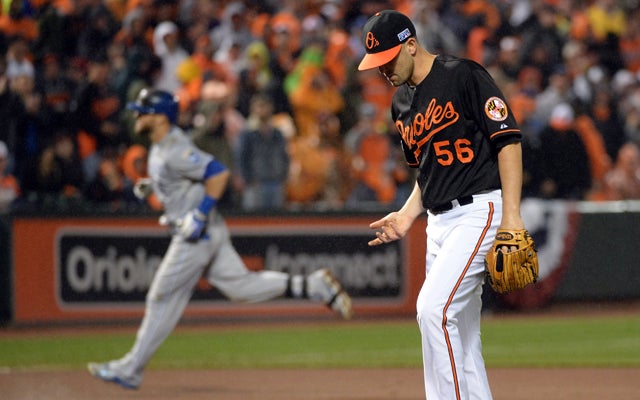
The Royals used speed and stolen bases to get to the ALCS, but in Game 1 on Friday night they flipped the script and did to the O's what the O's did to teams all year. Kansas City hit three home runs en route to their 8-6 win in Game 1 (box score) after hitting at least three homers in a game just four times during the regular season. The Orioles hit 3+ homers 27 times in 2014, by comparison.
"This is a park that's a lot more conducive to hitting home runs than our ballpark is," said Royals manager Ned Yost following Game 1 when asked about to compare Camden Yards and Kauffman Stadium. "You put our club in this ballpark, we would have hit a lot more home runs than we ended up hitting. It showed tonight. It was a good night."
The Game 1 homer parade started in the third inning thanks to an unlikely source: light-hitting shortstop Alcides Escobar. He hit three home runs in the regular season but turned on a Chris Tillman pitch for a no-doubt solo homer to left field to give the Royals a 1-0 lead. It was gone off the bat. I didn't know Escobar could hit a ball that hard.
Then, in the 10th inning, the Royals built a three-run lead on Alex Gordon's go-ahead solo homer and Mike Moustakas' two-run insurance tater. Those insurance runs came in handy when Greg Holland allowed a run and put the tying run on base in the bottom of the 10th before escaping to preserve the win.
How rare was it for Kansas City to hit two homers in the 10th? Very rare by the standard they set in 2014:
The Royals hit one home run in extra innings during the regular season. They have three in the playoffs.
— Rany Jazayerli (@jazayerli) October 11, 2014
It's actually four in the playoffs now following Moustakas' home run, by the way.
"We know we're capable of hitting home runs. We didn't do it during the regular season but, you know, it doesn't really matter now. This is the postseason," said Gordon after Game 1. "We're starting to swing the bats a lot better now, and that's good to see I think ... Up and down the lineup, we're starting to feel pretty good about ourselves. We like where we're at."
Now, is trying to out-homer the Orioles a sound strategy for the Royals going forward? No, of course not. They're still not a home run hitting team regardless of their Game 1 power display. They're a speed team. This was essentially an anomaly game for the Royals, an anomaly game at the best possible time.
This was also the type of game a team needs to win to advance deep into the postseason. We see it every year -- in every sport too, this isn't exclusive to baseball -- title-bound teams win games in unexpected ways. Someone unexpected will deliver the big hit or record the big out. Someone no one expects will be a surprise hero at some point. Every year it happens, without fail.
Considering their dearth of power, the Royals have already won three games in unexpected ways this postseason. The beat the Angels with extra innings home runs in both Games 1 and 2 of the ALDS, and on Friday they swatted three long balls to claim Game 1 of the ALCS. Kansas City is averaging 1.40 homers per game in the postseason after averaging just 0.59 homers per game during the regular season.
Game 1 could have been a very deflated loss for the Royals. They jumped out to an early 4-0 lead, James Shields and some other weirdness allowed the Orioles to tie the game 5-5 in the sixth, then they failed to score after loading the bases with no outs in the top of the ninth. Instead, the Royals shook it all off and took the first series of the year in an improbable way, by showing off their power.