Two reasons to worry about David Price and one reason he'll be just fine
The Red Sox's ace was knocked around again on Saturday, this time by the Yankees. Should Boston be worried about David Price?

By
Mike Axisa
•
5 min read

On Saturday, the Red Sox fell to the Yankees by a score of 8-2 (box score). From the Boston standpoint, the chief culprit was their ace David Price, who gave up six runs on seven hits in just 4 2/3 innings of work. He also walked three after being ahead in the count 1-2 on all three batters.
The surprising thing is that such an outing is very much in keeping with the rest of Price's 2016. Saturday's start raised his 2016 ERA to a glaringly uncharacteristic 6.75. Given that the Sox this past offseason invested $217 million in the 30-year-old lefty, concern abounds.
What's different for Price? "I don't know, honestly. That's something I've got to figure out."
— Tim Britton (@TimBritton) May 7, 2016
Should the Red Sox and their partisans be concerned about Price? Yes, but also maybe not, is the confusing answer. Now let's dig a little deeper.

1. His fastball is not nearly as effective as it has been in the past.
Saturday afternoon Price threw 67 fastballs, per PitchFX: 30 cutters, 27 four-seamers, and 10 two-seamers. That's a pretty standard mix for Price. What stands out is the velocity. His single fastest pitch on the day was a 93.5 mph four-seamer. That is the slowest top speed Price has achieved in any start in his career.
Here is Price's monthy average velocity since the start of the 2013 season, courtesy of Brooks Baseball:

Every pitcher loses velocity as they age. That's just a fact of life. Price is 30 years old, and he's been throwing 200-plus innings for the better part of a decade now, so of course there's going to be some velocity loss.
Still, that much of a dip from 2015 to 2016 is a red flag. Coming into Saturday, his average four-seam fastball this season was 93.2 mph, and obviously that's going to go down a bit after Saturday. Last season Price's four-seamer averaged 94.9 mph. He's down nearly 2 mph. For what it's worth, Price and the Red Sox insist he's healthy.
Price said he's "absolutely" healthy, and he's not worried about his velocity.
— Tim Britton (@TimBritton) May 7, 2016
Willis on Price: "We just haven't seen the velocity at this point that he's had before.... I think it'll come back."
— Tim Britton (@TimBritton) May 7, 2016
Price has excellent command, the kind of command that leads you believe he can remain effective even with a reduced fastball. He backdoors his cutter to righties with precision, and he can spot the two- and four-seamers to both sides of the plate. That's an effective strategy regardless of whether you're throwing 91 mph or 95 mph.
It does seem the reduced velocity may be leading to fewer swings and misses, however. Price got only one swing and miss on those 67 fastballs Saturday. He has three swings and misses total on 133 fastballs in his last two starts.
In his last 101 non-changeup pitches Price has got 2 swings and misses.
— Red Sox Stats (@redsoxstats) May 7, 2016
Price would routinely generate upwards of 10 swings and misses with his fastball per start in the past. It's pretty scary he is unable to come close to doing that right now. Price is a power pitcher who has spent years dominating hitters with a bevy of fastballs. That big heater is not there for him right now.
2. He's getting hammered from the stretch.
Here's a look how batters have fared against Price in certain situations this season, coming into Saturday:
Bases Empty: .247/.291/.333 (69 OPS+)
Men on Base: .291/.362/.532 (138 OPS+)
Just about every pitcher in baseball is less effective with men on base -- the MLB averages are a 96 OPS+ with the bases empty and a 105 OPS+ with men on -- but Price has been way more hittable when there are ducks on the pond in 2016.
Saturday was more of the same. The Yankees went 3 for 7 (.429) with a walk when the bases were empty against Price, and 4 for 14 (.286) with three doubles and two walks with men on base. That's a .286/.375/.500 batting line, right in line with the season numbers against Price with runners on.
It's possible Price is having some mechanical issues from the stretch and pitching with men on base. He does have a very simple windup, one that makes it appear he pitches from the stretch all the time, but it's not quite the same when men are on base. Poor mechanics could lead to a lack of execution, resulting in all that damage.
Baserunners are inevitable, even for the very best pitchers. For whatever reason Price is really struggling to keep hitters in check when there are men on base. The other team gets a man on and things keep snowballing. Price has been having trouble limiting the damage. A mechanical flaw is fixable, assuming that is actually the problem.
3. The underlying numbers are pretty good.
It goes without saying a 6.75 ERA is just awful. In fact, among the 99 pitchers who have thrown enough innings to qualify for the ERA title this year, only Wily Peralta has a higher ERA (7.50). Keeping runs off the board is the name of the game and Price is not doing it.
Some of the underlying numbers aren't nearly as bad. In fact, they're actually great. Here is where Price ranks among those 99 qualified starters in some other measures:
Fielding Independent Pitching (FIP): 2.93 (20th)
Strikeout Rate: 29.0 percent of batters faced (11th)
Walk Rate: 6.6 percent of batters faced (35th)
Strand Rate: 54.2 percent (99th)
Price has an excellent strikeout rate and a very good walk rate, which fuel that shiny FIP. The strand rate reflects his struggles with men on base. The league average is 73.5 percent and Price's career average is 74.6 percent, so he's well below that right now.
Like everything else, there is definitely some element of luck tied to strand rate. For example, Price gave up a bases-clearing double to Didi Gregorius on Saturday on a pitch that was nearly in the dirt. Check out the location:
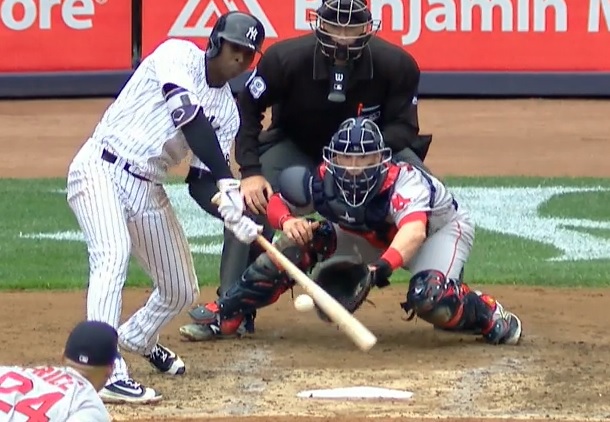
That's a pretty good pitch. It's an 0-2 changeup down in the zone that Gregorius took a little defensive half-swing at, and he managed to poke it down the line and into the corner. What can you do? Price executed the pitch and three runs scored. That's baseball being baseball.
Even with those problems with men on base, at some point that 54.2 percent strand rate will begin to creep up and approach Price's career average. Not every well-placed 0-2 changeup is going to end up clearing the bases, you know? Things will start to break Price's way before long and his ERA will come down.
For now, Price is off to a very tough start, and his fastball has to be a concern. Both the velocity loss and the inability to get swings and misses. There is definitely some element of bad luck in Price's numbers, and that should turn eventually. The fastball though? That's not bad luck. That's something physical.
Price is only seven starts into his seven-year contract, and this sort of performance can be really scary. I think it is too early for outright panic, but the red flags are very real. Price and the Red Sox have some things to fix and problems to solve. No doubt about it.