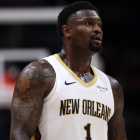
How Brandon Ingram is becoming a superstar by playing more like a role player
For the first time in his career, Ingram is playing within a system instead of dominating it

By
Sam Quinn
•
6 min read
When he Brandon Ingram went No. 2 to the Los Angeles Lakers in the 2016 NBA Draft, two months after Kobe Bryant's final game, the burden of replacing a legend fell on a 19-year-old still malleable enough to be corrupted by the ghosts of Showtime. Circumstance nearly doomed Ingram's career.
Had he gone No. 1 overall in the 2016 NBA Draft to the Philadelphia 76ers, he would have shared a roster with Joel Embiid. Had he slipped to No. 3, he would have joined a Boston Celtics roster that made the Eastern Conference finals without him the next season.
The trappings of superstardom were evident in Ingram's game from the moment he stepped on an NBA floor. Mid-range shots flowed like the wine Bryant was surely enjoying in retirement. Free-throw attempts were scarce, as the wiry Ingram was not yet bulky enough to attack the rim with consistency. What stood out most, though, was the dribbling. So much dribbling. Even as a rookie, Ingram took 2.72 dribbles per touch, per NBA.com. Among forwards to score more than nine points per game, that placed him seventh in all of basketball. You should be familiar with some of the names ahead of him: Giannis Antetokounmpo, Kawhi Leonard, LeBron James and Jimmy Butler. You'll be equally familiar with one who wasn't: Kevin Durant.
Durant was the aspirational comparison draftniks applied to Ingram, but in those early years, he fashioned himself as something a bit closer to Carmelo Anthony. He liked to hold the ball and dribble. His shooting stroke was evident, yet so often he found himself stepping inside of the arc before firing.
His partnership with LeBron was doomed before it even began because Ingram treated it as, well, a partnership. He held firm stylistically rather than adjusting to perhaps the greatest player of this generation, and through no fault of his own. He never needed to do the little things most players do to rise through the ranks. These are the habits lottery picks develop on lottery teams.
And they would have been justified on a Pelicans roster ravaged by injury early in this season. A glance at Ingram's astonishing raw numbers would indicate that he is doing just that. Rarely does a player average 26.8 points per game to open a season by controlling the ball less. But the numbers don't lie. Ingram is both holding and dribbling the ball at career-low rates.
| YEAR | AVG SECS PER TOUCH | AVG DRIBBLES PER TOUCH |
|---|---|---|
2016-17 | 3.52 | 2.72 |
2017-18 | 3.94 | 2.94 |
2018-19 | 3.82 | 2.82 |
2019-20 | 3.09 | 2.09 |
Where once Ingram killed the flow of his offenses by ceaselessly and aimlessly pounding the rock, he is now playing the most decisive basketball of his career. He is averaging career-highs in points, rebounds, and assists. At his current pace, he will garner serious consideration for an All-Star selection, if not an All-NBA nod. The irony in all of this happening now is practically palpable. After years of acting as a superstar would, Ingram is only now performing like one, and he's doing it by playing much more like a role player than he ever had before.
In a piece Rob Mahoney wrote for Sports Illustrated in October, he told the story of assistant coach Brett Gunning reveling in the Houston Rockets' league-low 4.2 mid-range shots per game last season. Immediately afterward, Russell Westbrook chimed in. "Those 4.2?" he declared to the team, "those are mine."
It was a joke grounded in growing truth. Mid-range jumpers used to be the backbone of NBA offenses. They are now portioned out on merit. Superstars are allowed to take them. Role players exist to facilitate them. Their job, on most offensive possessions, is to space the floor and hit shots from behind the arc to ensure that when players like Westbrook fire away from the court's most inefficient area, they are doing so with as much breathing room as possible.
Ingram's shot profile over his first three NBA seasons looked very much like those of the superstars who are allowed to take mid-range attempts. They haven't disappeared from his arsenal entirely by any stretch, but through four games, only 13.1 percent of his shots have been the dreaded long 2-pointers beyond 16 feet. That is a career-low. The decline goes hand-in-hand with the playing style that enabled those shots. Ingram is using only 13.3 percent of his possessions on isolations this season. That is still a reasonably high number, but it is also the lowest of his career.
Those career-lows are matched by an even more tantalizing career-high. Prior to this season, Ingram had never attempted more than 2.4 3-pointers per game. But Jrue Holiday and Lonzo Ball running the majority of New Orleans' offense necessitated a change. Ingram needed to learn to cope with life off of the ball, and so far, he has. Through five games, he is averaging 6.4 attempts per game, most of which are of the catch-and-shoot variety. More importantly, he doesn't have even a sliver of hesitation in taking them. Just compare Ingram's posture on 3-pointers last season to this season. The difference is stark.
Last season, Ingram had little idea what to do without the ball. His solution typically boiled down to waiting for it to find him. This season, he's demanding it in a shooter's pose, already in his motion by the time he catches it. That purposefulness has given him a major confidence boost. Ingram is shooting 50 percent from behind the arc this season.
That isn't sustainable for anyone, much less a below-average shooter over the past three seasons, but the inevitable decline doesn't need to be a steep one. Ingram's approach is meaningfully different this season, and that should lead to meaningfully different results. It is present throughout his game. It has been particularly noteworthy in his transition scoring, where Ingram is becoming a master at identifying poor cross matches in the chaos that follows a miss and attacking it mercilessly. Enjoy this compilation of him embarrassing point guards and big men who had the misfortune of getting lost in his neighborhood.
The old Ingram preferred to play with his food before he ate it. This version is a terminator. He identifies the mismatch and makes quick, hard moves to exploit it. The defense hardly knows what's coming, even if it very often creates its own demise. Alvin Gentry is such a transition maestro that most teams punt on offensive rebounding entirely against the Pelicans. That allows Ingram -- averaging 8.2 mostly uncontested rebounds per game -- to build up a head of steam. Once he's rolling, there isn't much a defense can do to stop him.
That kind of athleticism and skill is a rarity among role players, but then, Ingram was never meant to be a role player. He just needed to live like one long enough to find the balance necessary to coexist alongside better players. He failed in his first such test with James. The second, more important one is looming.
Just as Ingram was jettisoned from the Lakers in service of James, the Pelicans will soon need to make a decision on his future based on his fit with Zion Williamson. Ingram, who did not sign a contract extension prior to last month's deadline, will be a restricted free agent in July. Ball is eligible for an extension this summer as well, and New Orleans has a stable of young players who will eventually need to be paid properly.
The ones who are will be the ones who fit alongside Williamson. That wasn't Ingram when New Orleans acquired him. With Ball and Williamson -- two non-shooters -- entrenched as long-term starters, there was simply no future for Ingram as a Pelican if he did not become a true floor spacer.
Now that has happened, and it changes everything for the Pelicans moving forward. If Ingram maintains this level of play, he will have become the perfect co-star for Williamson. He's learned to exist within the framework of a team without sacrificing the one-on-one skill that made him a No. 2 overall pick in the first place. Both will be essential for this team for the long haul. As explosive as Zion will be, he isn't a proven half-court shot-creator. Ingram is. And now, he's so much more.