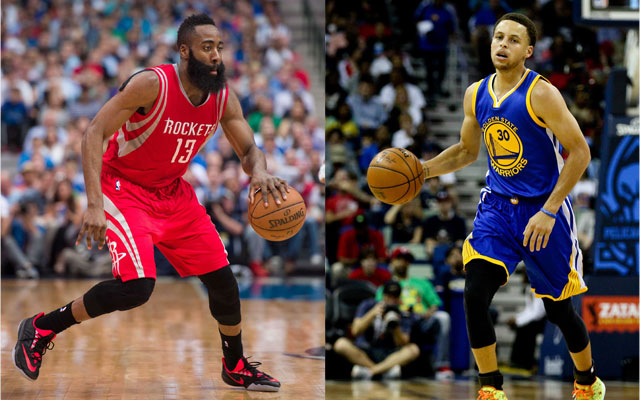
MVP Debate Part 3: Is Steph Curry or James Harden MVP?
A tale of narrative, garbage time, wins, losses, and the best MVP race of the past 20 years in James Harden vs. Stephen Curry.

By
Matt Moore
•
12 min read

Over the past two weeks, I've driven myself crazy over the Most Valuable Player award. which is funny, since of course, I don't have a vote. But I wanted to really dig down and see what the most complete picture is, to try and figure out the truth of who deserves it, Stephen Curry or James Harden.
I broke down the two players' scoring exploits, examining how they rack up the buckets and what their efficiency metrics look like.
In part two, I looked at their passing and defense, to see how the actual possession-by-possession performance measures up between the two.
I've watched roughly six hours of video in preparation for these breakdowns, not only in individual possessions, but their best games. I've talked to as many people as I could, read as many stats as I could find, and ruminated on this for far too long.
And after all this work, I'd still call it too close to call. The metrics and eye test paint a picture, and that picture leans a certain way. But we need more than highlights and metrics. We need to put their seasons in context. Let's try and do that today, and we'll start with the elephant in the room.
THE ONE-HAND-BEHIND-HIS-BACK ARGUMENT
The word narrative has gone through quite the rollercoaster over the past few years. First it just meant "story." Then it became "fabricated story that ignores the facts." Then it kind of circled back and it really just means "story" again. And narrative matters for the MVP. Voters and fans care about the story of how a player performed that year. What kind of player did he show himself to be. What kind of an inspiration was he? How did he handle his success? These things matter, whether you like them or not -- and there's a decent split on how many people do and do not.
James Harden's best hope for winning the award comes from this place. Most of the traditional measures for such a thing fail him here. Steph Curry is the best player on the best team. Steph Curry has a stronger media presence (despite Harden's hilarious array of commercials). Curry plays in a smaller, but more media friendly market. Curry plays for the darlings of the NBA, the Rockets are viewed as annoyingly nerdish to sycophantic in wide swaths of NBA culture.
Yet Harden still tops him here, because of this: He has carried a larger load than Curry, and been more efficient than the others who would challenge him on that. I've already broken down why this is a two-man race, but just to circle back; Westbrook has had to carry a heavier burden this season without Kevin Durant (and later Serge Ibaka) but also hasn't been as efficient. His defense dropped off a cliff, his turnovers skyrocketed, and his shooting efficiency went down. I don't mind that Westbrook shot over 40 times on his way to 54 Sunday. But the cumulative effect the burden has had on him drops him back only in comparison to Curry and Harden.
Harden's burden was an elephant, though. Dwight Howard has appeared in just 40 games this season. That's the guy that was supposed to be either Star A or Star B to Harden, the former MVP candidate and the guy many believed would hold the mantle of "best NBA center" for the next decade. Instead after a strong start, he was just gone, taken by a knee injury that would not get right.
And Harden thrived. He carried the offense possession after possession, keeping leads out of reach and crushing momentum when opponents would make a run. He's the unquestioned leader of the team, and his improvement on defense (which we chronicled earlier) has made him The Guy. Without Howard, someone had to provide for that missing part of the offense. Harden delivered. Big time.
There is a side to this that doesn't get talked about enough, though. Howard also soaks up a huge measure of possessions. His efficiency is lower than Harden's in every measurable category outside of field goal percentage (because Howard shoots only at the rim), but it still means that Harden's increased production is in part due to the fact that he was able to absorb that many possessions. It's the same measure that affects Westbrook. Of course he produces to a larger degree. He always has the ball. Howard's absence meant the defense could key more on Harden, but it also meant that Harden never had anything but a green light. He didn't have to take care of the other Rockets to ensure they were getting theirs; that's not how their offense works. Curry was in a different situation.
Still, Howard wasn't the only absent Rocket. Terrence Jones missed most of the season. Pat Beverley went down weeks ago. Donatas Motiejunas went down for the season within the past two weeks. The Rockets only added Corey Brewer in December, and Josh Smith not until the end of that month. Houston's been short-handed, and in flux for the entire season, yet Harden has maintained his level of excellence, and the Rockets have kept winning in the toughest division in the most difficult conference we've seen in 20 years.
This context is why Harden is getting so much love from other players for the award, including Blake Griffin among others. To be the one guy the defense is concerned about, and to still deliver with Harden's efficiency and production is crazy. The opposition is concerned with Harden first and foremost, but he's still burned them cinders at every opportunity.
Here's my biggest issue with that line of thought: you can't punish Steph Curry for that. You can reward Harden. You can say it's impressive. But to say "Curry didn't have to do as much" takes away from the fact that neither player had a choice in the matter. The MVP should be awarded based on who has been the most valuable to their team, to who has been the most outstanding player, to who has put together the best overall performance, depending on your definition of that delightfully and brilliantly vague term "valuable.
(Side note: My annual standing ovation to whoever came up with this as the term for the award, which creates all these debates. Just be aware, if you ask five NBA fans what "most valuable" means, you'll get five different answers. It's maddening for those of us that seek "the truest" answer, but it's genius for marketing.)
Curry has made the absolute most of what his team needed him to. So has Harden. That Harden was faced with a handicap shouldn't count against Curry, and it shouldn't decisively swing the vote to Harden, either. I can appreciate what he's done, stand in awe of how much he's had to take on, and still think that what each player did on the floor this season should matter most.
By the same token, Harden shouldn't be punished because his teammates were worse shooters and worse overall players than Curry's this season, nor should Curry gain considerable favor because of that.
Now keeping their performances within the context of their teams is important. But for the sake of argument, let's put it this another way. Everyone loves the "if you take Player X off of Team Y and replaced him with Player Z" argument, which is stupid. Those teams were specifically built for those specific players. But let's instead remove the specifics of their performances, look at their aggregate, and examine them in a neutral context.
If you took Curry's performance, and you took Harden's performance, and you removed them from the specific context of their teams, and placed them on an average team, say, the Milwaukee Bucks, how do their performances look? I'd argue they'd probably win a close-to-similar amount of games to one another. Their numbers would still look amazing. But in that context, whose performance would seem most valuable? If you believe one would win significantly more games than the other, that's a strong (but easily debated) argument in their favor.
Again, this isn't to take away from what Harden's had to do this season, or to lessen his accomplishments. It's to examine, within the context of these two brilliant players head to head, whether that argument should really swing the vote. It doesn't for me. But we're not done yet.
THE GARBAGE TIME VANISHING ACT
The counter to Harden's Atlas impersonation is the absence of Curry's fourth quarters. In short: the Warriors blow everyone out so often that Curry doesn't have to play. The theory goes that if he did, he would be dropping 40 points each and every night and this argument wouldn't even be a thing.
This, also, is a little misguided.
So again, let's go back to what we said before. You can't punish Harden because his team needed him to play fourth quarters, nor should you necessarily punish Curry because he didn't have to. It's essentially a wash. Harden was needed, in a vital capacity in those fourth quarters, and he delivered. Curry wasn't needed, and those fourth quarters exist as Schrodinger's Buckets. Curry both would have and would not have scored in those fourth quarters. It is a complete unknown.
We know what Harden did when he was on the floor in those games, which was deliver. You can say "And we don't know the same about Curry, hah! Eureka!" but hold up. We also don't know if Curry would have blistered the sun as he did in the first three quarters.
Curry's minutes in the first three quarters could be arguably more meaningful, but you could say the same for Harden's fourths. You need to take the complete picture of both players and measure them against one another in order to determine who the MVP is. Not simply hand one player the victory for what he did or did not have to do.
WINNING TIME
Finally, I was drawn to this number. Both are scorers, we touched on that in part one. They both do more, way more, but that is their primary identity. So I wanted to know what their teams looked like when they put up those numbers.
Now, bear in mind I think a lot of this is flawed. I don't think that you can look at Russell Westbrook scoring 54, and say "Doesn't matter, he lost." You do as much as you can and that's all you can ask of yourself. However, when we're in a race this tight, between these two great players? I did want to see how their individual performances shaped their team's exploits.
Because of the 4th quarter element we talked about above, Curry's got fewer 30-points-or-more performances. That's to be expected, as it is that Harden has more. The numbers are interesting.
When James Harden scores over 30 points, the Houston Rockets are 30-5 this season. When Stephen Curry scores 30 or more, the Warriors are 16-1. Because I was curious. When Curry scores 25 or more with five or more assists, the Warriors are 27-5. The Rockets are 34-7 when Harden does the same.
When Harden scores less than 15 points? The Rockets are just 3-5. When Curry scores less than 15, the Warriors are 8-1. That mostly speaks to what we talked about above, which is the strength of their teammates, but it's still something that raises an eyebrow.
So look at those numbers above. When Curry is "great," the Warriors win at a higher percentage than the Rockets do when Harden hits the same level. But when Harden struggles, the Rockets lose far more often than when Curry does. How do you parse that out?
Those numbers are outrageous. You want to know why those two are the MVP candidates? That's a great indicator. Their strong performances correlate strongly with their team's success, even if that doesn't equal causation, and the same can be said for Harden and his team's struggles.
The reason I bring this up within this context is that it sets up how I came to my conclusion for who the MVP should be. Ready for the section break?
AND THE WINNER IS
This is the best MVP race I can remember. Kobe vs. Nash 2006, Kobe vs. LeBron 2009, LeBron vs. Durant 2013, none of them have been this close. It is painful that one of these two players isn't going to get the award. In 2011, I argued for a split vote between Derrick Rose and Dwight Howard. It's tempting to split this one and hope both players get it. Yet that year was more about major problems with each of the candidates, from Rose to James to Howard.
This year deserves better. It's been too good of a race for there not to be a winner. I do think this sets up as the tightest race we'll have seen in a long, long time. LeBron James is going to take votes away from Stephen Curry's block, Russell Westbrook could take votes away from James Harden's. I think many voters still haven't put their votes in.
These two phenomenal players are the best the league has had to offer this year, and each should be praised, lauded, honored for what they've given their teams, their fans, and their sport this season. But someone has to win. So here goes.
Here's what I came away with after all my research, all my rumination, all my obsession over this MVP race.
Steph Curry's best was better than James Harden's best -- by the most microscopic of differences -- and occurred more consistently throughout the season, even if Harden's best was needed more often, and even if Curry's best was only needed for three quarters.
Curry has an edge in each of the metrics in the first two posts. Curry has more highlight reels to boost the eye test. He has more signature performances against top opponents on national television, and he's the player of the two that if he's cooking, you rush to text your friends and tell them to turn the television on. That shouldn't count against Harden, but it does count for Curry.
At the end of all of it, I return to this. Curry is the most lethal off-the-dribble shooter I've ever seen. He is the only player outside of Michael Jordan that I can remember watching who you need to pick up at half court or earlier and defend. You can run half-court pick-and-roll sets for Curry. No one shapes the defense the way that Steph Curry does. No one changes what they have to do, makes them feel so helpless, sets basketball fans' jaws unhinged like Curry. Harden is nearly as special. So very, very nearly. But Curry is unlike anything we've ever seen before.
Steph Curry should be your 2015 NBA Most Valuable Player.
If you'll excuse me, I'm going to go lie down somewhere and rest my brain.