NBA Playoffs: Warriors, Rockets, Celtics and Cavs all embrace the 3-pointer; here's how they excel from downtown
A 3-point profile on all four conference finals teams, including where and how they get their shots and who shoots them

By
Jack Maloney
•
9 min read
As you may have heard at some point over the past few seasons, the 3-pointer has taken over the game of basketball. For the sixth straight season, the league set a new record for 3s made, with the 30 NBA teams combining for over 25,000 triples.
For a quick look at just how quickly 3-point usage has changed, consider this. Just 20 years ago, the Houston Rockets led the league by shooting 20.4 3s per game. Every single team took more 3s than that this season, and, ironically, the Rockets once again led the way. But this time they hoisted a whopping 42.3 long-range shots per game. Even just 10 years ago, the Warriors were the most prolific 3-point shooting team, averaging 26.6 per game; that would have placed them just 23rd in the league this season.
The point is, the 3-pointer is more important than it's ever been, and that is especially true for the four teams remaining in the playoffs. Over the regular season, the Rockets were the most prolific 3-point shooting team, the Golden State Warriors and Boston Celtics finished first and second, respectively, in 3-point percentage, while the Cleveland Cavaliers were fifth in attempts and sixth in percentage.
Ahead of the conference finals, here is a look at each team's 3-point profile, including where and how they get their shots, who shoots them, and where they excel.
 Houston Rockets
We'll begin, most logically, with the Rockets, who have been the most prolific 3-point shooting team, both in the regular season and the playoffs.
3-pointers attempted/game | 3-point percentage | Ranks | |
Regular season | 42.3 | 36.2 | 1st/14th |
Playoffs | 39.9 | 35.3 | 1st/11th |
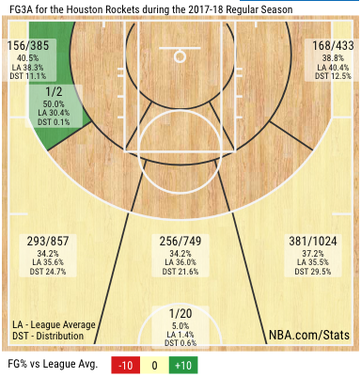
A look at the Rockets' shot chart from the regular season:
Houston's most frequent 3-point shooters in the regular season:
Player | 3PA/G | 3P% |
10 | 36.7 | |
8.8 | 35.9 | |
7.3 | 36.9 | |
6.9 | 36.8 | |
6.5 | 38 | |
5.1 | 38.6 | |
P.J. Tucker | 3.8 | 37.1 |
While the Rockets weren't exactly the most accurate 3-point shooting team, they were able to shoot at about a league average level (36.2 percent) from behind the arc, and doing that while launching far more 3s (3,470) than everyone else (2,924; second-most attempts), you get a lot of points.
Aside from the sheer number of 3s the Rockets put up each night, there were a few things that set them apart. Of course, they get plenty of looks, especially in the corners, from Chris Paul and James Harden driving into the teeth of the defense and spraying the ball out to open shooters. But that shouldn't come as much of a surprise, and frankly isn't very interesting. Let's look at some of the more interesting aspects of their 3-point attack.
The first is how fast they get those 3s up. Nearly 17 percent of their total shot attempts were 3-pointers that came either early or very early in the shot clock. Only the 76ers and Nets took more early 3s. Now, the Rockets aren't exactly the "Seven Seconds Or Less" Suns, but they do like to get out in transition, and when they do, it often leads to 3-pointers with their multitude of shooters spotting up around the arc.
Secondly, the Rockets -- specifically Harden -- love taking 3-pointers after lengthy dribbling sequences. A whopping 8.7 percent of their total shots came on 3-pointers that were launched after a player took seven-plus dribbles.
To put that in perspective, there were multiple teams who took less than one percent of their shots in that way, and the second-place team was the Trail Blazers, at 3.6 percent. If you want another look at how ridiculous this stat is, the Blazers took 242 3s after dribbling at least seven times. Harden, alone, took 283.
 Golden State Warriors
Next, we'll look at the Rockets opponent in these Western Conference finals: the Golden State Warriors.
3-pointers attempted/game | 3-point percentage | Ranks | |
Regular season | 28.9 | 39.1 | 17th/1st |
Playoffs | 29.8 | 32.9 | 6th/15th |
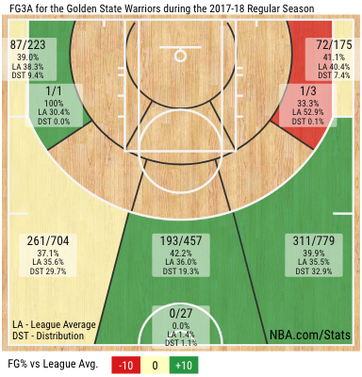
A look at the Warriors' shot chart from the regular season:
Golden State's most frequent 3-point shooters in the regular season:
Player | 3PA | 3P% |
9.8 | 42.3 | |
7.1 | 44 | |
6.1 | 41.9 | |
4.1 | 37.7 | |
3.7 | 30.1 |
The Warriors are synonymous with the 3-point revolution, and for good reason. You have to go back to 2009 to find the last year the Warriors weren't in the top five in the league in 3-point percentage. And once again this season they led the league in efficiency from downtown, shooting 39.1 percent. (They've struggled in the postseason, shooting just 32.9 percent from behind the arc, but, of course, Stephen Curry was not in the lineup for the entire first round.)
But for all their prowess from 3-point land, it's really just three players that opposing teams need to worry about: Curry, Klay Thompson and Kevin Durant. Now, when those three players include two of the league's three best players and another All-Star, that's plenty to worry about. But the point remains: The Warriors don't have a roster full of 3-point specialists.
Like the Rockets, they enjoy pulling 3s early in the shotclock (often in transition), with 16 percent of their total shots coming as "early" or "very early" 3s. Curry, in particular, seems to gain a thrill from knocking down these quick 3s -- over 18 percent of his total shots are 3s that come "very early" in the shot clock -- on the break, which can often be completely demoralizing to opponents.
As his college coach, Bob McKillop, said in an ESPN feature this week, "He [Curry] has a relentless appetite for putting a dagger in people," McKillop says. "He found great joy in winning but particular great joy when one shot, one play, could just completely demoralize somebody."
Another reason for the Warriors' prowess from beyond the arc is their ability to catch and shoot quickly, and with precision. They led the league by shooting slightly over 40 percent on 3s where the player had the ball in their hands for less than two seconds. It's mighty tough to defend the 3-point line when the ball is out of the shooter's hands before you can react.
Thompson is particularly adept at this aspect of the 3-point game. He took 6.2 3s per game -- good for fifth in the league -- during which he held the ball for less than two seconds, and knocked down a remarkable 45.3 percent of those looks.
 Boston Celtics
As we move to the Eastern Conference, we'll start with the Celtics, who finished the regular season second only to the Warriors in 3-point efficiency.
3-pointers attempted/game | 3-point percentage | Ranks | |
Regular season | 30.4 | 37.7 | 10th/2nd |
Playoffs | 30.3 | 36 | 4th/8th |
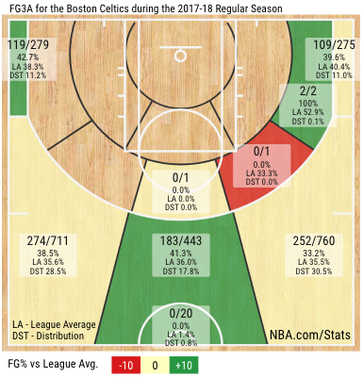
A look at the Celtics' shot chart from the regular season:
Boston's most frequent 3-point shooters in the regular season:
Player | 3PA/G | 3P% |
6.8 | 40.8 | |
5 | 38.1 | |
4.6 | 30.1 | |
4.4 | 39.5 | |
3.1 | 42.9 | |
3 | 43.4 |
The Celtics, obviously, do not have Kyrie Irving anymore, and have not had him for the entirety of their playoff run, which has changed some of the numbers above. Terry Rozier is averaging eight 3s per game in the postseason, while Jaylen Brown is taking nearly six a contest. Other than that, however, the numbers are relatively similar to the regular season.
As for the shot profile as a team, the biggest change has been in that they now take far more 3s late in the shot clock. In fact, the number of 3s they take in the last seven seconds of the shot clock has doubled in the playoffs to nearly 13 percent of their total shots. Part of this is the game just slows down in the playoffs, but it's also in large part because without an elite offensive player who can break down the defense at any moment, the Celtics have had to rely more on running through their sets to get open looks.
Of the four teams remaining in the postseason, the Celtics are taking the most 3s categorized as "late" or "very late" in the shot clock -- 10.2 per game. This has somewhat worked out. On "late" (4-7 seconds left) shots they are shooting over 45 percent. But on "very late" (0-4 seconds left) shots they are making just 27.7 percent of their looks.
The most notable aspect of the Celtics' 3-point profile -- and really their game in general throughout the postseason -- has been the splits between home and away. They're 7-0 at home in the playoffs, but just 1-4 on the road, and a lot of that has to do with their shooting splits.
At TD Garden, they're shooting an even 40 percent from downtown, a very solid mark. But away from home, that number plummets to 30 percent, which is not good at all. And no one on the team exemplifies that more than Rozier. "Scary Terry" has been a revelation this postseason, but his play -- especially his shooting -- has been far superior in Boston. He's shooting a stellar 50.9 percent from 3-point land at home in the playoffs, but just 24.4 percent on the road.
With Rozier taking over eight 3s a game, that makes a huge difference as you're talking about 12 points off Rozier 3s or just six points off them. Oh, by the way, but the Celtics have won four home playoff games by six points or less.
 Cleveland Cavaliers
Finally, we come to the Cavaliers, who, led by LeBron James, are trying to make the NBA Finals for the fourth straight season. They were the only team in the regular season to finish in the top-six in the league in both 3-point attempts and 3-point percentage.
3-pointers attempted/game | 3-point percentage | Ranks | |
Regular season | 32.1 | 37.2 | 5th/6th |
Playoffs | 30.8 | 35.1 | 3rd/12th |
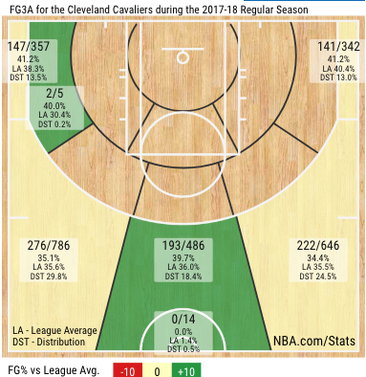
A look at the Cavs' shot chart from the regular season:
Cleveland's most frequent 3-point shooters in the regular season:
Player | 3PA/G | 3P% |
5.6 | 41.5 | |
5.2 | 43.6 | |
LeBron James | 5 | 36.7 |
J.R. Smith | 4.8 | 37.5 |
3.9 | 40.7 | |
3.4 | 35.2 |
The Cavs had a rare distinction of being both a high volume 3-point shooting team, and an efficient one. That's because they have an abundance of players capable of knocking down shots from the outside. During the regular season, they had six players taking at least 3.4 3s per game while shooting at least 35 percent. If you can put out a lineup with five guys capable of making an open 3, it makes life much more difficult for your opponent.
In addition, the Cavaliers were one of only two teams to finish in the top-eight in 3-point percentage on both catch-and-shoot 3s and off-the-dribble 3s.
Of course, they prefer to take the catch-and-shoot opportunities, as those are a much more efficient look. And they were especially strong on those kind of shots. Over 28 percent of their total shots on offense came off catch-and-shoot 3s, and they hit an even 39 percent of them, good for fifth in the league.
Much of that is thanks to Kyle Korver, who is one of the most accurate spot-up 3-point shooters in the league. Among all the players who took at least four catch-and-shoot 3s a game, only Joe Ingles shot better than Korver's 46 percent. He has such a quick release, and is pretty much automatic if you give him any kind of space.
But it wasn't just Korver, as both Kevin Love and J.R. Smith shot over 39.5 percent on catch-and-shoot tries from downtown. And that's not surprising, because when you have a player like LeBron James who can draw the attention of the defense and make passes on the money, life becomes a lot easier for the shooters on the perimeter.
Speaking of James, he also had a strong season from 3, shooting 36.7 percent from downtown, his highest mark since 2014. And when it comes to the Cavs' ability to make pull-up 3s, you have to look no further than "The King." LeBron is more than comfortable staring down his defender and walking into a 3.
Only eight players in the league were better at shooting triples off the dribble than LeBron this season, as he knocked down 36 percent of his looks that way. It's a shot he can get whenever he wants, and there isn't much the defender can do besides hoping he misses.