Should NBA teams only rebuild toward a championship?
Winning titles is why teams compete. But is there value in teams looking to simply be "good" as long as they keep their futures open?

By
Matt Moore
•
10 min read

In this rebuilding series, we've covered whether there's a proper timeline for rebuilding (Part 1), and whether you should rebuild through the draft, free agency or trades (Part 2). In our final segment, we'll go a bit more philosophic, on a question that seems to have an obvious answer on the surface, but in reality is much more complex.
Should your only goal in rebuilding be to win a championship?
THE NARROW WINDOW
On the surface, that question seems painfully obvious. The entire point of teams competing in professional sports is to win championships. Why would you spend the time and effort on building a team that isn't good enough to win a title?
Two things about this:
1. It assumes that the team you're realistically trying to build has winning a title as an actual ceiling. In reality, a lot of teams try and build a team good enough to compete for a playoff spot, and then leap into contention with either a trade or free agent. The Pacers did this by building a young core with Danny Granger, Paul George and Roy Hibbert, then added David West after their strong 2011 push vs. the Bulls and leapt to a contender in the Eastern Conference. The Rockets built a team with James Harden good enough to push the Thunder, and parlayed that success into signing Dwight Howard. Those teams didn't specifically have plans to sign those specific players when they started their process. Instead, they were just looking to "get better," which may be the most often used buzzphrase in professional sports, but it's also a realistic path to limiting both expectations and keeping a ceiling open.
2. It assumes your window is really open, and that window doesn't just depend on how good your team is. It has to do with the rest of the league.
This gets tricky because players, fans and team officials never want to outright admit that their ceiling isn't high enough. But there is a degree to which you need to survey the landscape to properly analyze exactly how good your team can be. You're not just competing against an average, you're competing against every other team in the league, from the dreck to the prestige. And within that construct comes certain unavoidable realities, and often among them is the fact that certain teams and players have a chokehold on the championship window.
Let's start with LeBron James. He is going to be on a contender in the Eastern Conference for the next five years at minimum. If you're in the Eastern Conference, you have to realistically look at your team and ask not whether you're a really good team, but if your team is realistically going to be better than one helmed by LeBron. That's not to say no one has a chance. The Pacers, for all the grief they took over their meltdown in 2014, had a very legitimate shot in 2012 and 2013 at beating Miami. They were right there. Let me put it this way: The 2013 Pacers would have run roughshod over the conference last year, even as good as the Hawks were. But if your team is in the dreaded "middle," you have to look at LeBron's existence within your conference and understand that as long as James is around, your window is pretty tight and you're going to need fortune (read: injuries or Cavaliers team discord) to get past.
In the West, it gets even more brutal. The Warriors have good reason to believe they are better than every other team in the conference. The Thunder, Spurs, Clippers and Rockets have reason to believe they can be the best in the conference. The Grizzlies have reason to believe they can beat anyone in the conference.
Outside of that, is there any team with a realistic chance of winning the West? No, and that's not because the Pelicans, Suns or whoever aren't good teams. You make the playoffs in the West? You're a great team. That's how high the competition level is in the West. But it's not just about how good your team is; it's all about the level of competition.
Think of it as an actual window, the most trusted metaphor. How good your team is determines whether the window is open or not. You can't get through that window if it's not open. However, if the window is too narrow, length-wise, you can't leap through either. And how narrow or wide the window is is determined by how good you are compared to the other teams in your conference.
This chart isn't based on data; it's just a visualization of what I'm talking about:
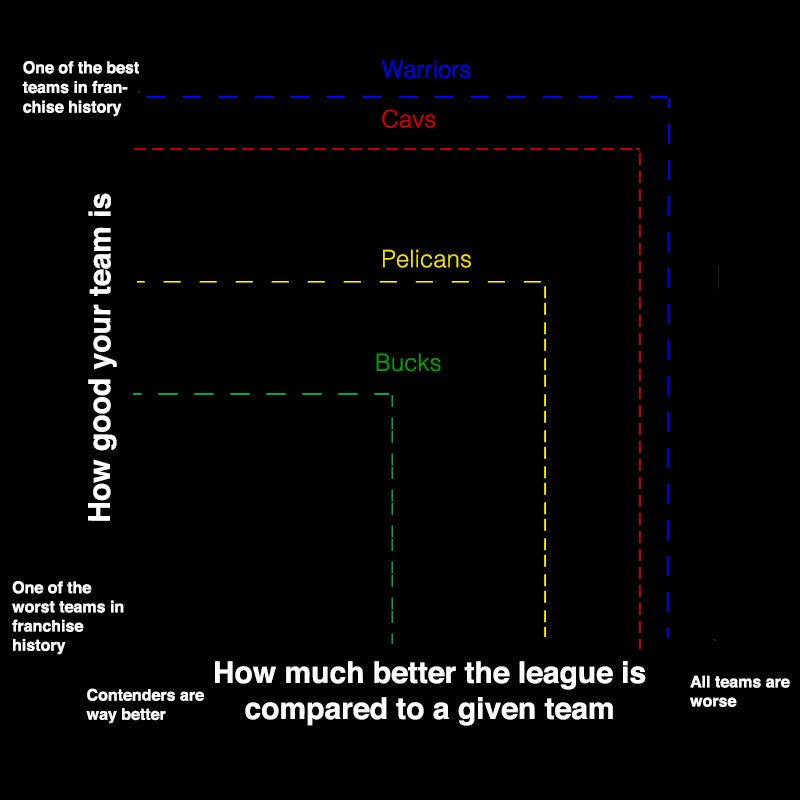
You can argue about the gap between the Cavs and Warriors, or the Bucks and the Pelicans, but that's not really the point. The point is that the Bucks will likely field a very good team next year based on their last 10 seasons, but they have almost no shot of making it through the window because it's comparatively narrow due to the presence of LeBron James and the other Eastern Conference contenders.
This isn't rocket science. I'm just trying to explain the nuance behind the idea of "other teams are better." Again, going back to the first point, if you get to where the Bucks are, you can make a move and make the leap (or develop that move if Jabari Parker or Giannis Antetokounmpo make the leap).
Here's where our original question comes into play. If you're beginning or in the middle of your rebuild, and you realize that your window will never be open enough to get through in your time frame because of how good your team is relative to the rest of the league, should you even try and compete?
DIFFERENT STROKES FOR DIFFERENT FOLKS
We started our series talking about the Sixers, Celtics, Magic and their relative approaches to building a team. We're going to return to them briefly and throw in the Bucks because it covers the gamut.
The Sixers' philosophy is "championship or bust." And they are continually busting on purpose to make sure that when they jump through that window, it's open enough. Let's say the Sixers had taken the opposite approach. They traded for Nerlens Noel back in 2013. Let's say they tanked that year and only that year, and in 2014 drafted Aaron Gordon and Elfrid Payton. What if they kept Thaddeus Young and signed a few value free agents. What's the absolute highest realistic upside of that team?
It could be good, very good in fact, given what Gordon and Payton showed last year. But the next five years are going to be dominated by Steph Curry, Anthony Davis, LeBron, Harden, and that's just a short list. The Sixers are so resolutely opposed to what happened to them in the mid-2000s -- being a 7th or 8th seed with a second-round ceiling, and trapped in what felt like eternal mediocrity -- that they will forgo any aggressiveness in pursuit of making sure the core is right from the get-go.
Here's the thing: that philosophy, at heart, you can't disagree with. You can argue about the morality of tanking (which seems unnecessary given the greater moral questions of our age), and you can argue about the specific decisions Philly has made (like I have about drafting Embiid and Saric, or trading K.J. McDaniels). Yet you can't argue with the idea that the point of all the pain rebuilding causes a team and its fanbase is to set it up to contend for a title. That's a fundamentally sound philosophy.
A much more interesting question is whether there's inherent value in rebuilding to a level that comes up short. The Sixers would say no, because of that sickening point of mediocrity. A lot of general managers have talked about how bad that middle is. Mediocre is so disappointing. Your fans can't get excited because you're only OK, but you can't just blow it up because you did win 40 or so games.
All 7th and 8th seeds aren't created equal, though. We already discussed the Rockets and Pacers, who made leaps from low seeds to conference contenders. The Pacers didn't win the title and the Rockets may or may not, but if they don't, you can't argue that their moves were made in vein. They were within the range of contention. They had teams good enough. Sometimes the other guys are just better. Their fans wouldn't trade those years for anything.
Let's look at Milwaukee and Boston, though. The Bucks were the sixth seed in a dreadful conference last year, while the Celtics squeaked in as the 7th. Both teams should be better next year, with another year of the Celtics' "core" together (though I'm skeptical on how much they'll improve) along with some acquisitions. Milwaukee figures to be a legit force in the conference, and perhaps a top-four seed if everything goes right. The Bucks are improving internally with the Greek Freak and Jabari, and they added Greg Monroe. They still have their eye on the future, which is why they traded Brandon Knight to avoid having to pay top dollar for him in free agency. They still should be quite good this year.
Are the Bucks ever going to win a title with this "core?" Right now that seems impossible. That's not to say magic couldn't strike; there are outliers in sports, and that's what makes it fun. But even if they don't, they'll get their core players' experience in playoff settings, give the fans something to be excited about, make some revenue for a small-market team that struggles to carve out a niche locally and, above all, have a good team.
There's inherent value in having a "good" team even if it's not going to be truly great. Being great is often beyond your control, as we talked about in Part 1.
That's the quandary the Magic find themselves in. Can their core of players be "good?" Can they be exciting? Can they become a team that people remember? They likely won't wind up as good as the 2009 or 2010 Orlando teams (both of which were title-worthy, particularly 2010). However, the path the Magic have set themselves on at least gives them the best combination of future upside and excitement right now.
That's likely the biggest key: balancing between building a good team now and keeping flexibility open so you can improve. The Bucks can make a leap. The Magic could make a leap if Victor Oladipo, Payton, or Mario Hezonja make a leap. The Celtics could make a leap if they were somehow able to trade for a true superstar.
The danger lies in Charlotte.
The Hornets-then-Bobcats have tried twice to reach the "not terrible" stage just to give themselves some sort of cultural boost. The result was the 2010 team that finally made the playoffs, and then was swept from existence by the Magic. They fell apart a year later. In 2014, the Hornets had done something similar by sporting a tough team with a strong defensive identity behind Steve Clifford, a star in Al Jefferson and a developing core of young players in Kemba Walker and Michael Kidd-Gilchrist.
They fell apart last season, and no one knows what to make of them for next season, but expectations are low.
If the Bucks suffered a similar drop-off like the Hornets did, all the optimism about what they've done is gone and they're just another team with some good pieces but nothing they can really count on. The Thunder knew after drafting Kevin Durant that if he was healthy, they could be a contender. The Spurs knew it with Tim Duncan.
Those transcendent players remain the difference between good teams and great teams. The key to all this is that you have to keep your options open. Charlotte has never truly committed to a tank job. Milwaukee hadn't either; it just happened to be so much more terrible than expected in 2014 that it wound up with Jabari Parker. You can strive for being a good-not-great team, there's inherent value in that for your organization and fans. You have to know, however, when to open the door, jump and deploy parachute for a true teardown.
It's just important to remember that the objective for every rebuild shouldn't be to only win a championship. Otherwise, you can drive yourself crazy waiting until everything is just right before committing. Sometimes you have to make sure you have outs through assets and draft picks, close your eyes and jump.
Part I: Different paths to rebuilding | Part II: Rebuilding a core