
Q&A: Vikings' Jared Allen on the sack record, future of the NFL
Jared Allen, the Vikings' star defensive end, sits down with Clark Judge to go over the evolution of the position, and whether or not the sack record will fall this season.
By
Clark Judge
•
11 min read
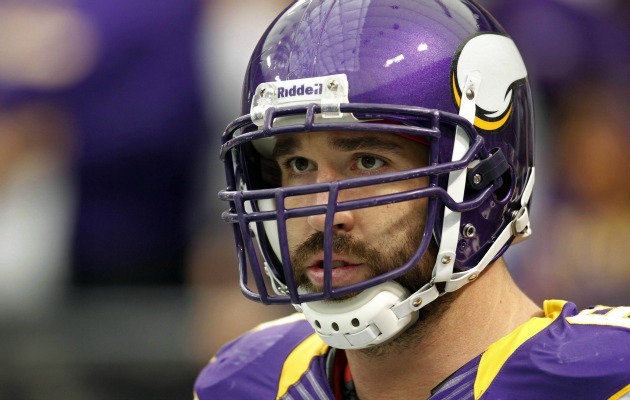
Minnesota Vikings defensive end Jared Allen is more than one of the NFL's best pass rushers. He's one of its most astute observers, unafraid to deliver candid assessments of where his game is and where the league is going.
So when I caught up to him after Wednesday's practice I asked about both and, as usual, Allen delivered. He explained why there's more to his game than sacks, identified the young pass rushers who have his attention, named the toughest linemen to beat and the toughest quarterbacks to catch and predicted what the NFL might look like in 20-30 years.
In short, he delivered. Here’s what he had to say:
Q: It's a leading question for a defensive end, but I'll ask it anyway. In a passing league who's more valuable: The premier corner or the premier pass rusher?
Allen: "Honestly I think they're of equal value. They work hand in hand. It's easier for me to get to the quarterback if I have a shutdown cornerback working on the outside, and it's easier for a cornerback to cover when you have someone getting to the quarterback. But as far as impact plays, as much as shutdown corner or ball-hawk corner can change the game with interceptions, if you look over the last handful of years a sack can do so much -- not only create a turnover and give you the yardage loss, but it's really a momentum killer for the offense in a drive."
Q: Where I was going with that was what happened with the Darrelle Revis contract and why he gained a deal ($16 million per) that dwarfed some of the best free-agent pass rushers like Cliff Avril.
Allen: "To be able take a receiver out of the game -- to be able to say, 'OK, this guy's not going to threaten us' -- is huge, and it really does play into the hand of being able to rush the passer ... because now you have an extra half-second or so when their primary (target) is taken away. So I understand the contract. If you look at Revis, he's never been a 10-plus interception guy. But what he does is nullifies that side of the field for the quarterback -- and that's valuable. A guy like Cliff Avril ... if he would be just more consistent; if he were a 10-to-12 (sack)-plus guy a year ... his numbers would've been bigger. This year the way the market with free agency played out was a little different. You see some of the older guys not getting contracts they were used to, then one or two guys on the team getting big numbers and meeting the rest of the CBA requirements through mid-level and minimum-wage kind of guys. But look at the money (Dwight) Freeney got when he broke the bank years ago. He was the first player to get $12 million a year, and that was strictly because of his impact rushing the passer. My contract came next, and I really believe as a defensive end -- a defensive lineman -- I'm the first to impact the play ... whether it's a run play, batted ball or interception. So the two positions are comparable. But, yeah, the numbers were higher because the cornerback ... Revis ... was probably the sexier pick because it's considered a skill position. I wouldn't hold it against us because what we saw Avril get because that was a skewed number as far as there wasn't a market. But now you look at what Clay Matthews got, and I think that's more indicative of what a good pass rusher and impact player can get a year."
Q: Since we're talking about pass rushing, let's cut to the quick: How much a measure of a pass-rushing defensive end is the sack? I mean, is it the most meaningful figure for you ... or are there others, such as pressures and tackles for losses?
Allen: "The way we're judged now is on the sack, but I don't think that's right. First of all, you're a defensive player, so your whole body of work should be judged. I thought it was pretty cool how (Jason) Pierre-Paul made it to the Pro Bowl this year on six sacks. His run game and 'splash plays' were pretty big, so people thought he warranted a Pro-Bowl caliber year. He was judged on his overall impact. But, unfortunately, we're pretty much judged on sacks alone. You have guys out there who might have 30 tackles in a year but have 15 sacks, and, all of a sudden, they're the next greatest thing. When I judge my own season, sacks is one of the ways because that's what we get paid to do. Plus, those are huge plays that help your team win. But I judge my season off of impact plays -- how many batted balls do I get? How many [tackles for a loss] do I get? Pressures are a great thing because they mean you're getting to the quarterback, but they also mean you need to get there about a half-step sooner. Basically, it's all about how can I help my team win. It's not always about getting to the passer. I had a coach tell me one time, 'If you can sack the passer one out of every 18 times, you're looking at 15-17 sacks a year.' But what are you going to do with those other 17 snaps? That's how I judge my game. What do you do on the three-step drops? Am I impacting a play there? Can I create turnovers? I see myself as a defensive player, not as a pass rusher, and try to judge myself differently than what we've been skewed toward because of pure sack numbers."
Q: Let's talk about those numbers. The sack record for one season is 22.5, a figure you came oh-so-close to breaking two seasons ago. How long does that record last and who breaks it?
Allen: "I'm hoping it's me this year. That's my goal every year. They took a sack away from me in the Green Bay game (in 2011) on Monday Night Football. I threw (Marshall) Newhouse into (Aaron) Rodgers, and he drops the ball. He recovers it, I tackle him, he's sacked and on Wednesday they (league officials) call and give it a team sack -- which I never understood. How do you give it a team sack? That would've been 23 for me ... not that I keep track. (Breaking the record) is going to happen because you have too many guys. There's Aldon Smith. And you have J.J. Watt. What he did from a five-technique was just ridiculous. I don't know that you're going to see another five-technique do that again. That should be a record in itself. You have Clay Matthews, DeMarcus Ware and Von Miller. There's the evolution of that lighter, skinnier, faster guy ... so I don't think 25 is out of reach. Obviously, that's lofty, and if you look at the history of the NFL, no player ever had two 20-sack seasons. So I would like to say it's going to happen just because you're seeing more people with higher numbers. You look at this year, and you had 20.5, 19.5 and 18.5 at the top, and then the year I had 22 (2011) DeMarcus had 19.5, and then there was (Jason) Babin at 18. I remember when 15 led the league by two or three. So with more people pushing, someone will eventually get it. But to say anything higher than 25 is doable ... I don't know about that. The evolution of the pass game is so much quicker, with the ball coming out faster, that it's going to be tough."
Q: You mention 25. Is that the barrier you believe no one crosses ... or, at least, no one but Greg Hardy?
Allen: "Honestly, I don't see anyone getting anything higher than that. Let's say you average one a game. Then you're hopefully trying to throw a handful of games in there where you get two or three a game -- and that's absurd because it's so tough to do. So I'd say anything over 25 would be miraculous. In fact, I would say 25 would be miraculous. I don't ever like to say there's a ceiling because people should never limit themselves, and records are meant to be broken. But, at some point it's a pure numbers game, and when you look at the probability factor you have to look at the history of the league. And of all the greats that have come before, they weren't able to attain it."
Q: You're one of those greats. You've had six straight double-digit seasons and were within a sack of breaking Michael Strahan's record. What's the secret to staying on top as a pass rusher as you age?
Allen: "There are a number of things I can control. I can control my preparation. I can control my knowledge of block reaction. And I can control my conditioning and fitness. I've always been a firm believer that the more you put into it the more you get out of it. As long as I can stay healthy, train how I need to train, study each opponent and prepare and stay mentally sharp, my technique (should be OK). Because, ultimately, technique is what wins in this game. People can get lucky, but what keeps you around, what keeps you on top, what gets you longevity and what keeps you productive are your technique and mental preparation. As I get older I make sure I study harder, I'm sharper and make sure I do a little extra to stay in top physical shape. That's really what it is. You have to diet properly because as you get older the weight is harder to cut. So it's really about taking care of yourself and understanding the process of how this game works."
Q: Then help me understand the process. Which offensive lineman gives you the most trouble and why?
Allen: "The bad ones. It's the guy who really has no technique that gives you the most trouble because then your technique can't beat him. So it's the guy who just gets in your way because then you've got 'chip' help and guard help. But when you've got a good player who has good technique, and they leave you one-on-one over there ... that's all you can ask for."
Q: Which quarterback is the hardest to take down?
Allen: "The hardest to take to the ground is Ben Roethlisberger. He's a huge, huge body. The hardest to get to is either Peyton (Manning) or Drew (Brees). They get rid of the ball so fast that even if you beat the offensive lineman now you're rushing against them, and they have that internal clock very few have."
Q: Which of the young pass rushers today do you identify as the next great one?
Allen: "I look at what Von Miller's done, and I think he's on the way up. It's tough to tell, but I think that hybrid position is where the next great ones are going to come from -- just because the defensive-end position is becoming a distant memory to the hybrid. Personally, I'm a fan of DeMarcus Ware. I know he's only a year behind me, but I think he's phenomenal. But what Von Miller has done is shown consistency his first two years, and I like the way Aldon Smith plays. He's a lengthy guy who's a lot like DeMarcus Ware, and what I mean by that is if he had to put his hand down he could. If they can stay consistent, I think one of those two will be the next up."
Q: Obvious question for a defensive end: The read option. Is it here to stay or is it, in the words of Mike Tomlin, "the flavor of the month?"
Allen: "I think it's a mixture of both. It's a good change-up. There are smart minds on both sides of the ball, so where the wildcat once was the thing of the future, you give some people some time to prepare for it and it becomes a change-up. The read-option is a little different in that it's always going to be a 'flavor' type of deal because you have to have the right personnel to run it. But once you do it's a wrinkle you always have to prepare for. I don't think it's ever going to become a main point or the staple of somebody's offense where that's all they do because look at the teams that run it. It's not their every-play situation. They run a traditional offense behind it."
Q: Since you're going to London this season, what do you think of the league's idea to put a team there one day?
Allen: "I think it's a cool idea, but logistically I don't think it works as far as travel. You're constantly going to be on a cross-country trip. I mean, eight games a [season] you've got to come back to the mainland, and that's a lot to ask of coaches and players to prepare for."
Q: Last one, Jared, but you're a pretty savvy observer of what's going on in this league. With all the rules changes that have happened lately where do you think the NFL is in 20 to 30 years?
Allen: "Honestly, I don't know. The way it's going I feel you may be going into two-hand touch mode eventually. I'm more of an old-school guy. I'm still mad they're making us put pads in our pants. I know it's for player safety, but I don't know anybody who's missed a game because of thigh contusions. Obviously, the (league) minds are doing what they think is best for the game, but at some point I think less is more. I'm a traditionalist so I think the more you can hold to the traditional core values of what the game is the better off you are. Obviously, you have to protect the players, as well. But I really don't know how much more you can change without taking certain plays, certain functions and, eventually, certain players away."