
With Declan Rice and Jurrien Timber signed, how will Arsenal line up next season?
The Gunners have boosted their squad big time, and here's how Mikel Arteta could set his team up

By
James Benge
•
7 min read
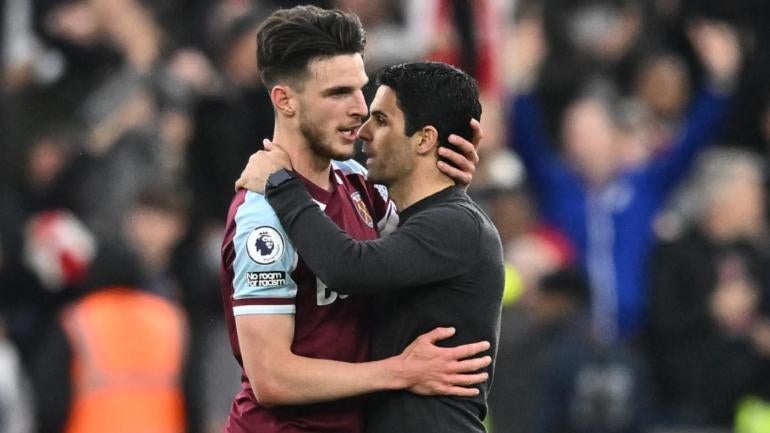
If the season were to begin next week, Arsenal might feel they are as well placed as any of their rivals to make a strong start. The signings of Declan Rice and Jurrien Timber are now official, following in the footsteps of Kai Havertz in joining the Gunners, who would have committed over £200 million to strengthening a squad that set the pace in the first 30 games of last season's Premier League.
However, with Granit Xhaka gone and doubts over the future of Thomas Partey, there is perhaps more restructuring to be done in the Arsenal engine room than one might reasonably expect of a team that performed so exceptionally last season. How will this new side look on the pitch then? Let's take a look:
Build-up versatility
One thing which will not change all that much is the foundation on which this Arsenal team is built. Aaron Ramsdale and William Saliba, both armed with new contracts, figure to be building blocks for this season and, if they can keep the former out of the clutches of Real Madrid and Paris Saint-Germain, for more years to come. One could add Gabriel Magalhaes to that category too. The Brazilian tends not to be garlanded in the same way as many others in this side but he was one of the Premier League's outstanding center backs.
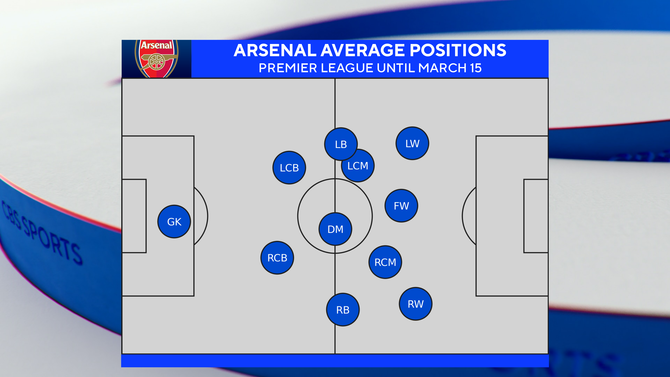
Those three matter perhaps more than anyone else in Mikel Arteta's squad. With Ramsdale, Saliba and Gabriel, Arsenal had the pace, technical quality and physicality to play the vertiginously high line you see above. Opponents were shackled into their final third by the Gunners' press, which was adept at forcing punts into the channel for Saliba and Gabriel to mop up. When Saliba and Takehiro Tomiyasu suffered season-ending injuries on March 16, the defensive integrity of Arsenal rather fell apart. They simply did not have the legs to cover in behind.
Saliba's return next season should ease the defensive calamities of the spring as could the arrival of Timber, deepening Arsenal's options at center back with Jakub Kiwior, Ben White and Rob Holding, who tends to excel when backs are against the wall. Most intriguing about Timber's arrival, however, is what it could do for Arteta's build-up options.
Last season, Arsenal oscillated between a 2-3-5 and 3-2-5 in possession. In some games Ben White might operate as an auxiliary center back, tucking infield to offer more protection and security against the counter. In others, he would bomb beyond Bukayo Saka. What was more consistent, at least when he was fit, was what Oleksandr Zinchenko offered. A left back without the ball, with it he was the heartbeat of the Arsenal midfield. No wonder that when injury struck him, the Gunners' ball progression stagnated.
Club sources believe that Timber can be developed into someone who eventually offers something approximating Zinchenko's build-up contribution but inverting from the right flank, not the left. The soon-to-be ex-Ajax man brings with him further options too. In last season's Eredivisie, no one completed more passes into the final third than Timber, who also completed the most progressive passes of any defender in the league. He also registered in the competition's top 15 for carries into the final third, no wonder when he moved more yards with the ball at his feet than anyone else.
Once Timber is integrated, an intriguing subplot of preseason could be whether Arteta opts to utilize Timber in a similar fashion to John Stones' deployment for Manchester City last term, a center back who steps up into midfield. Indeed Arsenal could entirely ape the four center back approach of their rivals with Kiwior having looked promising as a left back. With the Poland international on one flank and White on the other (Tomiyasu could also fill in on either side), the ball progression could come from any one of a number of center backs, so assured do they all look on the ball.
What none of these systems seem to need, however, is a full back who flies down to the byline. Kieran Tierney is one of the few big-money signings from the pre-Arteta age still at the Emirates Stadium but struggled to adapt to his manager's system last season. His future beyond the closing of the transfer window is in doubt, though for now, there have not been any expressions of interest in the Scottish international.
The midfield trio
Nowhere has Arsenal's investment been more pronounced than in the midfield. That is perhaps not surprising, if there was an obvious spot ripe for improvement in Arteta's side last season it was Xhaka's left-eight position, one which the manager himself had doubts over whether the Swiss international could fulfill. He did so far better than anyone could have expected, weighing in with seven goals, by far the most he had ever delivered in a domestic season. That is a pretty impressive return for a repurposed deep-lying playmaker but when his touch map is considered, perhaps a higher return would be feasible.
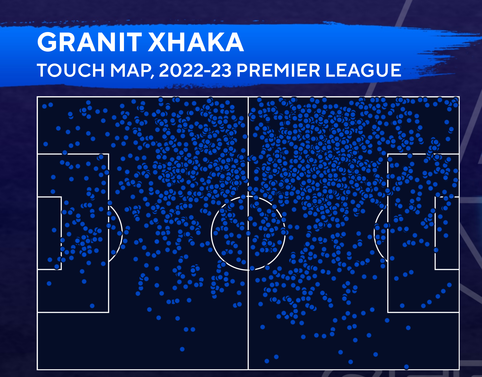
Havertz is the man who will succeed Xhaka and he will likely bring more goal threat even if he does not have the instincts to plug dangerous gaps that his predecessor did. The other new man in the Arsenal midfield, Rice, is as promising a young anchor man as exists on the market. He might not have the passing radar of Thomas Partey yet but in every other way, he is the Ghanaian's equal, perhaps even superior as a ball-winner and carrier.
Havertz, Rice and Martin Odegaard sound like a midfield three that could dominate most of the Premier League. Where the intrigue lies in preseason and beyond is what happens when Arsenal face a team that can match them in the middle of the park. The easiest answer is that Partey enters the fray, perhaps in place of Havertz, and Arsenal bulk up. However the 30-year-old is the subject of interest from Juventus as well as Saudi clubs Al Ahli and Al Khaleej. If Arsenal were to let him go -- and they would demand a significant price for his services -- then a replacement would be sought. There is also the prospect of bringing veteran Jorginho into the XI for the biggest games; he tends to deliver in those matches but is more of a tempo setter than ball winner.
Depth options
There are depth questions further forward too. The front three of Saka, Gabriel Jesus and Gabriel Martinelli seem fixed, perhaps excessively so. Last season none of City's wide forward options started more than 24 of 38 Premier League matches and the most minutes were given to Bernardo Silva, who registered 2,205. Erling Haaland was one of the first names on the teamsheet but his supporting cast changed by the game. Martinelli, by contrast, registered 2,789 minutes and Saka 3,181. It is not a surprise that the latter in particular was flagging in the final games, a huge attacking burden on a 21-year-old eventually weighing him down.
Still, there are options available to Arteta next season. The question is how frequently he will utilize them. Leandro Trossard was a sparky addition from Brighton midway through the campaign, averaging just shy of an assist every 90 minutes. He profiles as perhaps the most natural alternative to Jesus as a false nine with Eddie Nketiah a more orthodox center forward option. That makes Folarin Balogun something of an odd one out, at the moment his likeliest destination is viewed as another Premier League club if he were to depart, with Arsenal demanding a high price for one of Ligue 1's top goalscorers last season.
On the left, Arsenal are not short of alternatives to Martinelli and Arteta should be expected to use Reiss Nelson, who he was instrumental in tying to a new four-year contract, and Emile Smith Rowe, informed before departing to win the Under-21 European Championships that he would not be allowed to leave in the summer. Between them those two academy graduates played just 384 Premier League minutes; both had seasons disrupted by injury but they have shown in flashes the sort of talent that could make for valuable contributors to the squad.
Can Arsenal take the weight off Saka, however? There are internal solutions. Jesus has previously excelled on the right flank for City, he could play out there with Trossard, Nketiah or even Havertz through the middle. That rather seems like the Gunners weakening two areas of the pitch if their best attacker needs a break. If there is to be a fourth signing at Arsenal that is not replacing an outgoing player -- and there has not been the swift progress on that front that there was in securing Timber, Rice and Havertz -- then it is most likely to be a forward who could ease the pressure on Saka. That could well be a hard sell for Arsenal to make; Arteta is not exactly known for his rotation and even if that changes the new man would almost certainly be the support act to the face of the franchise in Saka.
It would seem then that as the first preseason matches loom in the distance, Arsenal's vision for how they will approach next season is set. Whether it will be enough to close the gap to Manchester City is more up for debate.