Inside College Sports: Texas-Nike deal shows sports apparel wars heating up
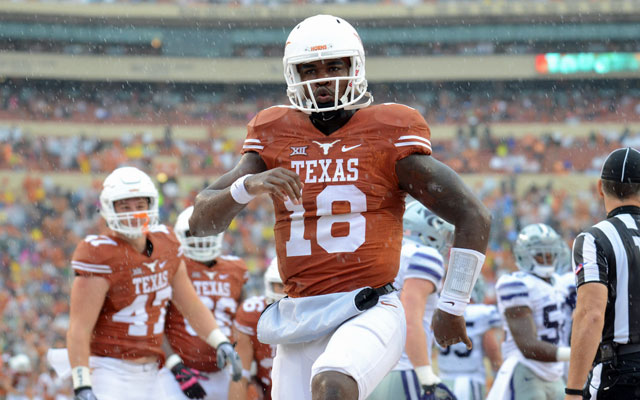
Texas and Nike signed a monster $250 million contract to extend their apparel deal. Similar deals are only likely to grow in similar manners over the next few years.

By
Jon Solomon
•
8 min read

First Nike signed Michigan in July to a record $169 million deal over 15 years. Now comes recent news that Texas agreed with Nike on a $250 million contract for 15 years, raising the bar for the next wave of apparel deals.
With most media rights deals tied up for a while and the costs of big-time college sports continuing to rise, welcome to the next significant revenue source for athletic departments.
As Matthew Kish of the Portland Business Journal described in an excellent article, the shoe companies are entering a new phase with universities. Adidas and Under Armour have shown they will compete with Nike to sign universities. Under Armour made significant headways by landing Notre Dame (one of the most valuable brands in college sports) and Wisconsin (a men’s basketball Final Four participant the past two seasons).
The duration of these deals are growing longer to lock up universities at favorable rates. This new trend is reminiscent of how media rights deals work in college sports. The apparel companies are largely chasing the popularity and broad distribution of college football as the TV networks have done for years.
Texas’ $250-million, 15-year deal with Nike (some of which is cash, some is apparel with a value attached to it) is fairly similar to the Longhorns’ $300-million, 20-year agreement with ESPN for the Longhorn Network. In exchange for a longer commitment, the apparel companies are willing to significantly increase the value they’re giving to universities for exposure.
After drawing serious interest from Under Armour, Texas will average more than $10 million a year in cash and gear with Nike, up from $4.1 million this year. Auburn recently stayed with Under Armour and went from an average of $3.7 million per year to $8.7 million. Indiana jumped from $3.7 million per year to $6.7 million by staying with Adidas. Arizona State jumped from Nike to Adidas for twice the money. Cincinnati almost doubled its deal by going from Adidas to Under Armour. NC State more than doubled than its annual value by saying with Adidas.
The list of deals go on and on. Driving these more lucrative and longer deals are competition within the industry and increasing value for college sports in a multibillion-dollar industry.
“It’s the same motivation that drove them 30 years ago when I said to the industry, ‘The athletes sell product,’” said Sonny Vaccaro, who signed Nike’s first all-shoe deal with a single university by landing Miami in 1988. “The stakes have just gotten higher because there are more people buying and more companies in the business. They’re going longer because the business is only going to get better. It’s cheaper to lock them up now. It’s a great investment, even though the numbers are staggering. The shoe companies are the wise ones. It’s a minor drop in the bucket of their marketing budgets.”
Back when Vaccaro lined up coaches for shoe deals, he hoped one of the schools would appear on the cover of Sports Illustrated to get some extra exposure to offset once-a-week appearances on TV. These days, so many games are televised that apparel deals with universities have become “the cheapest advertising in the world,” Vaccaro said. “You don't have to buy TV ads when the team’s wearing your shirt.”
Last year, Under Armour overtook Adidas in combined apparel and footwear sales to become the second biggest sports brand in the United States. Under Armour reported third-quarter earnings this year at $1.2 billion, still well behind Nike. The Wall Street Journal reported that the Baltimore-based Under Armour will soon expand its operations to Portland, Ore., in a building just 10 miles from Nike headquarters.
“(Under Armour founder and CEO) Kevin Plank is the brightest of the bright,” Vaccaro said. “He created a brand that I didn’t think could happen in my lifetime. I see in him what happened at Nike years ago. He’s in tune with the times.”
According to the Portland Business Journal, South Carolina’s apparel deal with Under Armour expires in 2016 and UCLA (Adidas) and Oklahoma (Nike) have contracts expire in 2017. After that comes a huge wave of prominent contracts expiring in 2018: Ohio State, Alabama, North Carolina and Nebraska. “Ohio State is the most valuable of those four,” Vaccaro said. “The one that signs last will get the most.”
Just like in Vaccaro’s days, there’s an escalating footwear and apparel war to use college athletes as billboards. The only difference is a whole lot more zeros are attached to the contracts.
NCAA chairman, Big 12 commissioner support transitional health care for players
Transitional health care for more college athletes is gaining momentum. South Carolina president Harris Pastides, the chair of the NCAA Division I Board of Directors, told USA Today he wants the NCAA’s wealthiest conferences to consider following the Pac-12 by providing health-care coverage for all athletes after their college careers. The Pac-12 began making post-college health care a requirement this year, leaving it up to its schools to decide how to determine who gets covered and who doesn’t.
Speaking this week at a Big 12 forum on the state of college sports, Big 12 commissioner Bob Bowlsby said transitional health care for athletes “is exactly the right thing to do.” Bowlsby pledged to further discuss “issues of commonality” such as healthcare with National College Players Association president Ramogi Huma and former Northwestern quarterback Kain Colter, who were on the panel.
“I think it’s the responsibility of the institution” to provide healthcare after college, Bowlsby said. “Now, when someone tears up their knee when they’re 35 years old and they’re a former football player and try to get the institution to pay for it, maybe you draw the line there.”
The Big 12 forum provided some compelling exchanges between critics of college sports and those who work for universities. During one exchange, Oklahoma State president Burns Hargis expressed surprise when told by Huma that the NCAA won’t investigate a coach who knowingly returns a player to competition with concussion-like symptoms. “I don’t understand what you're saying because I had people investigating us for some of the screwiest things you’ve ever seen,” said Hargis, whose program was recently investigated by the NCAA for two years.
Huma told Hargis that the family of deceased Frostburg State football player Derek Sheely unsuccessfully begged the NCAA to investigate his death from head injuries sustained at a practice through questionable coaching and training methods. “We have guidelines all day about return-to-play protocol,” Huma told Hargis, “but if they’re not enforced with the same vigor you were put under at Oklahoma State and Johnny Manziel was (after getting paid for signing autographs), then we clearly see where the priorities are at.”
Bowlsby said the NCAA has made progress in many areas. But he added, “Too frequently we are at odds between what we state are our principles and what we do with our actions, and we are called hypocrites and we deserve it.”
NCAA opposes O’Bannon review by full panel
The NCAA filed documents opposing the Ed O’Bannon plaintiffs’ attempts to have their antitrust lawsuit reviewed by a full panel of the US Ninth Circuit Court of Appeals. In September, a three-judge panel of the Ninth Circuit ruled the NCAA violates antitrust laws but that college athletes should not be allowed to receive deferred payments of about $5,000 per year for use of their names, images and likenesses.
Before granting what’s called an en banc rehearing, the court is required to give the other parties an opportunity to express their views on whether another review is appropriate. Sidney Thomas, the chief judge of the Ninth Circuit Court of Appeals, wrote in dissent that he would have allowed the plan to pay college athletes.
In a court filing, the NCAA argued that the plaintiffs’ case for an en banc review doesn’t have merit, and even if it did, granting the review would create other issues requiring a reversal. The NCAA said the three-judge panel’s reliance on the 1984 Oklahoma v. Board of Regents case provided no basis for further review.
Lawyers for the O’Bannon plaintiffs argued the panel improperly reevaluated the evidence in the case and failing to use “the language of clear-error review” in its analysis. Wrote the NCAA: “Panels of this Court are frequently asked to set aside factual findings as clearly erroneous; if mere disagreement with how a panel conducted clear-error review were a basis for rehearing en banc, rehearings would be commonplace.”
Read ‘Em
Each week this space will highlight some excellent recent work by college sports media on difficult topics to report.
* The Chronicle of Higher Education and The Huffington Post examined the rising costs of student fees to fund some athletic departments. Brad Wolverton, Ben Hallman, Shane Shifflett and Sandhya Kambhampati created a helpful database with student fees by university.
* Arizona State president Michael Crow said the Pac-12 football schedule needs improvement with start times so there’s less disruption to teams and schools, Steve Berkowitz of USA Today wrote.
* In case you missed it, I wrote about how Clemson had to heal its past from NCAA violations under Danny Ford and a fractured fan base when he left to now become No. 1 under Dabo Swinney. Clemson is breaking ground on a new $55 million football complex after moving into new offices in 2008.
Quote of the Week
“They ran through our ass like s--t through a tin horn, man, we could not stop them.” -- Alabama coach Nick Saban, offering his annual rant to build up an FCS opponent while reminding the public Georgia Southern ran the ball well against the Crimson Tide in 2011. Georgia Southern posted a picture on Twitter from the game and thanked Saban for the memories.
Follow and read more from Jon Solomon on Facebook and Twitter.