Miami refugee Ray-Ray Armstrong finds shelter at NAIA Faulkner University
According to his father, Armstrong is already in Alabama, and is only waiting final academic clearance to join the team
By
Matt Hinton
•
3 min read
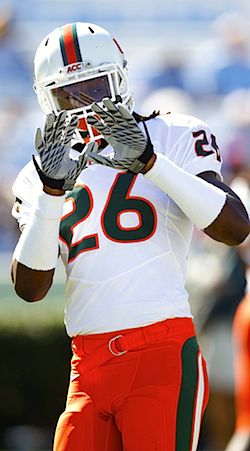 It's a long way from home, on a map and in terms of the level of competition. But a little less than one month after getting the boot from Miami , safety Ray-Ray Armstrong has landed safely at the last stop in his college career: Faulkner University, a member of the National Association of Intercollegiate Athletics, where Armstrong hopes to play this season outside of the reach of the NCAA scrutiny that cost him his final season in Coral Gables.
Faulkner is a small private college (undergraduate enrollment: 2,212) in Montgomery, Ala., founded in 1942 by the Churches of Christ. It competes along with 11 other religious schools – and one public school, the University of Virginia's College at Wise – in the NAIA's Mid-South Conference. According to his father, Armstrong is already in Alabama, and is only waiting final academic clearance to join the team. His name appeared on Faulkner's roster on Monday afternoon, briefly, but was removed because the school hadn't received his transcript.
NAIA schools operate independently of the NCAA, under a different set of eligibility standards.
Last week, Armstrong threatened to sue Miami over his dismissal, accusing the university of sacrificing him to "appease the NCAA" amid a wider probe into the athletic department. Monday, Armstrong's attorney said his client is dropping the threat, "despite the existence of several potential merit-based claims" against the university.
At 6-foot-4, 215 pounds, Armstrong was a versatile, two-way prep star in Sanford, Fla., and a no-brainer pick for five-star status by every major recruiting site in 2009; at Miami, he looked like a natural heir to the likes of Ed Reed and Sean Taylor. Through three years, though, he was suspended for as many games (5) as he started, and spent almost all of 2011 as a glorified backup.
First, he was one of a dozen 'Cane players benched by the NCAA last September for their alleged connections to Nevin Shapiro, the former UM booster turned convicted Ponzi-schemer who remotely detonated hundreds of possible NCAA violations from his jail cell. (In Armstrong's case, he reportedly toured Shapiro's mansion with a pair of high school teammates during a recruiting trip, and spent the night partying on Shapiro's dime.) Later, after he'd worked his way back into the starting lineup, Armstrong was hit with a second suspension in November following an expensive dinner with a potential agent; he was left at home for a subsequent trip to Florida State , a 23-19 Miami loss, and came off the bench in the 'Canes' last two games.
The school didn't supply a reason for Armstrong's departure, but it did happen to follow weeks of speculation that the NCAA is looking more closely into the dinner that got him suspended in November. Said probe has not been specifically confirmed amid the wider investigation inspired by Shapiro, but his departure from Miami and now his attempt to enroll in an NAIA school – outside of the jurisdiction of the NCAA – may speak for themselves.
Before the Shapiro grenade exploded last August, Armstrong's name was all over preseason All-ACC (and even a few All-America) teams, based largely on the strength of a sophomore campaign in which he'd finished third on the team in tackles, returned one of his three interceptions for a touchdown and picked up a second-team all-conference nod. He was also considered one of the top safety prospects in next year's NFL Draft, a likely second or third-round pick, and has subsequently watched his stock plummet into the lower rounds, or off of some draft boards altogether. If he has any chance of getting back on them, salvaging his damaged reputation off the field will have more to do with his recovery than anything he can still do on it.