
Tim Beckman situation turns focus to accountability of coaches
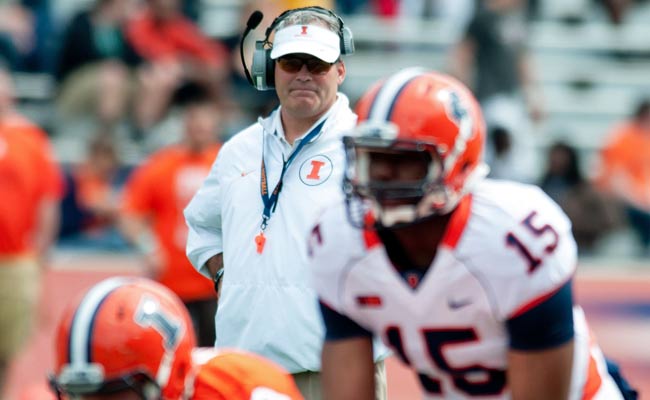
As mistreatment claims shatter Tim Beckman's reputation, the situation at Illinois shines the light on the fading coach-as-dictator mentality.

By
Dennis Dodd
•
5 min read
Tim Beckman may or may not be a good guy. At this point, it might not matter.
The Illinois coach's character, reputation and methods are being questioned in real time. This time there is no grainy film leaked to some network. In the now, guys he nurtured and coached up have ripped him to shreds on Twitter.
Specifically, former player Simon Cvijanovic said he was forced by Beckman to play hurt; he accused the coach of "abuse and misuse of power." Former receiver Darius Millines followed up Wednesday on Twitter, stating Beckman made it hard for him to visit his father who was fighting cancer. However, a school source tells CBSSports.com that Beckman aided Millenes in accessing funds from the NCAA Student Assistance Fund to visit his father.
It's become a national story, a referendum on the coaching profession. How much -- all of it suggests -- is too much? The piling on hasn't stopped. More Illinois players took to ripping Beckman on Twitter.
The coach is also mentioned in a lawsuit filed by a former Toledo player he coached.
When is it going to end? That matters less than how we got to this point. Beckman may be guilty of nothing more than tough love. The point is, in these modern times, players opened -- and continue to control -- the debate on the issue.
They're more self-aware. They understand more their place in an amateur universe dominated by a hungry for-profit motive. There's a reason at least some Northwestern players considered unionization. It's part of the reason athletic director Dave Brandon and coach Brady Hoke lost their jobs at Michigan. Remember Shane Morris' concussion?
The Pac-12 and Ivy League mandated on their own what NFL players had to collectively bargain -- limiting full-contact practices.
The age of player safety is upon us -- some of it driven by the players.
"We've all had to change..." Cincinnati coach Tommy Tuberville said. "You're going to have some disgruntled players and I think you're probably going to have some coaches from the old school who don't change their ways quick enough."
Tuberville is the president of the American Football Coaches Association. In one sense, he is an advocate for Beckman and the profession. But he's also as enlightened as they come.
"I'd say for the last 10 years or so, the [medical treatment] of the players, I have no say-so about it," Tuberville said. "It's all in the doctors' and trainers' hands. That's the way you have to handle it, unless you want a lawsuit on your hands."
Coaches are more accountable than ever, their motivations sometimes questioned. Their overarching power is being limited -- as it should be.
Now, when a situation arises, players like Cvijanovic know they have a hammer. He chose to act out on Twitter. But before he did, Cvijanovic chose to call Ramogi Huma, executive director of the National College Players Association.
Huma is the longtime player advocate who instigated that Northwestern unionization movement. His influence in players' rights is growing. Calling him is like reaching a 1-800 help line.
"This is one of the few times there's been a courage enough to speak out about it and say there is something more systemic," Huma said of the Illinois situation.
"This should be a way to open the door ... Simon is not accusing the university as a whole. It's how the university handles [the situation] that's really at a crossroads. If they do find wrongdoing, are they going to take steps to address it?"
Through a school spokesman, Beckman had no comment and the school stood by its previous statement: "When the process concludes, the university will release information in a manner that balances student privacy concerns, legal responsibilities, the need to respect the integrity of the process and an obligation to be transparent." Illinois has hired a Chicago law firm to look into the allegations.
"If you look at information coming out about abuse and bullying, our society is much more in tune with those things," Huma said. "People are seeing this through a whole different lens."
The coach no longer has the final say regarding his program, nor should he. The romantic notion of giving more for ol' State U. is being questioned. There is an inherent conflict of interest.
A coach oversees an enterprise that has as its goal to keep that coach employed. To do so, that coach must win. To win, well, corners sometimes are cut. That's why Huma called for an independent investigation at Illinois.
Out of all of it has come that awareness. A massive class-action concussion lawsuit is being settled. More than a century after it was formed, the NCAA has allowed players direct influence on the legislative process.
You might have noticed an overall change in the national narrative. For a broad cross-section, a scholarship is no longer enough. Not even close. In the middle is the coaching philosophy. It is shifting before our eyes -- from winning at all costs to player welfare coming first.
These sort of player abuse claims tend to trend nationally. Bob Knight and Neil Reed, Rutgers and Mike Rice, Mark Mangino and Kansas.
Beckman is the latest face on the Most Wanted poster. Some fans were already upset he was retained for a fourth season. Recruiting definitely won't be any easier.
If it happens, Beckman wouldn't be the first coach run out of his job following player complaints. He also wouldn't be the first to have waves of supporters in the middle of the tempest.
That's why it's less about Beckman as a person and more about what the situation symbolizes. This time a player (Cvijanovic) had no fear to act out. Maybe his social-media rant was the desperate act of a desperate man. Maybe it's the sign of things to come -- a new normal between player and coach.
"Players don't go out of their way to stir up a hornet's nest with a bunch of lies," Huma said. "In my experience, that just doesn't happen."
Former Big 12 commissioner Dan Beebe consults with schools on risk management. His company is the corporate embodiment of the new narrative. Beebe wants to teach athletes that self-awareness, have them be brave enough to pick up the phone.
"We'll sit there in front of a group of athletes and ask how many had anti-bullying, anti-hate training in middle school," Beebe said. "Ninety percent will say yes.
"Now they come into [a college] environment where, is it bullying or tough-assed coaching? It may be that the coach needs to be coached to be less harsh. Or it could be the player needs to be coached [to understand] 'You stepped into Division I football.'"
Cvijanovic, Beckman, Illinois -- and the sport -- are about to find out.