2020 Fantasy Football Draft Prep: Strategies to spend, save and smash your Salary Cap draft
Drafting with a cap demands more strategy and offers much bigger potential rewards.

By
Dave Richard
•
8 min read
For over a decade, I've sung the praises of Salary Cap drafts and why they're better than the more common snake drafts you've probably participated in.
But besides the longer, more fun process, the ability to get exactly who you want and the chance to put together a "super team," the real fun part of Salary Cap drafts are the bargains you get. The inexpensive values right under the noses of every other person in your league. The steals that make people angry because they didn't get them BUT YOU DID.
Finding those happy moments don't always just happen. Sometimes people get lucky, but it takes a little work and effort. With tons of Salary Cap draft experience in my rearview, here's what I know to help you improve your chances of building a dominating lineup, along with real-life examples from our early-August analyst draft.
Before the draft
1. Create your own tiers
When you group together players with similar expectations, you create a general sense of depth at every level for every position. The bigger reason to apply this to Salary Cap drafts is so you can gain an understanding of what a player's value should be before they're actually nominated based on the market being set by other players near and in the same tier.
If you want to know what tiers look like, or just want a starting baseline of tiers that you can alter to your own liking, check out my version from mid-August: QB | RB | WR | TE.
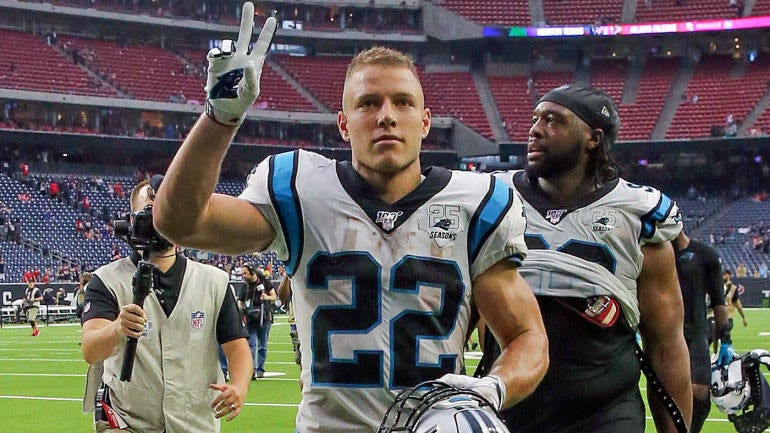
Real-life example: When Christian McCaffrey fetched $31 as the first big-money buy, all of the managers got over the shock of the cheapish price and focused on the other running backs in the same tier. Saquon Barkley promptly went for $36. Based on these two prices, one could assume that a fair value for two other elite-tier running backs -- Alvin Kamara and Ezekiel Elliott -- was between $31 and $36. Sure enough, Elliott and Kamara went for $32 each. This also meant that the next highest tier of running backs including guys like Dalvin Cook, Clyde Edwards-Helaire, Miles Sanders, Joe Mixon and Derrick Henry, shouldn't go for anywhere near $31. And they didn't.
2. What's the better build?
There are two primary ways people put their Salary Cap draft teams together: balanced approach and studs-and-scrubs.
Both are pretty self-explanatory. If you end up spending too much on a couple of players, you'll have to settle for starters and backups at cheap-o prices. If you don't spend up too much, you can put together a seriously well-balanced team.
I've done both and had a little more success with the studs-and-scrubs when the studs have actually played like studs. The biggest key to studs-and-scrubs is being very savvy with add/drops. That's where you can turn your lineup with three greats and five other meh players into a true powerhouse.
Not that you couldn't do that with the balanced approach, either ... but if you're going to find diamonds off waivers, you might as well place them in a crown with other diamonds and not with ... gems that are not diamonds? Where in the world did I come up with this analogy?! Get me outta here.
2. Know your limits
There is always a wave of passive bidding in the early parts of a Salary Cap draft. No one wants to overpay, everyone wants to see what the market settles into. It's an opportunity to steal players, particularly elite-tier guys since they tend to get nominated first. The key is to get an idea of what percentage of your total budget you're OK spending on the top-shelf studs.
A tip: Once you find a number you're comfortable with on the No. 1 overall player at a position, you should be able to cascade values down to everyone else. If your absolute limit is 35% of your budget on McCaffrey, then 34% for Barkley and 33% for Elliott and Kamara are reasonable.
You can find our Salary Cap draft values in our rankings: PPR | non-PPR
Real-life example: McCaffrey going for $31. He was the second player nominated, the majority of the league wasn't ready to spend a large chunk of capital without knowing the market, and our buddy Jamey Eisenberg had himself a heist. Even I regret not bidding $32. Don't be passive early.
During the draft
1. Nominations matter early
When you nominate players, you either want to spend your own budget or force others to spend big from theirs. Deciding which method to employ depends on your situation.
Early on, you can either nominate the top-rated kickers and DSTs for 1% of budget and hope no one else overspends to get them (thus getting those pesky positions out of the way), or you can nominate players you do not want and let other managers spend their budgets while you kick back.
Real-life example: Eisenberg spent his third nomination on the Steelers DST for a buck. No one else bid. He got one of the best DSTs in the game for the lowest possible price.
Real-life example part II: I knew Jonathan Taylor would be one of the more popular running backs to get picked. I didn't want to overpay for him, so I nominated him with my first choice. He went for $8, which was less than I had hoped but still more than what I would have paid.
2. Pay attention!
You can't come to a Salary Cap draft on three hours sleep or with a hot new app to distract you. Well, you could, but your team wouldn't be as good. Get coffee or an energy drink and keep those neurons in your brain firing.
Doesn't matter if you use a laptop, a desktop, a smart phone, a dumb phone, a pad of paper and a pencil or the back of a couple of napkins -- you must stay up to speed on what your opponents' needs are, how much budget they have left to spend, how much YOU have left to spend and who's still available to be nominated.
2b. Nominations matter later, too
Use this information to your advantage: If you're set at a specific position and know that the manager with the most budget left to spend needs someone from that position, nominate the highest-ranked player from that position and get him to spend! That way he'll have less ammo when there's a player you really want to splurge on.
Real-life example: With Derrick Henry and Aaron Jones already on my roster, I began nominating highly ranked running backs so other managers would burn through their dough.
Obviously knowing what your maximum bid is carries weight, too. Don't bid what you can't afford. But if you know someone else's max bid is low, and you can match their max bid with your nomination, he or she cannot outbid you. This really comes in handy with sleepers and insurance-policy running backs late in the bidding process.
Real-life example: Heath Cummings used the power of his remaining budget to drop a 6% bid on D'Andre Swift, keeping others with 6% max bids from getting him.
3. Follow the 20/50 Rule
The tendency most people have is to spend early and often. You shouldn't miss out on shelling out some dinero yourself, but not to the point where you're crippled for that time when bargains are usually found -- the last half. Save at least 20% of your total budget for the last 50% of your Salary Cap draft.
Real-life example: Scott Engel spent 76% of his budget through the first 79 nominations. He had plenty of shekels left over to spend on bargains like Tyler Higbee (3%), Brandin Cooks (3%), Diontae Johnson (2%), James White (1%) and a potential steal in Cam Akers (6%). Pretty cool to get those guys for the same price as Odell Beckham.
4. Do not price enforce
Sometimes you'll see players get a bid that's ludicrous. Obviously when it's something like Davante Adams for 4%, you should jump in whether you need a receiver or not. But when you're 40 nominations in and you've already got a starting quarterback, don't bid up another quarterback because you think they're not going for a fair price. Why? Because if you get stuck with him, you'll have unnecessarily added a player you don't need while giving up salary cap space you can't afford to lose. If someone else gets a steal, you should just live with it and not risk unnecessarily dumping moolah.
5. When in doubt, spend the buck
You will absolutely find yourself in a war with another manager for a player you really want. And you'll undoubtedly see a bid that's fair. If you really want the player, spend the extra dollar (or three) to get him. Deal with the consequences for not having that currency later on.
After the draft
Want to know if your team is any good? Take the roster and match it up with that format's ADP.
If you have a roster with a guy with a first-round draft average and more than two second- and third-rounders, or perhaps two first-rounders, two third-rounders, a fourth-rounder and two fifth-rounders, you've built a team you could have never pulled off in a regular snake draft. Congratulations!
Similarly, if you're missing a guy from Round 3 and Round 6 but you have four guys with a Round 9 or Round 10 draft average, then you botched it. You better get ready to hit the waiver wire for help. Maybe. You never know. Maybe you nailed it. That's why we play the game!
Real-life example: I was fortunate to roster Derrick Henry (1.08), Aaron Jones (2.10), George Kittle (3.03), Cooper Kupp (3.11), Russell Wilson (4.05) and A.J. Brown (5.09). Not bad, right?
Well, it's nothing compared to Christian McCaffrey (1.01), Ezekiel Elliott (1.03) and Julio Jones (2.06) working together.
Just don't ask about the rest of Eisenberg's team.
So which Fantasy football busts should you completely avoid? And which running back going off the board early should you fade? Visit SportsLine now to get cheat sheets from the model that called Baker Mayfield's disappointing season, and find out.