Five Baseball Hall of Fame candidates running out the clock in ballot purgatory
Let's talk about Bobby Abreu, Jimmy Rollins, Dustin Pedroia, David Wright and Torii Hunter

By
Matt Snyder
•
6 min read
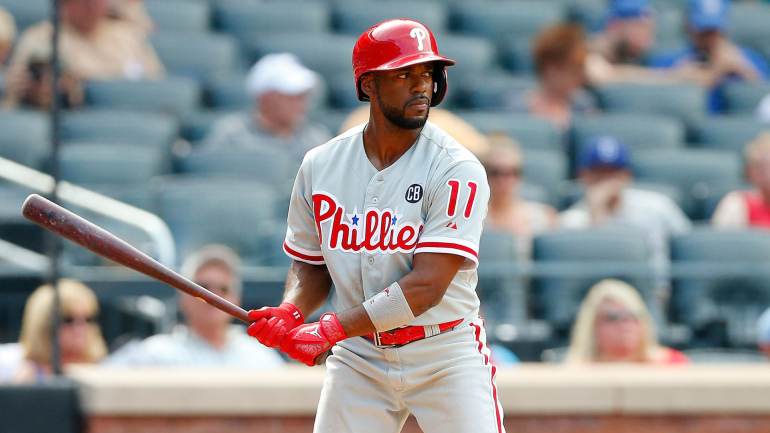
Welcome to ballot purgatory. When players get more than 5% of the vote on a Baseball Hall of Fame ballot, they get to advance to the next ballot for another chance. This can happen until a player has been on the ballot for 10 years (it used to be 15). Over the nearly 100 years of the Hall of Fame, we've seen a litany of players stick around on the ballot for the maximum number of years and still never really get all too close to induction. Thus, purgatory.
There are five position players on the ballot this year who could well be headed that way (it's possible three pitchers are, too, but I already profiled them). I speak now of Bobby Abreu, Jimmy Rollins, Dustin Pedroia, David Wright and Torii Hunter.
How do their Hall of Fame cases look? Could any of them catch fire like Billy Wagner and Larry Walker and make the Hall, as it appears Chase Utley has a chance to do? Let's take a look, in order of their vote percentages from last season.
Bobby Abreu (19.5% last year, 7th ballot this year)
This could well be a huge ballot for Abreu. It's possible if he gets within, say, 20% of induction by his ninth cycle that a campaign could surge him in the same way it did for Walker. There needs to be more momentum, though. Fortunately for Abreu, this is a relatively weak ballot and that means that people who will only vote for a handful of players per year might have openings for him.
He started at just 5.5% of the vote. His big leap came between his third and fourth years (8.6% to 15.4%) and he rose to nearly 20% last year. There sure needs to be a huge leap this year to make induction realistic, because where he sits right now with only four chances left, historically, has meant it's overwhelmingly likely a player won't make it.
It's fair to argue Abreu was underappreciated in his time. In parts of 18 seasons with the Phillies, Angels, Yankees, Astros, Dodgers and Mets, he hit .291/.395/.475 (128 OPS+). He compiled 2,470 hits along with 1,476 walks, helping him to sit, currently 49th all time in times on base. He also collected 574 doubles, 59 triples and 288 home runs. He's 25th in career doubles, 89th in total bases and 62nd in extra-base hits. He's also 74th with 400 career stolen bases. He ended up with 1,363 RBI and 1,453 runs, putting him 52nd in runs created.
It's an incredibly well-rounded offensive profile.
This should show up in WAR and it does. Abreu is 21st in WAR among right fielders all-time, ahead of Ichiro Suzuki, Vladimir Guerrero, Enos Slaughter, Willie Keeler, Sam Rice, Harry Hooper and a few others already in the Hall of Fame.
Bobby Abreu was underappreciated as a player; is his Hall of Fame case also getting overlooked?
Matt Snyder
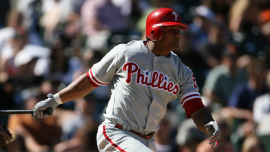
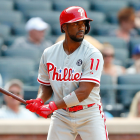
Jimmy Rollins (18%, 5th)
I recently published a book, "The Leadoff Man," and wrote the following about Jimmy Rollins:
You know how sometimes you look at a great team and there's one player in particular who just feels like he's the "heart and soul" of a team? He's the engine. There might be better players, but there's this one dude who, when you watch the team play regularly, just exudes an aura that he makes everyone around him better. You can't necessarily explain why, you just feel it in your bones.
The Phillies won their second World Series in franchise history in 2008. It was part of a run where the Phillies won the NL East five consecutive years, took the NL pennant twice and, of course, won the championship. It was arguably the best stretch in Phillies history (1976-83 is the other stretch with an argument). The highest-WAR player from this time period was Chase Utley and he's the one from the position-player side with the best chance to make the Hall of Fame. Ryan Howard was one of the biggest sluggers in baseball. Cole Hamels debuted in 2006 and was an ace by 2007. Hall of Famer Roy Halladay joined the fray in 2010. Cy Young winner Cliff Lee was there, too.
And Jimmy Rollins was absolutely the heart and soul of those Phillies teams. No one could convince me otherwise, not that many people would even try.
Should that give a player bonus points? I've always said that my personal opinion is that there's room in the Hall for different types of all-time great players. Rollins was a champion and heart-and-soul guy and one of the greatest leadoff hitters ever.
Rollins' rate stats won't look as shiny as others. He finished a .264/.324/.418 (95 OPS+) hitter. He collected 2,455 hits (he's the Phillies franchise record holder), including 511 doubles (again, he's the Phillies record holder), 115 triples (he led the league four times), 231 home runs, 936 RBI, 1,421 runs and 470 steals (46th all-time). He was an exceptional defender and baserunner.
In WAR, Rollins is 27th all-time among shortstops and there are 23 Hall of Fame shortstops. He's clearly below the current Hall of Fame standard, statistically.
The voting totals have reflected as much so far. He started with 9.4% of the vote, though he's risen each year without really stagnating. He gained 4.8% last year. Still, he'd need a huge turn of events to get in.
Breaking down Jimmy Rollins' Hall of Fame case: Does Phillies great have shot at Cooperstown?
Matt Snyder

Dustin Pedroia (11.9%, 2nd)
Last year was Pedroia's first time on the ballot and he got over 10%, so it isn't a lost cause just yet. Maybe he makes a big second-year leap and starts to resemble Utley in vote percentages moving forward.
Pedroia was also a "heart and soul" type who was a great table-setter for a championship team (two, in Pedroia's case). Injuries in his mid-30s really conspired against his Hall of Fame case. On a rate basis, he looks good. He hit .299/.365/.439 (113 OPS+). Due to injuries, his compiling fell short, though. He ended up with 1,805 hits, 394 doubles, 15 triples, 140 home runs, 725 RBI, 922 runs and 138 stolen bases. He earned three World Series rings, though he was inactive due to injury for the Red Sox's run in 2018. He won a Rookie of the Year and MVP along with four Gold Gloves.
Despite the injury shortfall, Pedroia's all-around value pushed him to 51.8 WAR, good for 23rd among second basemen. Using the JAWS system, which accounts for high-peak players, Pedroia is 20th, ahead of recent inductee Jeff Kent, along with other Hall of Famers like Tony Lazzeri, Johnny Evers, Nellie Fox and Bill Mazeroski. There are currently 21 Hall of Fame second basemen.
David Wright (8.1%, 3rd)
Like Pedroia, injuries wrecked Wright in his mid-30s, if not earlier. Through two ballots, he's gotten 6.2% and 8.1%, respectively, of the vote. There's still time for a big push, but it feels unlikely so far.
In parts of 14 seasons, entirely with the Mets, Wright hit .296/.376/.491 (133 OPS+) with 1,777 hits, 390 doubles, 26 triples, 242 home runs, 970 RBI, 949 runs and 196 stolen bases. Through age 30, some of the most statistically similar players to Wright were Rolen, Freddie Freeman, Chipper Jones, George Brett and Mookie Betts. With complete careers now, the closest matches are Ken Caminiti, Hanley Ramirez, Mike Lowell and Charlie Blackmon. It's evident that the injuries caused him to fall from the Hall of Fame line to below it.
Among third basemen, Wright's 49.1 WAR sits 29th all time and there are 18 Hall of Famers from the position. Given that it factors in the player's peak, JAWS should be kinder to Wright and it is. He's 27th there, ahead of a few Hall of Famers like Pie Traynor and George Kell.
Did David Wright's career-ending injuries wreck his shot at the Hall of Fame? Making a case for the Mets great
Matt Snyder
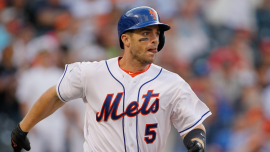
Torii Hunter (5.1%, 6th)
Hunter is the most likely to leave this group this season and fall off the ballot. There were 394 votes cast last year; 5% of that is 19.7. Hunter got 20 votes. Yes, he survived by a single vote. He topped out at 9.5% of the vote in his first try and has been unable to get any footing. In fact, he has actually gone backward. It's a lost cause unless there's some sort of unforeseen shift somewhere on the horizon.
In parts of 19 seasons, Hunter hit .277/.331/.461 (110 OPS+) with 2,452 hits, 498 doubles, 39 triples, 353 home runs, 1,391 RBI, 1,296 runs and 195 stolen bases. He was a hell of a lot of fun on defense in center field, racking up nine Gold Gloves and dozens upon dozens of highlight-reel catches. The JAWS system shows Hunter 35th all-time among center fielders and there are 19 from the position in the Hall of Fame.