How A's slugger Matt Olson blends unorthodox stance with textbook swing
Olson's last seven hits have all been home runs

By
Dayn Perry
•
4 min read
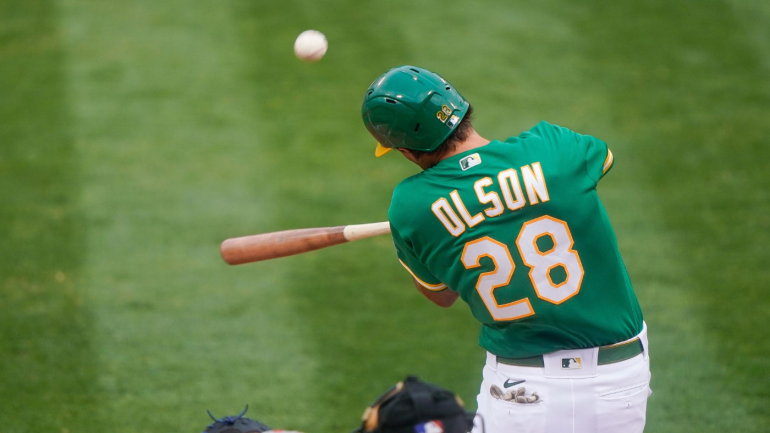
Going into Sunday's slate, Oakland A's first baseman Matt Olson has homered in back-to-back-to-back games and has eight home runs on the season. Olson's last seven hits, in fact, have all left the ballpark. The overall numbers aren't up to his usual standards, but it's still early in terms of games played, if not the calendar. The larger reality is that the 26-year-old Olson owns a career OPS+ of 129 and boasts elite exit velocity numbers.
What's striking about Olson's established high level of production is that it somehow flows from an unlikely looking batting stance.
We distinguish "stance" from "swing" for reasons that Olson himself will soon demonstrate. Here, drink deeply of this 2019 home run off the bat of Olson:
Matt Olson's swing is ________#RootedInOakland pic.twitter.com/gdKOSiZILl
— Oakland A's (@Athletics) July 7, 2019
Captured above through the magic of color television is one of Olson's 96 career home runs. Now let's home in on his stance/setup that we mentioned:
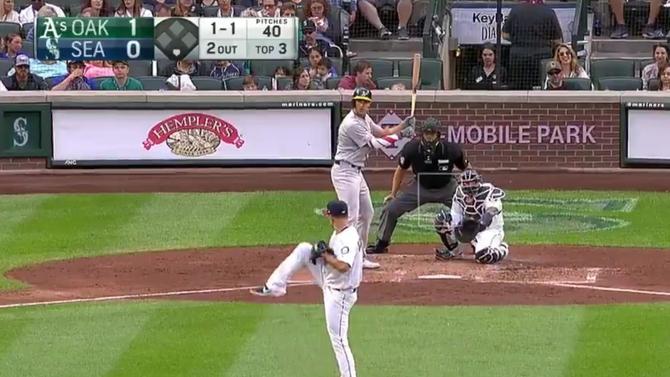
Olson's standing pretty much upright, and he starts his hands in an unusual spot. Rather than hit a baseball, he looks like he's about to knight someone -- Benny Hill, perhaps. Olson used to set his hands in a more conventional manner, cocked and in the vicinity of the back shoulder, but prior to the 2017 season he re-positioned his hands in the unconventional manner you see above.
That somewhat unorthodox stance reminds us of something pretty important, and that is the stance -- the set up -- matters only to the extent that the hitter prefers it or that it helps him. There's no universal correct approach. Think of Gary Sheffield's wagging the bat almost the top of the barrel was almost trained on the pitcher. Think of Craig Counsell's "corkscrewed whooping crane" stance or Jeff Bagwell's sumo squat or Joe Morgan's flapping back elbow. All of that is merely personal preference and prelude to the more important aspects of the swing.
And here that is, modeled by Mr. Olson:
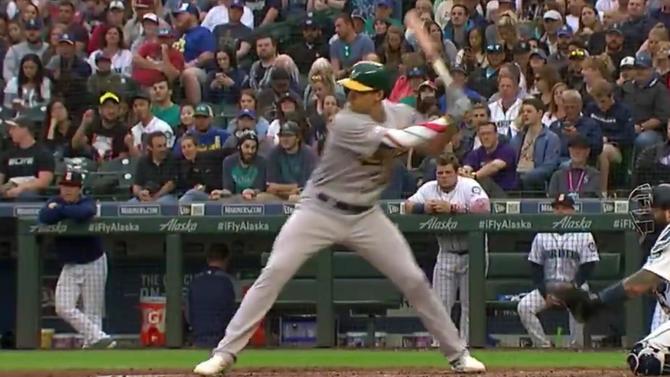
Here's what pretty much every MLB looks like when the stride foot hits the ground. Regardless of whether the hitter uses a toe-tap, an ankle-turn, a lift-and-step, or a coil of the leg (not unlike a pitcher), this is a common position at front foot plant. Olson's front shoulder is tucked, his hips have advanced toward the pitcher, and his hands have moved or stayed back as his lower half has gained ground. This creates tension across the upper body and helps the hitter explode into the ball. Many hitters have the bat angled a bit more sharply than Olson does, so that the barrel is basically hovering above the head, but Olson isn't far from that position. That initial upright stance with the hands out and forward simplifies for Olson that essential "hands go back as the foot goes toward the pitcher" action. Putting the hands unnaturally forward forces them to go back.
And then comes this:
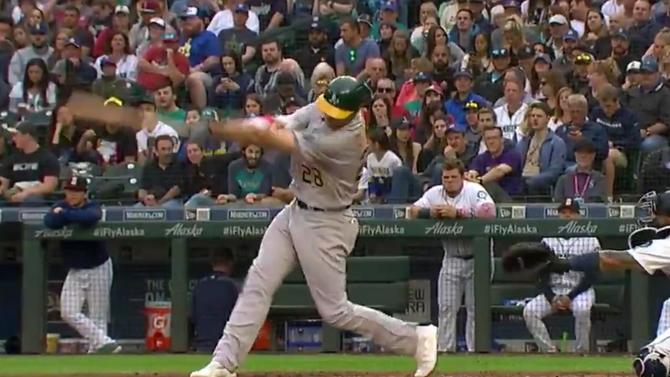
This is another key element of the major league swing. Olson almost seems to be looking toward the ground as he finishes past contact. That's because he's maintained his body tilt that was in place when he addressed the ball. Also note that his arms are "stacked" right on top of left. That body tilt and proper stacking of the arms (it would be left on top of right for a right-handed batter) allows Olson to stay on plane with the ball as gravity makes it gradually drop on its journey to the plate. That, in turn, affords him as better chance to drive the ball in air and do extra-base damage. Basically, bend at the hips and maintain that bend through the swing.
Now the extension:
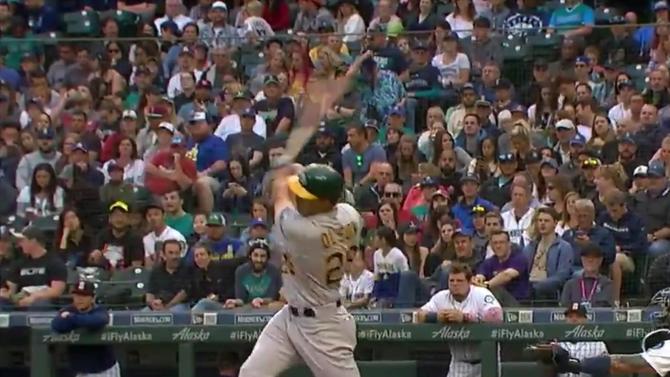
Olson -- again, as most MLB hitters do -- delays allowing his arms to collapse, or bend, until late in his finish. Here the bat almost looks perpendicular to the ground and he's still got his arms extended. Hitters hate rolling over and hitting ground balls to the pull side, and a good way to avoid that is to delay the bending of the elbows until late in the finish. That's what Olson does.
Speaking of the finish:
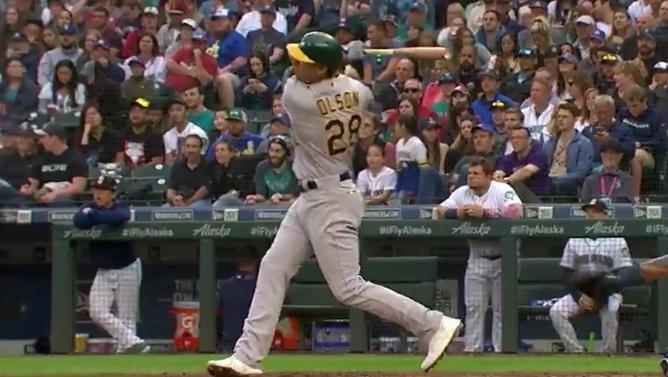
If you watch him at full speed, it almost looks like Olson fails to fully follow through with his swing. That's because his arms don't wrap all the way around his body on the finish. (In contrast, Don Mattingly at times appeared to be trying to stick the bat in his back pocket on his finish.)
Above you'll see Olson's arms at their deepest point on the finish. In that he's not unlike Chase Utley, who almost looked like he took half-swings at times. Don't let the arms confuse you, though. It's the shoulders that make a thorough finish. In the above image, you can see Olson's name and number on the back of his jersey, and his back shoulder has in essence "replaced" his front shoulder in terms of positioning. That's full rotation and a proper follow-through and finish regardless of where the hands wind up.
Home run, Matt Olson? Home darn run, Matt Darn Olson.
This is what makes the high-level swing such an intriguing broth of individualism and time-tested universal principles. They don't all start or end the same, but in the middle of that journey most MLB swings satisfy a few truths. Olson reminds us of all that in compelling fashion.