Rockets vs. Warriors: Five big questions for massive Western Conference finals showdown
Will this potential WCF classic be the full-blown 3-point shootout we once thought it would be?

By
Brad Botkin
•
9 min read
Back on Oct. 17, the NBA season began with two matchups: Celtics vs. Cavaliers and Rockets vs. Warriors. Eight months later, we're down to the same four teams in the 2018 conference finals. Both series have the makings of a classic, but out West, Houston-Golden State could be one for the ages. The Rockets and Warriors are both healthy, both have been the best two teams all season and both moved through their first two rounds with relative ease. These teams are a lot alike, and yet strikingly different in a few areas.
Here are five major questions that will go a long way in determining who will represent the Western Conference in the NBA Finals.
1. Will the Rockets win the 3-point battle?
If Houston loses the battle of the arc, you could argue all other factors become moot. It's just hard to imagine the Rockets beating the Warriors any other way. Problem is, the Rockets haven't shot the three particularly well in these playoffs. They've shot a high volume, of course, and thus lead all postseason teams in 3-point attempts and makes, but they're falling at just a 35-percent clip, which ranks 11th in the playoffs.
Golden State has actually been worse from three with just a 32.9-percent clip as a team, which ranks 15th among 16 playoff teams. But the Warriors -- and this may surprise people -- don't rely on 3-pointers nearly as much these days. With Kevin Durant on board, they wear you out with traditional matchup advantages, with Durant simply shooting over shorter defenders from 18-19 feet and in, and with Klay Thompson and even Stephen Curry coming off a lot of their screens for mid-rangers as well. All told, just 28.9 percent of Golden State's attempts come from downtown, compared to 42 percent of Houston's shots.
Volume can only carry you so far against a team as efficient as Golden State. Houston has to hit its threes at a more consistent clip than it has so far in the playoffs. And that's not just going to happen by luck. We'll talk more about pace in a minute, but in terms of 3-pointers, Houston -- which wants to play a slower, more half-court game against Golden State generally speaking -- does need to selectively run for some good looks in early offense and transition. Getting quality, clean looks against that Warriors' half-court defense with all that length and switching ability is a tall order for 48 minutes. Ultimately, whether in selective transition or the half-court, it's all about the kinds of shots the Rockets are able to get -- which is to stay contested, or uncontested. Which brings us to ...
2. How much will the Warriors help on Paul and Harden?
The Rockets play a very simple style of basketball: Give it to James Harden or Chris Paul, run pick and roll again and again until they get the switch they want then exploit the mismatch one-on-one. They do not move the ball (fewest passes per game in the league) and, beyond that, their players don't move much either (fewest off-ball screens in league).
The way the Rockets get a lot of their threes is by Harden or Paul getting into the lane, collapsing the defense around them and kicking to shooters who are always spotted up and ready to fire the second their defender drops down. But what if the defense doesn't collapse? What if the perimeter defenders stay glued to their shooters and effectively concede Harden and Paul as many mid-to-short-range 2-pointers that the Rockets' analytical hearts can stand? For much of their semifinal series vs. Houston, that's what the Jazz did. Have a look at this possession:
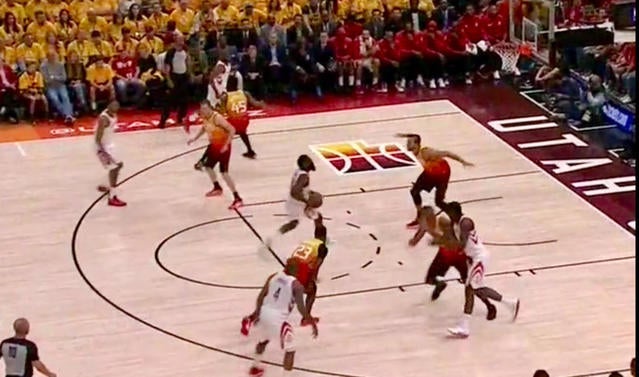
As you can see, all three of Utah's perimeter defenders are resisting the urge to help down on Harden. Heck, Donovan Mitchell isn't even looking; he's flat out face-guarding Paul. Joe Ingles is a step away from Trevor Ariza, as is Royce O'Neale from P.J. Tucker. Harden wound up making this shot, but again, from a defensive standpoint, two is better than three. When Utah stayed disciplined in this approach, it worked. When it didn't, it got burned, as in the following clip where the perimeter defenders can't fight their instincts to gravitate toward Harden just a couple steps, losing track of their shooters for just a split second, which is all Harden needs to burn them with a kick-out to Ariza for three:
For Utah, this was an easier strategy to deploy because it has one of the best rim protectors in the league in Rudy Gobert, who was enough on his own to at least make Harden and Paul pull up for short jumpers and floaters. Golden State doesn't have a true shot blocker the caliber of Gobert, which could mean layups for Harden rather than short jumpers. It's a little harder to concede layups. How the Warriors decide to defend these situations will go a long way in the type -- and quantity -- of half-court threes the Rockets get in this series.
3. Will the Rockets single cover Durant?
Flip the previous section to the other side, and you have the same question: Will the Rockets allow Durant to play one-on-one for the most part so they can prioritize staying attached to Curry and Thompson behind the line? The Pelicans played it this way, letting Jrue Holiday battle with Durant all by himself, and for the most part guarding him straight up when others got switched onto him as well. It was a field day for Durant when he got going, because nobody on earth can guard him one-on-one; he's just too tall and too skilled. Look at this array of jumpers, all of which went in despite there being a hand right in his face every time:
Shane Battier-esque contests from the Pels on some of these shots by Durant, especially from Jrue Holiday. KD just too good from the midrange even when it looks like he can't see the rim #TwitterNBAShowhttps://t.co/OsWzn0jfeZpic.twitter.com/zBKLUKwv4G
— Nate Duncan (@NateDuncanNBA) May 6, 2018
The Pelicans lived with these shots because, again, for the most part they were 2-pointers. The Rockets will be thrilled if these are the shots Durant has to hit against them as well. They will take that all day.
The good news for the Rockets is they do have multiple defenders who can at least reasonably challenge Durant -- Ariza, Tucker and Luc Mbah Moute, namely. The bad news is the Warriors, unlike the Rockets, move the heck out of the ball, and their players cut and move like crazy, too, so it's not as easy to stay attached to their shooters as it is for the Warriors to stay attached to the Rockets' shooters -- who, again, hardly move. The Warriors are a far more versatile offense than Houston, so there isn't one action you can key on and try to shut down. That said, there is a game-plan here to simply let Durant cook from two in an effort to keep track of Thompson and Curry as they maneuver through their maze of screens.
Also, that's just in the half-court. Transition is a whole different story. The Rockets don't want this series being played in transition. They might gun, but they don't really run. They want to slow the pace and play pick-and-roll, possession basketball. Keeping tabs on all Golden State's shooters in the open floor is a nightmare. This is another reason the Rockets need to make threes, because missed threes equal long rebounds which in turn equal fast breaks. Who gets the pace they want -- Warriors fast, or Rockets slow -- will be a big factor here.
4. Can Clint Capela punish the Warriors' death lineup?
This is simple: The Warriors want to play small with Draymond Green at the five surrounded by Curry, Thompson, Durant and Andre Iguodala. The Death Lineup. The Hamptons Five. Whatever you want to call them, that unit's been a ruthless killer in these playoffs -- outscoring opponents by one point for every minute they're on the floor together. Do the math if Kerr decides to deploy that lineup for upwards fo 20 or 25 minutes per game in this series, which he'll certainly try to do.
The Rockets, of course, want to see as little of this lineup as possible, not just because it's a nightmare on offense, but because with Green at the five the Warriors are far less susceptible to Houston's pick and roll, which is designed to force bigs to switch onto Harden and Paul on the perimeter. Green can guard either one of those guys straight up, but Kevon Looney and JaVale McGee, who will play the majority of the center minutes in Golden State's traditional lineups, will get cooked if and when they get switched onto Houston's guards out high.
So, how can the Rockets see as little of this lineup as possible, or at least neutralize the minutes they see it? Clint Capela, baby. If Capela, who is a monster rebounder, can get on the glass -- particularly the offensive glass -- against the smaller Warriors and get the Rockets extra possessions, that would be a huge for Houston. He can also earn his keep by defending Durant on occasion which he'll likely have to do with all the switching. You simply have to make the Warriors pay some kind of cost for putting a small lineup on the floor that is, for all intents and purposes, going to kill you in every other facet. If they're beating you on the boards on top of all the scoring and defensive pressure that unit is going to put on you, forget about it. You're cooked.
5. All this said, who stacks up better defensively?
For all the talk about these teams' explosive offenses, they've also been the top two defenses in these playoffs. But Golden State is No. 1 by a significant margin, the only team giving up less than 100 points per 100 possessions with a 99.3 defensive rating. Taking it a step further to the aforementioned Death Lineup, that five-man unit of Green, Durant, Thompson, Iguodala and Curry is giving up just 86.6 points per 100. In Game 4 against New Orleans, that lineup had a defensive rating of 66.3. Over essentially three quarters worth of minutes against the Pelicans in Games 4 and 5 combined, that lineup had a defensive rating of 76.2 and outscored New Orleans by more than 54 points, which is pretty much the equivalent of watching a hungry python waste absolutely no time in strangling a helpless rabbit.
So, yeah, give me the Warriors' defense.
And its not just the Death Lineup. The Warriors just have so much versatility with Green, Durant, Iguodala and Thompson, at least two of which will be on the court pretty much at all times regardless of the rotations Kerr chooses. Houston relies so much on getting the switches we've talked about, but the Warriors neutralize switches because for the most part their players can guard any position. The one exception to that is Curry, and surely the Rockets will do everything they can to go right at him and make him play both ends, just as the Warriors will do with Harden.
Houston has a very formidable defense; frankly, that's the only reason we can even consider it a threat to Golden State. In years past, the Rockets had to outscore you. With the additions of Tucker, Mbah Moute and Paul, who is still one of the best ball defenders in the game, and a guy like Ariza on the perimeter, they can switch most anything, too. But not quite at the level of the Warriors.