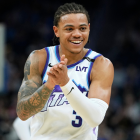
Thunder vs. Jazz: Paul George era in OKC could be brief after early playoff exit
The Thunder face a challenging task of keeping their talented swingman after an early first-round playoff exit

By
Kyle Boone
•
3 min read
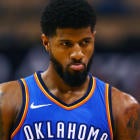
When the Oklahoma City Thunder traded Victor Oladipo and Domantas Sabonis for Paul George on July 6, 2017, they accomplished two things. First and foremost, they pitted an All-Star forward alongside reigning MVP Russell Westbrook, laying the foundation for what would lead to Westbrook's super-max extension to keep their most firm building block in town for the long haul.
Second, they sent a message to their new addition Paul George, whose potential free agency slated for the summer of 2018 was reason enough for the Pacers to part ways with him for fear of losing him to the West Coast:
We know you'll love it here, and we're willing to trade two talented young assets for the mere opportunity to turn what many believe will be a one-season pit-stop into your long-term residence.
The acquisition of Carmelo Anthony 81 days later in exchange for a second-round draft pick, Enes Kanter and Doug McDermott only firmed up a similar message. They went all-in on the now with a pitch for an even brighter future.
But in losing to the Utah Jazz, 96-91, on Friday night, the Thunder's message rings a lot more hollow than anticipated. They've handily been dispatched from the playoff picture entirely too early against a worthy opponent in the Jazz who were flat out better. It was no fluke. It ends with a thud a season-long recruitment process that, at first, was seen as an advantage for OKC.
The Thunder's pitch, however -- what it has to offer and the direction of the franchise -- suddenly doesn't look all that appealing.
So now it leaves George with a decision to make. Should he stay or should he go?
Though the Westbrook-George pairing has been good, maybe not great, it has shown promise. In the regular season, the duo led the Thunder to a 6-3 record against the NBA's top three teams -- the Rockets, Warriors and Raptors, which qualified as the best record against those teams this season according to ESPN. As a collective group they unquestionably ratcheted up their intensity in big games.
And while their somewhat tumultuous season brought angst among their loyal backers, they proved they were capable of playing at another level and flipping a switch against top-tier teams.
That switch-flipping is why many believed OKC could be a legitimate threat to make noise in the Western Conference playoffs. The problem is that the wiring to its switch short-circuited upon playoff initiation -- particularly in Game 6. Their offensive struggles were never more glaring, and it appears the Thunder were running on 120 volts rather than 240 all along. They never really had as much juice as they could have, and maybe should have, been flowing with.
And thus lies the predicament George finds himself in.
Maybe another year for George in Oklahoma City allows the pairing to fully enmesh as previously predicted on paper between him and Westbrook. Maybe with defensive stopper Andre Roberson back healthy for the Thunder next season, their glaring defensive deficiencies disappear -- or at least decrease significantly. Or maybe, just maybe, the Thunder run it back with the same squad and their season ends once more in similar fashion.
If you were George, what would you do? Anthony is not only a far cry from the star he once was, but he's perhaps one of the biggest liabilities on the roster. And OKC is saddled with him through next season if he picks up his player option in 2018-19, which he'd be crazy not to do. Outside of Steven Adams and Westbrook, the pieces aren't the most firm blocks to build on moving forward, and the franchise doesn't have immediate first-round draft assets to bring in young talent or flip for a quick roster makeover.
The Thunder have touted themselves as being built for the playoffs all season, deflecting any questions about their deficiencies with a "we'll figure it out later" approach. But there is officially no more later for this team. The season -- and potentially a season-long era with Paul George -- could be over before it really found its footing.
Would anyone really blame him if he left?