2021 NFL Draft: These prospects could be the next Tyreek Hill or A.J. Brown, plus other receiver comparisons
From Jaylen Waddle to Kadarius Toney, this WR class is loaded with high potential

•
5 min read
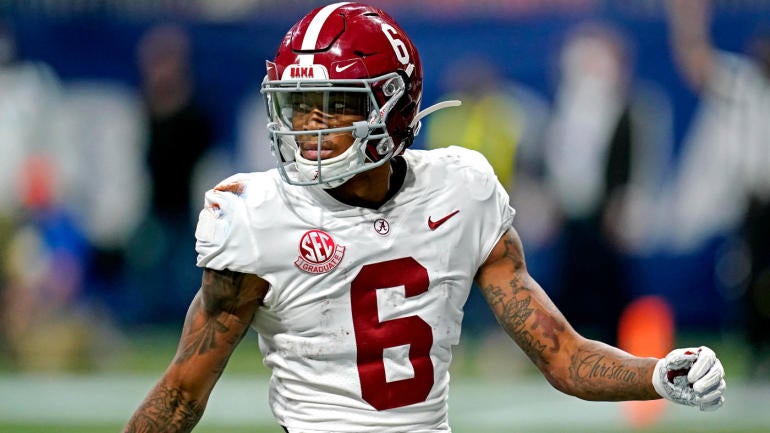
The 2021 wide receiver class is a doozy, so it shouldn't be surprising that the top of the class compares to All Pro receivers.
It's important to remember NFL comparisons for draftees don't intend to guarantee a prospect will have the exact same career as his professional counterpart. In this article, I'll run through the top consensus receiver prospects and give NFL comparisons -- some current players, some former. These comparisons are not based on size. They're almost solely stylistic.
(Prospects are listed in the order they appear in my draft rankings.)
Jaylen Waddle, Alabama
NFL comparison: Tyreek Hill
Waddle is the closest receiver we've seen to Hill since the Chiefs superstar entered the league in 2016. Hill wins with the league's best combination of speed and quickness -- at the line and after the catch -- and he plays like he's well above 6-foot because he's got NBA hops and outstanding ball-tracking skills. His YAC brilliance was born in his return prowess at Oklahoma State. All of that almost identically describes Waddle, who excels because of his nasty twitch, Olympic speed, bounce to go up and get it and game-breaking ability as a returner.
Ja'Marr Chase, LSU
NFL comparison: A.J. Brown/Chris Godwin hybrid
Chase is a power receiver with dynamic run-after-catch skill based in ridiculous contact balance and strength in his lower half. He flourishes in traffic because of his strong hands. Those are the two more striking attributes for Brown and Godwin on the field in the NFL. At Ole Miss, Brown was essentially impossible to tackle and consistently made difficult grabs look effortless. Godwin did the same at Penn State. Neither are absolute burners and while Chase doesn't play to the 4.38 he timed at the LSU pro day, there were plenty of vertical wins on film.
Craving even more NFL coverage focusing on previews, recaps, news and analysis? Listen below and follow the Pick Six podcast for a daily dose of everything you need to follow pro football.
DeVonta Smith, Alabama
NFL comparison: Smaller, souped-up Marvin Jones
Jones was 6-2 and 199 pounds at his combine -- so he's clearly larger than the 6-0, 170-pound Smith. Stylistically, they're very comparable -- Jones' YAC capabilities were based on bendy movements with the ball in his hands to get the corner and avoid tacklers in space, and he routinely made high degree of difficult snags outside his frame thanks to long arms and a naturally wide catch radius. All that applies to Smith, who might be the most elastic receiver to ever enter the NFL. I adore how he can be thrown a football anywhere in his vicinity and typically reel it in. What he lacks in pure size to Jones he makes up for with deceptive long speed and acceleration off the snap.
Rashod Bateman, Minnesota
NFL comparison: Allen Robinson
Robinson was bigger than Bateman -- who measured in at only 190 pounds at his pro day -- on the field, they're similarly well-rounded wideouts who won with high-point mastery, snappy routes, and burst after the catch at Penn State. Those elements have made him arguably the most underrated receiver in football today. Watch Bateman, and it's a real challenge to find a clear flaw to his game. He plays much larger than 6-1, 190.
Rondale Moore, Purdue
NFL comparison: Shorter, faster D.J. Moore
At the 2018 combine, D.J. Moore was just over 6-0 and 210 pounds. That equates to a body mass index (BMI) of 28.5. Ronalde Moore measured in at 5-7 and 181 pounds, good for a BMI of 28.3. Rondale Moore is short but absolutely not small. At Maryland, partly due to his high BMI, Moore was a running back in space. Defenders ricocheted off him and the same has happened in the NFL with the ball in his hands. He's quietly a deep threat, too, with 4.42 speed. Moore can absolutely take the lid off the defense.
Elijah Moore, Ole Miss
NFL comparison: Rocket fueled Jamison Crowder
At Duke, Crowder's film and production were outstanding. He went over 1,000 yards in three-consecutive seasons and scored 22 touchdowns in those campaigns. A nifty, multiple-break slot receiver who caught everything and was a disaster to corral in the open field, Crowder looked like one of the best pure slots in the 2015 class. However, he tested like a low-level athlete, and his combine effort sunk his stock to the fourth round. We now know he plays much quicker on the field than he does in workout gear. In every season he's played at least 10 games, Crowder's gone over 600 yards receiving and he has 26 receiving scores to his name entering his seventh season. Moore is a sudden slot wideout who produced at a high level in college and gets open with great regularity. Plus, he has high-end speed and a dazzling pro-day workout on his resume. Expect him to hit the ground running in the NFL like Crowder did.
Terrace Marshall, LSU
NFL comparison: D.J. Chark
Didn't even have to venture away from the LSU program for this comparison. At LSU, Chark was a big-play specialist at nearly 6-3 with 4.34 speed. In the NFL, he's established himself as one of the game's best young wideouts, mostly due to his linear speed and body control when tracking it downfield. That's precisely where the nearly 6-3, 200-pound Marshall wins -- vertically with deceptive long-striding speed and a soccer-net sized catch radius on back-shoulder tosses or throws over his head.
Kadarius Toney, Florida
NFL comparison: Faster Kendall Wright
The third receiver picked in the 2012 draft, Wright was a creative, at-times-explosive slot receiver who loved deploying a variety of jukes to free himself at the line, down the field, or when he had the football in his grasp. That's precisely how Toney operates -- at times to a fault. While Toney can dance too much, he also can pull off highlight-reel YAC plays on somewhat of a regular basis, and he'll need to be in the slot in the NFL. Toney provides more acceleration than Wright, which makes him more of a complete wideout who can be utilized at all levels of the field.