NFL Draft 2023: Exploring how Will Levis compares to Josh Allen ... the accuracies and inaccuracies
Allen and Levis each started two seasons in college and arrived to the draft process with similar concerns

By
Josh Edwards
•
4 min read
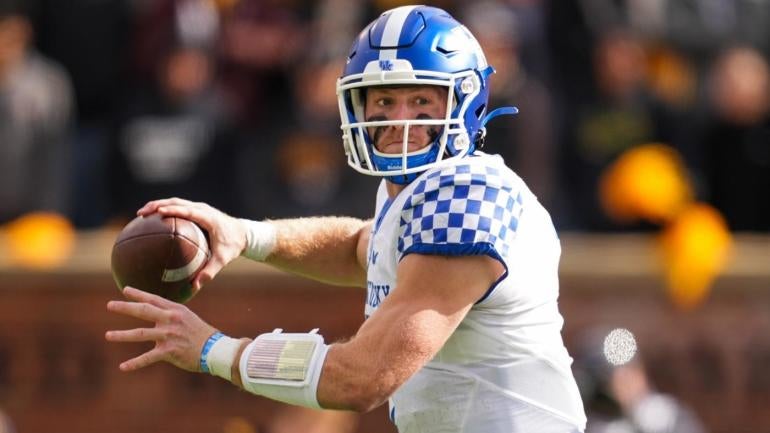
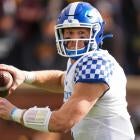
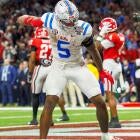
Several have drawn a comparison between Kentucky quarterback Will Levis, a prospective top overall selection in April's draft, and Buffalo Bills quarterback Josh Allen. It is a comparison that is not inaccurate, but requires some context.
Allen measured just shy of 6-foot-5 and 237 pounds during the pre-draft process. Levis is projected at 6-foot-4, 240 pounds. Both have over 10-inch hands and elite arm strength. From a physical standpoint, they look similar in uniform.
Allen was overlooked coming out of high school and that initially led him to Reedley Community College.
At Wyoming, Allen was a two-year starter. In his first season as a full-time starter, the offense featured key contributors like running back Brian Hill, wide receiver Tanner Gentry and tight end Jacob Hollister. The team went 8-6 and Allen had his best season as a Cowboy, completing 56% of his passes for 3,203 yards, 28 touchdowns and 15 interceptions. Those key contributors were gone in 2017 and the quarterback's statistics dipped as a result: 56.3% completion percentage for 1,812 yards, 16 touchdowns and six interceptions; hardly the raw numbers expected of a potential top-10 overall selection.
During that final season in Laramie, the California native missed two games due to a nagging shoulder injury. Prognosticators' pre-draft talking points revolved around his diminished statistics at a lower level of football, general inaccuracy and his inability to elevate the talent around him.
Josh Allen let it fly at his pro day today in Wyoming. pic.twitter.com/U0AyMiNRlv
— ESPN (@espn) March 23, 2018
Levis joined the Wildcats for spring practice as a transfer from Penn State ahead of the 2021 season. It was an ideal situation for a player with little time to waste. First-year offensive coordinator Liam Coen was an innovative, younger mind looking to create his own legacy out from the shadows of Rams head coach Sean McVay.
In that first season, the quarterback completed 66% of his passes for 2,826 yards, 24 touchdowns and 13 interceptions. He also averaged 3.5 yards -- Allen averaged 2.75 yards per carry over his final two seasons -- on 107 carries for nine touchdowns. Plus arm strength and mobility were boxes that Allen and Levis could each check.
Kentucky's 10-3 season ended with a Citrus Bowl victory over Iowa and Coen returned to Los Angeles as McVay's offensive coordinator.
"Touchdown to the freshman, @DaneKey6. @will_levis HOW ABOUT THAT?" - @JoeTessESPN
— Kentucky Football (@UKFootball) September 11, 2022
📺 - @ESPN 📲 - https://t.co/G4ZTknMNuv pic.twitter.com/V8FLL7Cwif
Much like Allen in Year 2, it was an offseason of turnover for Levis. Three members of the offensive line -- left tackle Dare Rosenthal, center Luke Fortner and right tackle Darian Kinnard -- would leave for the NFL following the 2021 season. Wide receiver Wan'Dale Robinson, who was responsible for 44.6% of Levis' completions, was drafted in the second round by the Giants.
Niners offensive coordinator Rich Scangarello arrived in Lexington to take over offensive play-calling duties. It was a union that was not fruitful and a parting of ways would occur after the season. Like Allen, Levis missed two games during his final season as a result of shoulder and other injuries. He had a 65.3% completion percentage for 2,406 yards, 19 touchdowns and 10 interceptions in 2022.
Statistical breakdown for each in two seasons as a starter:
Allen
- Team record: 16-11
- 56.1% completion percentage, 5,015 passing yards, 7.8 yards per attempt, 44 touchdowns, 21 interceptions
- 3.0 yards per carry, 12 touchdowns
Levis
- Team record: 17-9
- 65.7% completion percentage, 5,232 passing yards, 8.2 yards per attempt, 43 touchdowns, 23 interceptions
- 1.5 yards per carry, 11 touchdowns
Fans that have indulged in any draft coverage to this point will have heard some of these talking points on Levis: underwhelming statistics in his final season, did not elevate the talent around him and general concerns about ball placement. They may sound familiar to what was said about Allen. Levis gets stuck on his first read occasionally and just generally needs to improve his processing.
What is next?
The next few months should be nothing but positive for Levis. When he is standing next to other quarterback prospects, he will fare favorably. When executing a scripted set of throws at pro day, and given the opportunity to display his arm strength, he will thrive. Levis is intelligent but there is a difference between completing an internship on Wall Street smart and possessing high football IQ. As teams interact with him more, they will certainly deduce his ability to read defenses and get through his progressions. Does he understand and has he learned from his mistakes?
Conclusion
It is fair to compare Levis to the Wyoming version of Allen but, to Allen's credit, he is an improved passer relative to where he began his career. In his rookie campaign, he completed just 52.8% of his passes. Over the past three seasons, he has completed 65.2% of his passes. Allen had his share of doubters across the league even as he began Year 3. It is possible to become more consistently accurate, as he has shown, but it is not to be expected. For every Allen, there are several examples of players who did not improve in that aspect over the course of their career. Levis has the same opportunity in front of him.
The difference, however, is that Allen was a month shy of his 22nd birthday when he was picked No. 7 overall. Levis will turn 24 years old in June. Allen also landed in an ideal situation with then-offensive coordinator Brian Daboll, who was able to connect with and simplify the offense for Allen. To maximize Levis' potential, he needs to land in a situation that will support his growth and provide him with the resources to improve. He is the third-ranked quarterback and the No. 6 prospect overall, according to CBSSports.com's prospect rankings.