Agent’s Take: 10 players under contract who could be on new teams next season
Dez Bryant, Tyrod Taylor and Randall Cobb are among potential salary-cap casualties
By
Joel Corry
•
8 min read
Job security in the NFL isn't as great as it is in the NBA and MLB because player contracts aren't fully guaranteed as they are in those sports. NFL players are released and occasionally traded every offseason because their performances aren't deemed to measure up to their pay.
The Chiefs have already gotten the ball rolling with the NFL's annual roster purge. When the trading period opens at the start of the 2018 league year on March 14, Chiefs quarterback Alex Smith is being dealt to the Redskins for cornerback Kendall Fuller and a 2018 third-round pick. With this transaction, the Chiefs will create $16,352,500 of 2018 salary-cap space. The impending trade paved the way for Kansas City to release seven-time Pro Bowl cornerback Darrelle Revis. Kansas City freed up $4.5 million of cap room in the process.
A majority of the time, when a player is traded or released there is a residual cap charge. This cap charge for a player that is no longer on a team's roster is commonly referred to as dead money. It exists because the remaining proration of the salary components that are treated like a signing bonus immediately accelerate into his team's current salary cap with a trade or release. Dead money is typically a sunk cost, where money isn't owed to a player. A payment will be associated with dead money only if there are salary guarantees when a player is released.
There are two major exceptions to this general rule of bonus proration accelerating. Only the current year's proration counts toward the cap with players released or traded after June 1. The bonus proration in future contract years is delayed until the following season. A team can also release two players each league year prior to June 1 (known as a post-June 1 designation) that will be treated under the cap as if they were released after June 1. With a post-June 1 designation, a team is required to carry the player's full cap number until June 2 even though he is no longer a part of the roster. The player's salary comes off the books at that time unless it is guaranteed.
Here's a look at 10 players who could be in different uniforms next season because of their contracts.

2018 salary cap number: $18.08 million
2018 compensation: $16 million ( includes $1 million 2018 base salary guarantee)
2018 dead money: $8.64 million ($7.64 million if traded)
2018 salary cap savings: $9.44 million ($10.44 million if traded)
Head coach Sean McDermott benching Tyrod Taylor for rookie Nathan Peterman prior to a Week 11 game against the Chargers while in the middle of the playoff hunt was a strong indication he wasn't considered the long-term answer at quarterback. Taylor got his job back the following week after Peterman's five-interception performance demonstrated he clearly wasn't ready to play. Back in the lineup, Taylor helped the Bills snap a 17-year playoff drought. Buffalo is going to try to trade Taylor before his $6 million roster bonus is due on the third day of the 2018 league year (March 16). A potential suitor could be found because the demand for competent quarterbacks exceeds the supply.


2018 salary cap number: $20 million
2018 compensation: $17 million
2018 dead money: $9 million
2018 salary cap savings: $11 million
Wilkerson hasn't come close to living up to the five-year, $86 million deal he signed in July 2016, right before the deadline for franchise players to sign long term. At $17.2 million per year, Wilkerson became the NFL's third-highest paid non-quarterback. Wilkerson was a healthy scratch the last three weeks of the 2017 season primarily because the Jets didn't want to risk him getting hurt, which could have triggered the injury guarantee for his $16.75 million 2018 base salary. This amount is fully guaranteed on March 16, which is the third day of the 2018 league year. Use of a post-June 1 designation shouldn't be necessary because the Jets are expected to have over $75 million of 2018 cap space without factoring Wilkerson's departure into the equation.


2018 salary cap number: $16.5 million
2018 compensation: $12.5 million
2018 dead money: $8 million ($4 million with post-June 1 treatment)
2018 salary cap savings: $8.5 million ($12.5 million with post-June 1 treatment)
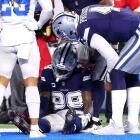
Dez Bryant hasn't had hit the 1,000 receiving yard mark since signing a five-year, $70 million contract in 2015 after being designated as a franchise player. The rapport Bryant had with Tony Romo has been non-existent during the two seasons 2016 NFL Offensive Rookie of the Year Dak Prescott has been Cowboys quarterback. With Prescott throwing to him, Bryant has averaged nearly 60 catches for 817 yards with seven touchdowns each season while missing three games during this span. This is great production for a number two wide receiver. Bryant dismissed the idea of a paycut when asked about his contract situation late in the 2017 season. NFL Media's Ian Rapoport has reported that Dallas would rather work out a contract extension to lower his 2018 cap number, which is the NFL's third highest for a wide receiver, rather than release him. It remains to be seen whether Bryant and the Cowboys can get on the same page financially.

2018 salary cap number: $12 million
2018 compensation: $11 million
2018 dead money: $1 million
2018 salary cap savings: $11 million
Cornerback Bradley Roby's salary increasing to $8.526 million on his fifth-year option has the Broncos shopping Talib despite him earning his fifth-straight Pro Bowl berth in 2017. The 32 year old is scheduled to make $19 million in the two years remaining on his contract. That type of money is more in line with the top of the number-two cornerback market than a player who possesses Talib's coverage skills. If the Broncos are unable to move Talib and they release him, there has been speculation the Patriots would be interested in bringing him back.


2018 salary cap number: $6.5 million
2018 compensation: $6.5 million
2018 dead money: None
2018 salary cap savings: $6.5 million
Murray went from a Pro Bowl 2016 season in which he led the AFC with 1,287 rushing yards to Derrick Henry cutting into his workload in 2017. A changing of the guard appeared to have taken place in the playoffs when Henry had a Titans playoff-record 191 yards from scrimmage (156 rushing) in a wild-card playoff win over the Chiefs while Murray was out with a torn MCL in his right knee. New offensive coordinator Matt LaFleur may look to feature Henry in the same way Todd Gurley was featured last season when LaFleur was coaching with the Rams.


2018 salary cap number: $8,840,625
2018 compensation: $8.5 million
2018 dead money: $1.2 million
2018 salary cap savings: $7,640,675
Cushing's 10-game suspension for performance enhancing drugs, the second such infraction of his nine-year NFL career, opened the door for 2017 second-round pick Zach Cunningham to crack the starting lineup. Cunningham remained a starter after Cushing returned. Cushing was used on the outside. With Benardrick McKinney firmed entrenched at one inside linebacker position and Cunningham showing promise, Cushing is more of a luxury than a necessity.

2018 salary cap number: $12,718,750
2018 compensation: $9.5 million
2018 dead money: $3.25 million
2018 salary cap savings: $9,468,750
Davante Adams signing a four-year, $58 million extension right before the end of the 2017 regular season makes it unlikely that both Randall Cobb and Jordy Nelson ($12,518 million cap number and $10.25 million salary in 2018) will return next season under their existing contracts. It's unheard of for an NFL team to have three high-priced wide receivers. Collectively, the trio is taking up $35.775 million of 2018 cap room. Nelson's production was dramatically impacted by quarterback Aaron Rodgers being limited to seven games because of a broken right clavicle. His 482 receiving yards were his lowest total since 2009. Both Cobb and Nelson are entering contract years. Although Cobb is the younger of the two by slightly more than four years, Nelson may be more receptive to taking a pay cut. Cobb hasn't had a 1,000-receiving-yard season since 2014 while Nelson's three-year streak of hitting the 1,000-yard mark ended in 2017. Nelson has better chemistry with Rodgers and is also capable of playing Cobb's slot wide receiver role.

2018 salary cap number: $16 million
2018 compensation: $15 million
2018 dead money: $4.5 million (includes fully-guaranteed $2.5 million roster bonus)
2018 salary cap savings: $11.5 million
Glennon's three-year, $45 million contract was sizable for such an unproven commodity. His poor play was responsible for him losing his starting job four games into the season to Mitchell Trubisky, who the Bears moved up one spot in the 2017 NFL Draft to select with the second-overall pick. The benching sealed Glennon's fate in Chicago. Matt Nagy replacing John Fox as head coach isn't expected to change things. Glennon's contract has a fully-guaranteed $2.5 million third day of the 2018 league year roster bonus payable on March 16. Since the guarantee has an offset, the Bears could recoup the entire $2.5 million (and the cap space) if he makes at least that amount next season from another team.


2018 salary cap number: $6.75 million
2018 compensation: $6.75 million
2018 dead money: None
2018 salary cap savings: $6.75 million
Martin has been a disappointment since signing a five-year, $35.75 million contract (worth up to $42,937,500 with salary escalators and incentives) after finishing second in the NFL during the 2015 season with 1,402 rushing yards. He began the 2017 season serving the final three games of a four-game suspension for violating the NFL's performance enhancing drugs policy. Martin had his second-straight season averaging 2.9 yards per carry in 2017. His last 100-yard rushing game was in 2015 before he signed the contract.


2018 salary cap number: $8 million
2018 compensation: $8 million
2018 dead money: $5 million (comes from fully guaranteed $5 million roster bonus)
2018 salary cap savings: $3 million
The Rams inexplicably gave Austin a four-year extension in 2016 averaging approximately $10.5 million per year with $28.5 million of guarantees. The deal also has $14 million of incentives and base-salary escalators. Austin hasn't earned any of his bonuses. The wholesale changes made at wide receiver reduced Austin to spot duty in 2017. His most extensive action came as a overpriced change-of-pace running back. Austin had a career-low 317 yards from scrimmage (combined rushing and receiving yards) last season. He was on the field for only two of the Rams' 68 plays in the wild card playoff loss to the Falcons.
Other notables
Sean Smith, CB, Raiders: $8.5 million 2018 salary cap savings
Adrian Peterson, RB, Cardinals: $2.625 million 2018 salary cap savings
Chris Ivory, RB, Jaguars: $4 million 2018 salary cap savings ($6 million with post-June 1 treatment)
Julius Thomas, TE, Dolphins: $5.6 million 2018 salary cap savings
Matt Forte, RB, Jets: $3 million 2018 salary cap savings