
Why an ailing Cam Newton does not belong in Patriots' QB plans for 2021
2020 isn't all on him, but we now have five years of evidence that Cam is a subpar QB

•
4 min read
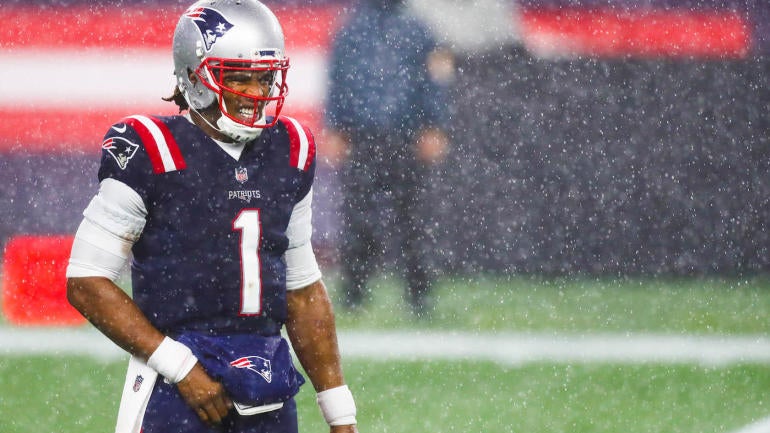
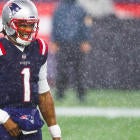
Cam Newton is not primarily to blame for the New England Patriots' fall from dominance. For all of Bill Belichick's coaching wizardry, most people knew, entering 2020, that the team's divorce from Tom Brady, coupled with a low-budget supporting cast and aging core veterans, would not be seamless. It takes more than just bad quarterback play to derail an 11-year streak of division titles.
But bad quarterback play will certainly accelerate the downfall, and that's what Newton has given them in 2020.
To reiterate: The Patriots are not below .500, an anomaly of the Belichick era, solely because of Cam. The longtime Panther is throwing to one of the worst groups of pass catchers in the NFL. He's helped supercharge an unpredictable ground game, leading all QBs in rushing touchdowns (11). And he's played amid both a battle with COVID-19 and a recent abdominal injury.
You need only look at the numbers, or through your own eyes, however, to know that Newton is not himself. Five TD passes and 10 interceptions in 12 games? That doesn't happen just because your receivers are replaceable. Nine of 12 starts with fewer than 200 yards passing, including five under 150? Doesn't happen in today's NFL. As CBS Sports' Tyler Sullivan writes, Newton's "arm appears to be shot," making a turn to unproven Jarrett Stidham the most logical path forward.
But what if Newton is himself? What if this is who he's been all along? The Patriots are approaching a critical offseason in which identifying a long-term possibility at QB will be paramount. And it's not just Cam's ugly 2020 on an ugly New England team that suggests he does not belong in that conversation.
Some pundits heralded the Patriots for getting Newton on a "bargain" one-year deal worth up to $7.5 million in June. Most of us were at least intrigued at the idea of Belichick resurrecting Cam's career in Foxborough. But a resurrection isn't necessary if something isn't already dead. Why did Newton remain on the open market until late summer? Why did the Patriots get him much cheaper than other QBs? Maybe, just maybe, because Newton has not been a good QB for something like five years.
If we split Cam's career into two halves, with his wondrous 2015 MVP and Super Bowl run serving as the fitting divider, we can see clearly that Newton has been mediocre at best since his peak Panthers days:
| Years | Games | Record | TDs | INTs | Comp. % | Rating |
|---|---|---|---|---|---|---|
| 2011-2015 | 78 | 45-32-1 | 117 | 64 | 59.6 | 88.3 |
| 2016-2020 | 59 | 29-29 | 70 | 54 | 60.7 | 82.0 |
The numbers tell us that Newton has never been a particularly accurate passer, but more concerning is the one-time superstar's regression in both availability and, well, almost everything else. You can write off his middling record as a starter to playing on bad Panthers teams, but you can't overlook a significant drop in passer rating during a time in league history where almost every competent QB has enjoyed the inflated marks of a pass-happy era.
Here are the league average passer ratings over that span:
- 89.3 (2016)
- 86.9 (2017)
- 92.9 (2018)
- 90.4 (2019)
- 93.4 (2020)
Newton, then, has been below -- and sometimes well below -- NFL-average in that category for a half-decade. If his name were Derek Carr or Philip Rivers or Kirk Cousins, would there even be a question as to his effectiveness (or lack thereof)? That's not to take away from Cam's legitimate accomplishments; he was, at one point, a truly dynamic dual threat, and he's still physically capable of certain feats that are foreign to all of those QBs. As a quarterback, however, he's long left a lot to be desired throwing the football.
Well that's just because Newton does most of his damage as a runner!
Perhaps. There's no doubt he remains a battering ram on the ground, when healthy. But even those numbers have seen notable drop-offs in the five seasons since the MVP campaign. Between 2011-2015, Newton averaged 41.4 rushing yards per game, 5.4 yards per attempt and about one TD every other game. Since then, he's averaging 34.7 yards per game, 4.6 yards per carry and just over one TD every three games. That's a decline in every category. Expected, for an aging QB? Sure. But darn near unacceptable if you're banking on Newton using his legs to overcome his aerial shortcomings.
Oh, and about the availability part? It's fine to attribute Newton's decline to declining health. We wouldn't expect any other QB to endure back-to-back serious injuries -- first to his shoulder, then to his foot, and potentially now to his abdomen -- and maintain MVP form. But the physical wear and tear is part of the evaluation process. If the Saints must factor Drew Brees' medical history into their forthcoming QB decisions, the Patriots -- and other prospective teams -- must do the same with Newton. The issue is, on top of the injuries, Newton has simply not been good enough -- for almost five seasons running -- to justify an unquestioned starting gig on a contender.
Is Cam immune to a real turnaround? Probably not! This was an unusual season, remember, in which Newton was unable to fully acclimate to a new team under typical circumstances. It was also a season in which, playing alongside a top-10 defense at age 31 and with the Belichick-Josh McDaniels duo overseeing his return, he's looked more like a 38-year-old desperate to salvage any remaining juice from a body that's taken quite the beating over an illustrious, but changing, career.
It's unclear if we'll ever see Old Cam again, but one thing is clear: It almost certainly, for the Patriots' sake, cannot be in New England.