Would You Rather: Richard Sherman or Darrelle Revis?
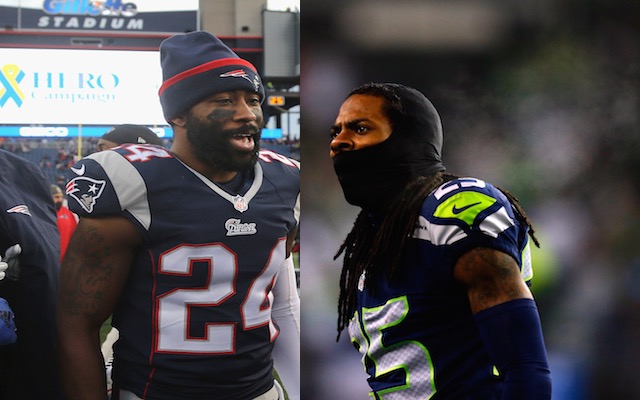
They're clearly the NFL's two best corners, but who's really superior: The leader of the Legion of Boom, or No Fly Zone 2.0's top man?

By
Jared Dubin
•
10 min read
This all started with Pete Prisco's Top 100. Ranking the best players across positions is a nearly impossible task and it's sure to lead to friendly discussions among rational observers. Which brings us to "Would You Rather," where we take a closer look at whether one player really is better than another. Earlier on Friday, Ryan Wilson looked into Giants wide receiver Odell Beckham Jr. and Steelers pass-catcher Antonio Brown. Now, let's compare the two players many consider the NFL's top two cornerbacks: the Seattle Seahawks' Richard Sherman and Darrelle Revis of the New York Jets.
Though Sherman and Revis have only suited up in the same game twice (including Super Bowl XLIX), they actually have an extensive "rivalry" of sorts. It began back in 2013 with -- what else? -- Sherman strolling down Bourbon Street and asking fans who the better corner was between himself and Revis, and of course, an ensuing war of words on Twitter.
I never seen a man before run his mouth so much like girl. This dude just steady putting my name in his mouth to get notoriety @rsherman_25
— Darrelle Revis (@Revis24) February 20, 2013
@rsherman_25 I ain't your competition bro, @roddywhiteTV is!!!
— Darrelle Revis (@Revis24) February 20, 2013
My boy @JohnGeiger_ got more followers then @rsherman_25. Sit down young pup & wait your turn.
— Darrelle Revis (@Revis24) February 20, 2013
@Revis24 one season u will get 8 picks.... But it won't happen anytime soon... I did it in my 2nd season... So u have something to chase
— Richard Sherman (@RSherman_25) February 20, 2013
Since then, Sherman and Revis have each continued their extremely high level of play. Though there have been challengers who have reached or even exceeded their level of play for a single season, they are still widely considered the two best cover corners in the league.
Prisco's Take: Sherman checked in at No. 7 on Prisco's list, while Revis was right behind him in the No. 8 slot. They were, obviously, the top two cornerbacks on the list, and each was the highest-ranked player on his team. Sherman and Revis were also the third and fourth highest-ranked defensive players, respectively, behind J.J. Watt (No. 1) and Ndamukong Suh (No. 4).
On Sherman, Prisco said, "He is perfect for their scheme, but I think he could play in any scheme. He is physical mauler who is long and can play both zone and man schemes. He can be a bit thin-skinned, but he's earned his spot here."
And on Revis, Prisco said, "After a down year in Tampa Bay in 2013, he reverted to his All-Pro form last season and helped New England win a Super Bowl. He can take your best receiver out of the game, which is key to any defense. He signed with the Jets, his original team, as a free agent."
Word of mouth: On Tuesday, Revis' teammate Antonio Cromartie had this to say:
"Go follow the No. 1 receiver. Follow him around for a whole entire game and let's see what you can do. Darrelle Revis has done that his whole career. I've done that. Patrick Peterson has done it. Joe Haden has done it. [Sherman] is the only defensive back that hasn't.
"Go play in a defense where you don't have two All-Pro safeties. That's what I would tell him."
HOWEVER, just last year, Cromartie was singing a different tune. Via ProFootballTalk:
“I think what he does at the line,” Cromartie said while explaining what makes Sherman special. “He’s lanky, he’s a long guy like myself. He gets his hands on the receiver and he pays attention to the receiver. He pays attention to what that receiver is doing down the field and he knows once that receiver gets 15 yards down the field he’s not coming back for the ball, the ball’s going to be down the field so he plays the leverage of what he has and he also uses the sideline to much of his advantage to try and get the receiver as much to the outside as he can. Most quarterbacks you see that are throwing it to him, most of those passes are underthrown balls because of the pressure on the quarterback in the pocket also.”
Cromartie initially hesitated to declare unequivocally that Sherman is the best cornerback, qualifying it with “arguably.” When pressed by Erik Kuselias, Cromartie embraced it.
“No arguably,” Cromartie said. “He is the best. There it is.”
I think it's fair to say there's a degree of bias in his thoughts.
For whatever it's worth, a Google search for "Richard Sherman best cornerback in NFL" yields 916,000 results, while a similar search for "Darrelle Revis best cornerback in NFL" brings up 195,000. That, though, is likely affected by how much Sherman himself talks about being the best corner in the NFL.
The measurables: In Sherman's four-year NFL career, he has played in all 64 of the Seahawks' regular season games, totaling 183 tackles, 1.0 sack, 24 interceptions, 65 passes defensed and two touchdowns.
Meanwhile, Revis has played 111 games across eight NFL seasons (he missed three games in 2010 and 14 in 2012), amassing 391 tackles, 2.0 sacks, 23 interceptions, 123 passes defenses and three touchdowns. During the last four years that Sherman's been in the NFL, Revis has accumulated 160 tackles, 1.0 sack, nine interceptions, 49 passes defensed and a touchdown in 50 regular season games.
Those numbers, obviously, do not tell the whole story. For a more detailed look, let's turn to Pro Football Focus, which uses game tape to track every single play throughout the NFL season and assigns each player a number grade. Their grading takes into account only performance, not technique or upside, and works toward a goal of gauging "how players execute their roles over the course of a game by looking at the performance of each individual on each play."
Let's look at the numbers PFF has for quarterbacks throwing at Sherman and Revis throughout their careers, over the last four years (for which Sherman's numbers will be the same as his career totals), and in the 2014 season. The leader in each category is bolded for easy tracking. (Note: Playoffs included)
Career
Sherman: 150-322 (46.6%); 2,027 yards (6.3 per attempt, 13.5 per reception); 8 TD (2.5 TD%); 26 INT (8.1 INT%); 41.8 QB Rating
Revis: 300-614 (48.9%); 3,676 yards (6.0 per attempt, 12.3 per reception); 20 TD (3.3 TD%); 25 INT (4.1 INT%); 61.6 QB Rating
Last 4 Years
Sherman: 150-322 (46.6%); 2,027 yards (6.3 per attempt, 13.5 per reception); 8 TD (2.5 TD%); 26 INT (8.1 INT%); 41.8 QB Rating
Revis: 116-241 (48.1%); 1,505 yards (6.2 per attempt; 13.0 per reception); 9 TD (3.7 TD%); 9 INT (3.7 INT%); 65.1 QB Rating
2014
Sherman: 36-75 (48.0%); 479 yards (6.4 per attempt, 13.3 per reception); 1 TD (1.3 TD%); 6 INT (8.0 INT%); 39.8 QB Rating
Revis: 44-85 (51.8%); 582 yards (9.2 per attempt; 13.2 per reception); 4 TD (4.7 TD%); 3 INT (3.5 INT%); 74.7 QB Rating
As you can see, Sherman has a slight edge over Revis in completion percentage, touchdowns, interceptions and quarterback rating across the board, while Revis holds a slight edge in the yardage categories over the course of their careers and last four years, but yielded that edge to Sherman in 2014. Of course, these numbers are also influenced by the drastically different systems the two cornerbacks have been asked to play in.
By now, everybody knows the deal with Sherman's role in the Seahawks' defense. Seattle almost always plays a Cover-3, with each cornerback patrolling a deep third on his respective side of the field and Earl Thomas covering the deep middle. The Seahawks stray from a typical Cover-3 alignment by having their corners start in press man position and staying with receivers step-for-step until they break away, but for the most part, it's a fairly traditional Cover-3.
Sherman nearly always plays to the defense's left side of the field in this alignment. Before the Super Bowl, ESPN noted that Sherman lined up there on 91.3 percent of his snaps this season, and of the 2,839 snaps he'd played on defense in his career to that point, he'd been lined up on the defense's right side for only 90 of them.
Meanwhile, Revis split his snaps much more equally all over the field. ESPN noted in the same piece that Revis spent 50.5 percent of his snaps this season lined up wide left, 26.2 percent lined up wide right, and 23.3 percent lined up in the slot. That's a significantly more balanced distribution than Sherman.
It's those alignment numbers which gave birth to the common line of Sherman criticism that he "doesn't cover No. 1 receivers," a criticism that colored the Sherman - Patrick Peterson debate last offseason. While it's true that Sherman does not shadow No. 1 wideouts in every game, asserting that he doesn't cover them at all is patently untrue. While he didn't shadow them everywhere in every game, Sherman stuck with No. 1's more this season when the Seahawks dealt with injuries to Byron Maxwell, Jeremy Lane and Tharold Simon, who missed regular season three games apiece.
It's also important to note that Sherman's presence on a particular side of the field often caused opposing offenses to drastically alter their game plans. For example, here's a stat we mentioned in our Super Bowl Key Matchup post:
In Seattle's Week 1 game against the Green Bay Packers, Aaron Rodgers famously avoided throwing at Sherman at all. The Packers sent Jarrett Boykin to Sherman's side for almost every play and basically pretended the right side of the field didn't exist. Rodgers threw only three of his 32 passes to the right side of the field in that game, less than 10 percent. Meanwhile, 11 of his 32 passes went to the left side of the field. That was a massive shift from his pass distribution for the rest of the season, which saw him throw more passes to the right (26.8 percent) than to the left (23.0 percent). Rather unsurprisingly, that Week 1 contest wound up being one of Rodgers' worst games of the season.
That type of adjustment is not unusual when teams are playing the Seahawks. Sherman is just that good. When a cornerback is targeted less often than nearly any other and still manages to routinely finish near the league lead in interceptions -- a fact that has resulted in Sherman's career interception rate (8.1 percent) TRIPLING the league-wide average (2.7 percent) during his time in the league -- quarterbacks tend to want to avoid him.
Revis, though, sometimes simply has a more challenging role than Sherman does. He moves all over the field, often within the same game. Revis covers No. 1 guys, he covers No. 2s, he works in the slot and sometimes he even covers tight ends. He's extremely versatile, maybe more so than any other corner in the NFL.
The additional time spent in the slot also artificially inflates the completion percentage allowed on passes when targeting Revis; the NFL average was a 62 percent completion rate this past season, but the average on passes to slot receivers was 66 percent. Short passes like that are also typically harder to intercept -- the ball comes out faster and there's just not as much time to break on it while it's on the air.
And it's not as though he's a stranger to quarterbacks avoiding his side of the field entirely. There's a reason "Revis Island" is a permanent part of the NFL lexicon, after all.
Decision time: In the end, Sherman and Revis each have a worthy claim to being the NFL's top DB. Sherman is simply the best at what he does. Revis does more things well than any other corner. Revis' peak season (2009, when he held opposing quarterbacks to a 37.8 percent completion percentage on an amazing 127 targets, picked eight passes and yielded a 29.1 quarterback rating) is slightly better than Sherman's (2013, 48.4 percent on 64 targets, eight interceptions and a 31.4 rating), but Sherman also is more likely to continue at peak level for a few more years, given that he's almost three years Revis' junior.
Forced to choose between the two, I'd likely have to side with Richard Sherman. He was better in 2014, he's younger and thus more likely to continue playing at an elite level for a longer period of time, and -- this is a fairly important consideration -- he's cheaper, both this coming season and by average annual value. But I wouldn't begrudge anybody choosing Revis. Catch me on a different day, and I might even do so myself. It's a spectacularly close call.